 lop News
Better weather forecasts, more efficient wind farms, more accurate blood-flow models — the practical upside of a new hybrid quantum-AI method published this week in Science Advances is considerable.
Researchers at University College London have shown that feeding quantum-computed data into a conventional AI model produces significantly better long-term predictions of chaotic physical systems — fluid dynamics and turbulence — than classical methods alone. The quantum-informed model was roughly 20% more accurate and required hundreds of times less memory.
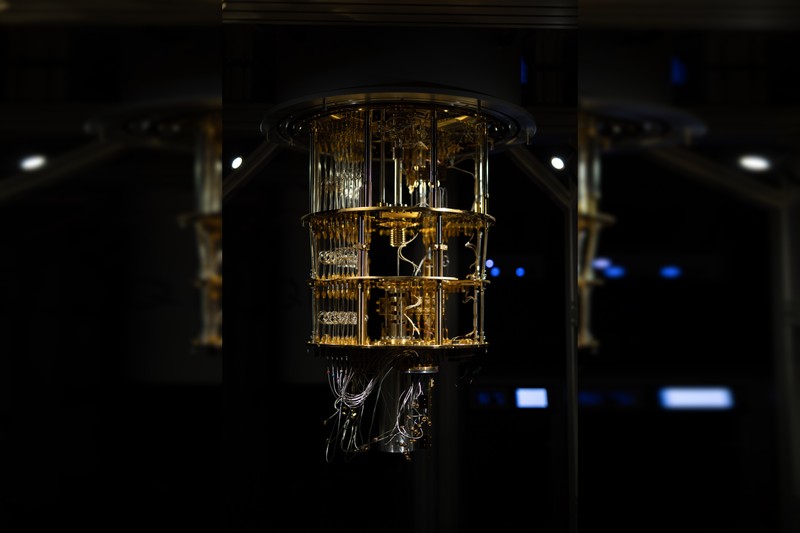
The approach is elegantly simple. Rather than trying to run an entire simulation on a quantum computer — still impractical given today’s noisy, error-prone hardware — the team used a 20-qubit IQM quantum processor at just one stage: identifying the statistical patterns in data that remain stable over time. Those quantum-learned patterns were then handed to a classical AI model running on a supercomputer at the Leibniz Supercomputing Centre in Germany, which used them as a compressed representation of the system’s underlying physics.
Senior author Professor Peter Coveney framed the trade-off clearly: full simulations of complex systems can take weeks — too slow to be useful — while standard AI models are fast but degrade over longer time horizons. The quantum-informed approach, he said, offers “more accurate predictions quickly,” with applications spanning climate forecasting, molecular interactions, and wind-farm design.
First author Maida Wang said the new method appears to demonstrate “quantum advantage” in a practical way — meaning the quantum computer outperforms what is possible through classical computing alone, particularly in data compression and parameter efficiency.
The next challenge is scaling up. The experiments used controlled test cases; real-world systems involve far more complexity. But as a proof of concept — a quantum computer making an AI model meaningfully better at a genuinely hard problem — it lands with unusual clarity.
Sources
- Quantum computer improves AI predictions — EurekAlert! / UCL
- Quantum AI just got shockingly good at predicting chaos — ScienceDaily / UCL
Discussion (5)