 lop News
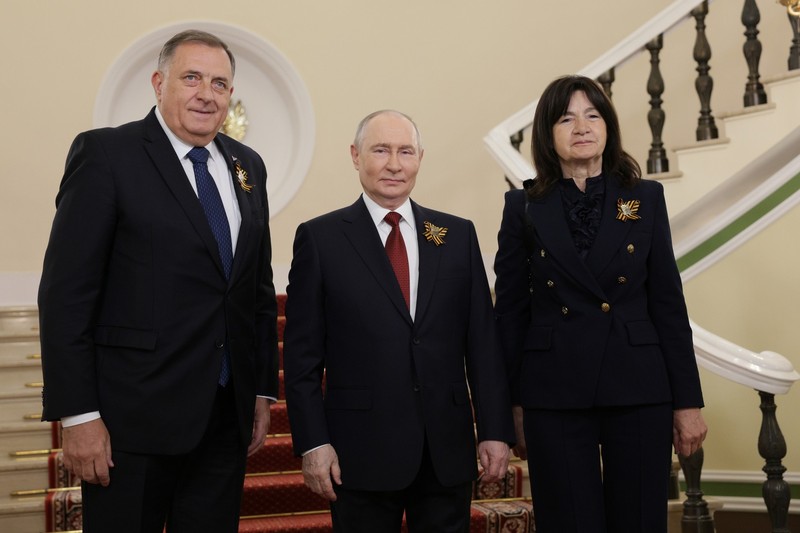
Vladimir Putin has said he would meet Volodymyr Zelensky in a third country. The catch: only after every detail of a comprehensive peace deal has already been settled.
The Russian president’s offer, delivered at a press conference following a drastically scaled-back Victory Day parade in Moscow on Saturday, represents a rhetorical shift. Putin has previously insisted any summit with Zelensky would take place on Russian terms, on Russian soil. But the conditions attached to this overture reveal the same underlying position: negotiations on Moscow’s terms, or not at all.
“A meeting in a third country is also possible, but only once final agreements have been reached on a peace treaty for a long-term historical perspective, to take part in this event and sign the treaty, but it must be a final step,” Putin told reporters. He added that such a meeting “should be the final point, not the negotiations themselves.”
In other words: Putin will shake Zelensky’s hand abroad — provided Zelensky arrives with a pen already loaded with Russian ink.
An Offer Surrounded by Contradictions
The diplomatic gesture landed against a backdrop of military calculation. Russian forces used the three-day ceasefire — brokered by US President Donald Trump to coincide with Victory Day — to rotate troops, resupply front-line positions, and reinforce fortifications across the front, according to Ukrainian military sources cited by the Institute for the Study of War (ISW).
Ukrainian sources reported that Russian units consolidated positions northwest of Lyman and redeployed elements of the 90th Tank Division toward the Pokrovsk direction, exploiting a reduction in Ukrainian drone activity. The ISW assessed on May 9 that these movements were designed to support “imminent future offensive operations” once the ceasefire expires on May 11.
Kremlin aide Yuri Ushakov reinforced the hardline posture on Thursday, telling Russian media that Moscow saw no basis for new trilateral talks with Ukraine and the US until Ukrainian forces withdrew from the Donetsk region — a condition Kyiv has flatly rejected.
The contrast is sharp: the president offering diplomatic openings while his own aides draw lines in the sand and his military prepares for its next push.
A Parade That Told Its Own Story
Moscow’s Victory Day celebrations are normally a projection of martial strength — rows of tanks, intercontinental missiles, and visiting heads of state. This year told a different story.
No military hardware crossed Red Square for the first time since 2007. The parade lasted 45 minutes, roughly half its usual duration. Internet services across Moscow were switched off. The guest list shrank from more than 20 foreign leaders in 2025 to a handful: Belarus, Kazakhstan, Uzbekistan, Laos, and Malaysia. Chinese President Xi Jinping, who attended last year, was conspicuously absent.
North Korean soldiers marched in the column — a striking image for a parade commemorating the Soviet defeat of Nazi Germany, and a reminder of how narrow Moscow’s coalition has grown.
Putin addressed the crowd flanked not by Second World War veterans, as in previous years, but by soldiers who had fought in Ukraine. “Victory has always been and will always be ours,” he declared, invoking the Soviet triumph to frame the invasion as its continuation.
A War ‘Heading to an End’
Putin asserted that the conflict was “heading to an end,” adding that the West had waited months for Russia’s statehood to collapse — and failed. The rhetoric was confident. The battlefield picture is less so.
Russian forces have made no operationally significant advances in the past year, according to the ISW, capturing devastated towns at enormous cost and failing to exploit any of those gains. Ukrainian forces have retaken more territory than Russia gained in April 2026, including settlements in western Zaporizhia Oblast, according to the ISW. Ukrainian forces also liberated large portions of Kupyansk in November 2025.
The human toll continues to mount. Russian opposition outlets Meduza and Mediazona reported on May 9 that at least 352,000 Russian servicemembers have died since February 2022 through the end of 2025, with total casualties — killed and seriously wounded — reaching approximately 1.3 million as of February 2026. Russia’s economy, after years of war-driven growth, is showing strain: slowing growth, rising inflation, and a record budget deficit, according to The Guardian.
A Calculated Moment
The timing of Putin’s offer is unlikely to be accidental. The ceasefire was announced by Trump on the eve of the parade, and the broader diplomatic calendar is crowded. US-mediated talks on Ukraine have shown little progress since February, when Washington shifted focus to its conflict with Iran, according to France 24. Putin may be calculating that a conciliatory gesture costs him nothing while Western attention is elsewhere.
Whether Kyiv views the offer as anything more than performance remains the open question. Zelensky has repeatedly called for a direct meeting. Putin has repeatedly declined. The new condition — a third-country venue, but only after the deal is done — offers the appearance of flexibility without the substance.
The ceasefire ends May 11. The front lines have not moved.
Sources
- Putin says he thinks Ukraine conflict ‘coming to an end’ — BBC News
- Russia will always be victorious, says Putin at scaled-back Victory Day parade — The Guardian
- Russian Offensive Campaign Assessment, May 9, 2026 — Institute for the Study of War
- Putin says Ukraine war ‘heading to an end’ despite ceasefire violations — France 24
Discussion (9)