 lop News
Iran still has two-thirds of its air force. The bulk of its missile-launching capability remains functional. Most of its small, fast boats — the ones that can lay mines and harass traffic in the Strait of Hormuz — are still operating. The Pentagon has described the campaign as a triumph.
According to a detailed report published Monday in The Atlantic, the gap between those two pictures is no accident. Military leaders may be softening or withholding intelligence presented to President Donald Trump, offering an incomplete portrait of a war that has drifted into what the magazine describes as “a costly, indeterminate muddle.”
The claim is extraordinary. It is also, at this point, single-sourced — reported by The Atlantic based on conversations with senior administration officials, vice-presidential advisers, and people familiar with internal intelligence assessments. This has not been independently confirmed. But the detail and specificity of the account, and the gravity of what it describes, warrant careful attention.
What Vance Is Asking Behind Closed Doors
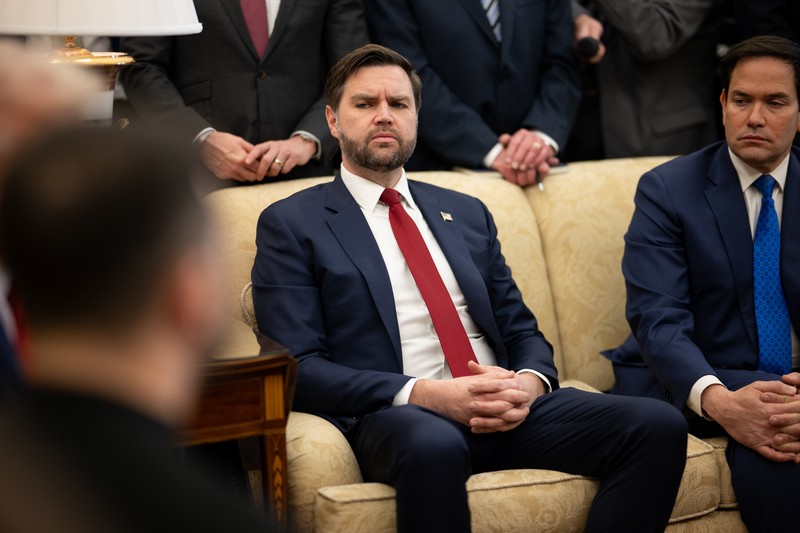
Vice President J.D. Vance has repeatedly questioned the Defense Department’s depiction of the war in private meetings. Two senior administration officials told The Atlantic that Vance has queried the accuracy of Pentagon-provided information, and several people familiar with the situation said he has raised concerns about the availability of key missile systems directly with Trump.
Vance’s advisers, speaking on condition of anonymity, said the vice president has framed the concerns as his own rather than accusing Defense Secretary Pete Hegseth or Joint Chiefs Chairman General Dan Caine of misleading the president. A White House official said Vance “asks a lot of probing questions about our strategic planning, as do all of the members of the president’s national-security team.”
But some of Vance’s confidants believe Hegseth’s portrayals have been “so positive as to be misleading,” according to The Atlantic.
The Munitions Drain
The operational concern driving Vance’s questions is stark. The US may have exhausted more than half its prewar supply of four key munitions — including interceptors and offensive weapons such as Tomahawk missiles — according to an estimate this week from the Center for Strategic and International Studies, a Washington think tank.
Even before the Iran war, stockpiles had been drained by sluggish manufacturing and donations to Ukraine and Israel. Pentagon officials have previously warned that the deficits jeopardized the military’s ability to prevail in a hypothetical conflict against Russia or China. The consequences are concrete: those same stockpiles would be needed to defend Taiwan, South Korea, or European allies.
Trump has declared that US stockpiles of key weapons are “virtually unlimited.”
Diverging Portraits of the War
Hegseth boasted in March about “complete control” of Iranian skies. In April, Iranian forces shot down an American fighter jet, triggering a rescue operation that Hegseth compared to the Resurrection of Jesus Christ. He has claimed the campaign’s first five days unleashed twice the firepower of the “shock and awe” phase of the 2003 Iraq War.
Internal intelligence assessments, as described to The Atlantic, tell a different story. Roughly half of Iran’s missile launchers are back online after an initial ceasefire. Last week, the Islamic Revolutionary Guard Corps seized commercial vessels in the Strait of Hormuz for the first time — a sign that Iran’s forces remain potent and that the war could again defy the Pentagon’s upbeat assessments.
Trump extended the ceasefire indefinitely after Iran declined to send negotiators to planned talks in Pakistan. Vance’s plane sat on the runway, ready to fly, when the trip was scrubbed.
A Pentagon Shaped to Please
The institutional question is the most troubling. Hegseth “strives to tell the president exactly what he wants to hear,” one former official told The Atlantic. “I think that’s dangerous.”
Hegseth’s career depends on retaining Trump’s support at all costs. His confirmation was contentious, his early tenure exasperated some White House officials, and he has fewer allies in Congress than most Cabinet secretaries — leaving him singularly reliant on presidential favor. Pentagon spokesperson Sean Parnell said Hegseth and other leaders “consistently provide the president with the complete, unvarnished picture.”
The two men who dominate the administration’s war policy drew opposite conclusions from their own military service in Iraq. Hegseth, a former National Guard lieutenant, championed the 2007 surge and has argued that restrictive rules of engagement cost America its wars. Vance, a former enlisted Marine, came to believe those conflicts were “flawed from the start.” He proclaimed in the Senate: “We were lied to.” The irony of his current position — questioning whether the president is being told the truth about his own war — is difficult to miss.
One senior administration official told The Atlantic that Trump is satisfied with the information he receives, casting the disagreements as “healthy tension.” Whether the commander-in-chief is getting the truth, or a version of it calibrated to his preferences, is a question only the people in those rooms can answer.
The rest of the world, including adversaries in Beijing and Moscow, will draw its own conclusions from the available evidence. Iran’s two-thirds of an air force is one data point the Pentagon has not managed to explain away.
Discussion (10)