 lop News
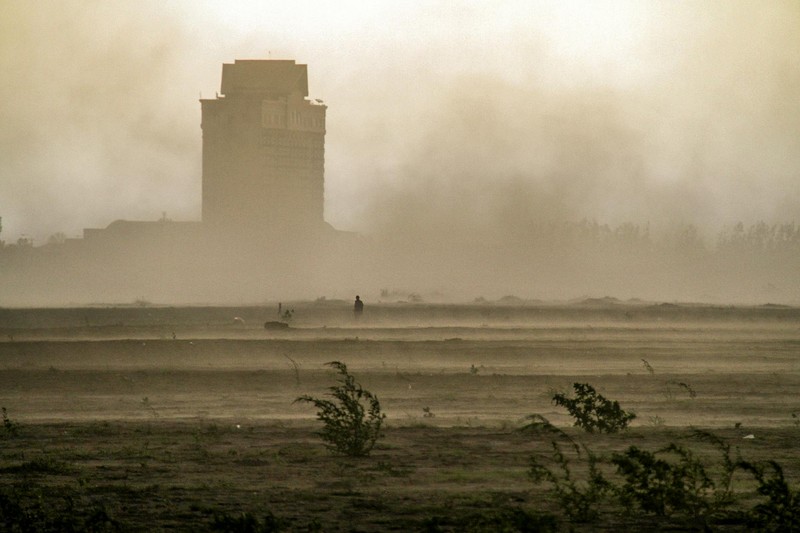
Uttar Pradesh is home to more than 200 million people. On Wednesday evening, a wall of dust and wind swept across the northern Indian state and killed more than 100 of them in a matter of hours.
At least 104 people are confirmed dead and over 50 injured after dust storms, heavy rain, hail, and lightning battered nearly 30 districts, according to state officials. Uttar Pradesh relief commissioner Harikesh Bhaskar Yashod said the deaths were caused by collapsing structures, falling tree branches, and uprooted trees, Xinhua reported. Lightning strikes also claimed lives in several districts.
The weather changed with startling speed. Witnesses described clouds of dust engulfing entire areas before high-speed winds ripped hoardings from their mounts, sent tin sheds flying, and uprooted trees. Roads were blocked. Vehicles were crushed. In several places, rescuers dug through debris with their bare hands.
In Bareilly’s Bamiyana village, a man named Nanhe Miyan was thrown an estimated 50 feet through the air along with a tin shed. He survived with fractured hands and legs. “I don’t know where I fell. I was at least 50 feet away,” he told NDTV.
The Hardest-Hit Districts
Prayagraj recorded the highest death toll at 21, according to district administration data cited by NDTV. Bhadohi followed with at least 16 dead, Mirzapur with 15, and Fatehpur with nine to ten, depending on the source. Six people died in Badaun. Four deaths each were reported in Pratapgarh and Bareilly.
In Fatehpur, eight of the dead were killed in Khaga tehsil alone, including five women. Additional district magistrate Avinash Tripathi said one woman died when a house wall collapsed in Sadar tehsil.
In Pratapgarh, the dead included Bhim Yadav, 25, trapped under a collapsed cemented shed, and Bhushan Pandey, 56, killed when a wall fell. Superintendent of police Deepak Bhukar named Shanti Devi, 46, and Lal Bahadur, 44, as additional victims in the same district.
In Kanpur Dehat, a 19-year-old woman identified as Ruchi was killed by lightning while sheltering under a neem tree with her goats during heavy rain. Several of the animals died in the same strike.
Two pontoon bridges were damaged — one in Bhadohi, where people reportedly fell into the Ganges, and one in Mirzapur, where the collapse cut access to roughly 20 villages, according to NDTV.
Relief Underway
Chief Minister Yogi Adityanath has ordered all divisional commissioners and district magistrates to verify the destruction and disburse financial assistance to affected families within 24 hours. He has demanded updates from every district every three hours.
Yashod said relief operations were being monitored from the state’s integrated control and command center, and that district administrations had been directed to rescue trapped residents, provide medical care, and reopen blocked roads.
The Relief Commissioner’s office, in a statement posted on X on Thursday, said it had received reports of 89 deaths, 53 injuries, 114 livestock losses, and damage to 87 houses. Those figures continued to climb through the day as information arrived from harder-to-reach areas. By Thursday afternoon, Xinhua reported the toll had reached 104.
Adityanath also instructed the Revenue and Agriculture departments, along with insurance companies, to conduct a full damage survey and submit a report to the state government, The New Indian Express reported.
The Pre-Monsoon Question
Wednesday’s disaster struck during India’s pre-monsoon season, when thunderstorms, dust storms, and lightning are routine across the subcontinent. But the scale of destruction — more than 100 dead in a single evening — fits a broader pattern of increasingly severe pre-monsoon weather events across South Asia in recent years.
Witnesses and local officials described Wednesday’s storm as sudden, with dust clouds descending before many residents could reach adequate shelter. In a state where millions live in structures built from mud, thatch, and corrugated tin, the margin between a damaging storm and a lethal one is measured in minutes of warning.
The immediate relief effort is focused on reaching families and clearing debris. The harder question — whether early warning systems and disaster infrastructure across the region are evolving fast enough to match storms that appear to be intensifying — will remain long after the roads are reopened.
Discussion (10)