 lop News
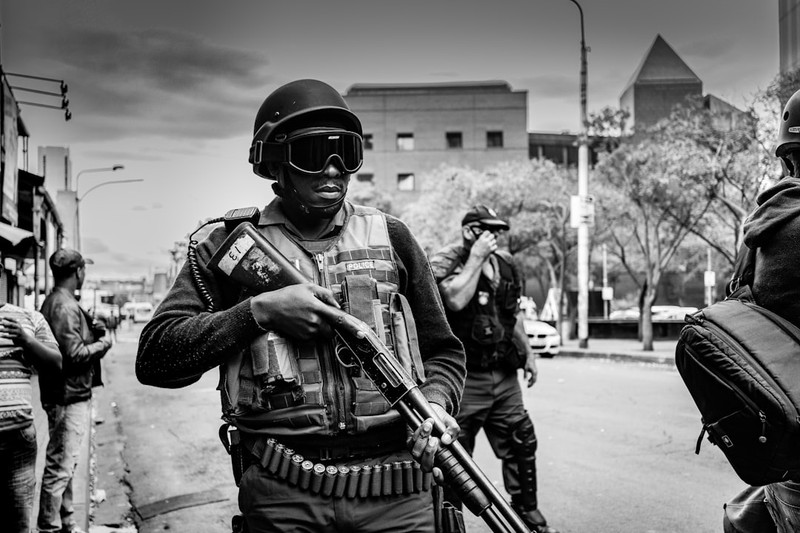
A man lies in the street as vigilantes beat him with sticks. Armed groups patrol neighbourhoods demanding identity documents. A politician’s camera rolls as she tells a Ghanaian man to go fix his own country. These videos, widely shared on social media since late March, are not random outbreaks. They are the visible record of an organised campaign that has killed at least seven people — five Ethiopians and two Nigerians — according to Reuters and the African Press Agency.
Movements, not mobs
The violence is being driven by two named organisations with leaders, branding, and political ambitions. Operation Dudula, founded in Soweto and now a registered political party led by Zandile Dabula, has been staging anti-migrant actions for years. It is joined by March and March, founded in 2025 by former radio presenter Jacinta Ngobese-Zuma, which describes itself as a popular movement.
Both groups demand the mass deportation of undocumented foreigners and have drawn support from conservative parties ahead of 2026 local elections. Both have moved far beyond protest. According to Mpho Makhubela, who works with Lawyers for Human Rights and the association Kopanang Africa Against Xenophobia, vigilantes are running illegal checkpoints, searching people, and forcing migrants from their communities.
“People are threatened, ordered to leave their communities and their businesses are looted,” Makhubela told France 24. “There is a strong racial element: the vast majority of those targeted are black African migrants.”
Human Rights Watch has documented members of both groups physically blocking migrants from public health facilities and schools. In July 2025, a one-year-old Malawian boy died after Operation Dudula blocked his family from accessing treatment at two clinics in Alexandra because they lacked a South African identity card. A high court order in November 2025 banned the group from demanding documents, harassing foreign nationals, or blocking access to services. The judgment has been routinely ignored.
The kindling
South Africa’s unemployment rate sits above 30 per cent — closer to 33 per cent by some measures — and the country ranks among the most unequal on earth. Migrants, who comprise roughly 4 per cent of the population at approximately 2.4 million, are concentrated in visible informal commerce and small businesses.
“In this context, frustration is growing and migrants are an easy group to blame,” Makhubela said. The legacy of apartheid still shapes who controls land and capital. Black South Africans, who remain the overwhelming majority of the poor, find themselves competing for scarce resources — and populist leaders are directing that frustration outward rather than upward.
A GovDem survey cited by Human Rights Watch found that 73 per cent of South Africans do not trust African immigrants “at all” or “not very much.” In February, Zulu King Misuzulu kaZwelithini used a derogatory term for foreigners and said they should all leave — echoing language his father used eleven years earlier, before a previous wave of deadly attacks.
Denial and diplomatic fallout
The government’s response has been contradictory. President Cyril Ramaphosa used his Freedom Day address on 27 April to condemn attacks on foreigners and remind citizens of the solidarity African nations showed during the anti-apartheid struggle. Days later, Minister in the Presidency Khumbudzo Ntshavheni told reporters there were “no xenophobic attacks in South Africa” and blamed “fake videos and images” for damaging the country’s reputation.
The dissonance has not gone unnoticed abroad. Ghana has written to the African Union requesting a fact-finding mission. Nigeria summoned South Africa’s acting ambassador on 4 May after two Nigerians died in separate incidents involving South African security personnel. At least 130 Nigerians have requested voluntary repatriation. Kenya, Malawi, Lesotho, and Zimbabwe have warned their citizens. UN Secretary-General António Guterres condemned what he called “criminal acts perpetrated by individuals inciting violence and exploiting socioeconomic conditions.”
A cycle unbroken
Xenowatch, a database at the University of Witwatersrand, has documented nearly 700 deaths from xenophobic violence since 1994, along with more than 128,000 displaced people and 5,600 looted businesses. Very few perpetrators have been arrested. Fewer still convicted.
The current wave follows patterns established in 2008 and 2015: economic pressure, political opportunism, organised targeting of African migrants, and a government that alternates between condemnation and denial. What is different this time is the infrastructure. Social media amplifies both the violence and the ideology behind it, while branded movements with named leaders give xenophobia an institutional sheen it previously lacked.
The international response, meanwhile, has been measured — diplomatic notes and UN statements rather than the coordinated pressure that comparable outbreaks of targeted violence have triggered elsewhere. South Africa’s continental economic weight, and the diplomatic caution it commands, may explain the restraint. Whether that holds through election season is another matter.
Sources
- ‘It’s organised intimidation’: New wave of anti-migrant violence sweeps South Africa — France 24
- African migrants warned to close shops during South Africa anti-migrant march — BBC News
- South Africa condemns ‘fake videos’ of alleged xenophobic attacks — BBC News
- Hate on parade: Xenophobic marches gather pace as UN warns South Africa — Daily Maverick
- South Africa rejects xenophobia claims over anti-migrant protests — RFI
- World Report 2026: South Africa — Human Rights Watch
Discussion (10)