 lop News
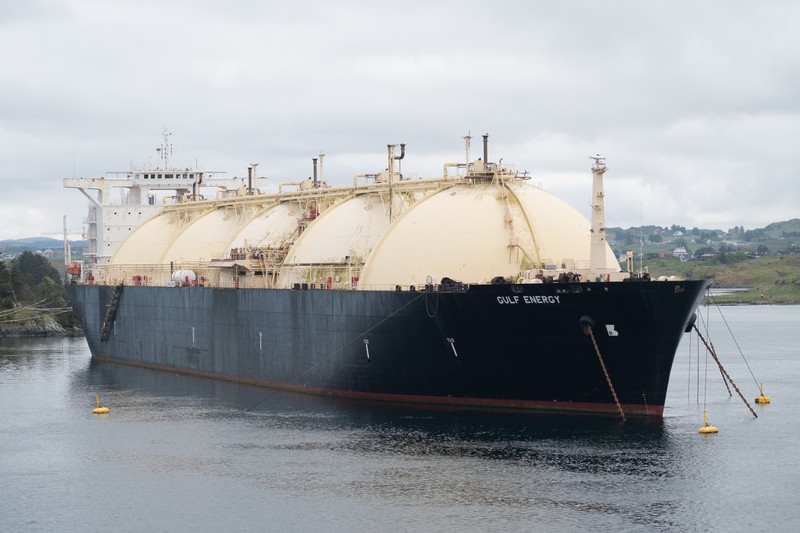
On Sunday afternoon, the Al Kharaitiyat slipped through the Strait of Hormuz carrying liquefied natural gas bound for Pakistan. By any normal measure, a routine transit. These are not normal times.
The QatarEnergy-operated carrier is the first Qatari LNG tanker to traverse the strait since the US and Israel launched their war on Iran 72 days ago. Its safe passage offers a narrow beam of relief for Pakistan, which has been suffering rolling blackouts after vital gas imports from Qatar were severed. But a single ship does not make a waterway open for business.
Hours before the Al Kharaitiyat completed its crossing, a cargo vessel caught fire 23 nautical miles northeast of Doha after being struck by what the British military described as an unknown projectile. In Kuwait, authorities detected several hostile drones in their airspace early Sunday. The ceasefire that took hold on April 8 is nominally still in effect. The evidence suggests it is fraying at the edges.
A controlled exception, not a reopening
The Al Kharaitiyat’s transit was no act of daring by a private shipping company. Sources told Reuters that Iran explicitly approved the shipment under a government-to-government deal involving Qatar and Pakistan — two of the conflict’s key mediators. Two previous Qatari LNG tankers, the Rasheeda and the Al Daayen, attempted a crossing on April 6 and were forced to turn back after failing to obtain Iranian clearance, according to The National.
This time, Tehran gave permission — calculated to build confidence with Doha and Islamabad. But the exemption was narrow. Iran’s semi-official Tasnim news agency reiterated on Sunday that vessels from countries enforcing US sanctions against Tehran would “face problems” crossing the strait. The waterway remains, in practice, controlled by whichever side has the guns pointed at it on any given day — and both sides do.
A ceasefire under constant strain
The month-old ceasefire between the US and Iran has held in the sense that neither side has resumed full-scale bombing. In every other respect, it is being tested daily.
The US imposed its own naval blockade on Iranian ports. Central Command reported it has “disabled” four ships and prevented 58 commercial vessels from entering or leaving Iranian ports since April 13. Iran’s Revolutionary Guard has responded with threats of “heavy assault” on US bases and allied ships if Iranian tankers come under fire. A military spokesman warned that any country enforcing American sanctions will face difficulties in the strait.
Sunday’s cascade of incidents — the cargo ship ablaze off Qatar, the drones over Kuwait — fits a pattern of sporadic clashes that have persisted beneath the formal ceasefire. Each one has been contained before it escalated. Each one also demonstrates how little margin for error remains.
The $33.6 billion hedge
While the Al Kharaitiyat inched through the strait, Saudi Aramco was reporting first-quarter profits of $33.6 billion — a 26 percent year-on-year increase that beat analyst forecasts of $31.2 billion. The numbers tell the story of a crisis that has been very good for the kingdom’s bottom line, at least in the short term.
Aramco’s East-West Pipeline, which bypasses Hormuz entirely by running across Saudi Arabia to Red Sea ports, has reached its full capacity of 7 million barrels per day. CEO Amin Nasser called it “a critical supply artery, helping to mitigate the impact of a global energy shock and providing relief to customers affected by shipping constraints in the Strait of Hormuz.” The pipeline’s existence has given Aramco a geopolitical hedge that few other producers can match.
Brent crude closed Friday at $101.29 per barrel — up 95 percent over the first quarter and 67 percent year to date, according to CNBC. The International Energy Agency estimates the global gas market lost roughly a fifth of supply in March alone. Iran’s blockade has resulted in the loss of nearly a billion barrels of oil, with the shortage compounding daily.
Tehran’s long pause
The holdup in resuming broader traffic through Hormuz is inseparable from the diplomatic standoff over the war itself.
Washington submitted a 14-point proposal to Tehran earlier this week. Its core terms: Iran would freeze uranium enrichment for at least 12 years, reopen the Strait of Hormuz within 30 days, and hand over its stockpile of roughly 440 kilograms of uranium enriched to 60 percent purity — a short technical step from weapons-grade. In exchange, the US would lift some sanctions and release frozen Iranian assets.
President Donald Trump said Friday he expected Iran’s answer “very soon.” Secretary of State Marco Rubio, speaking in Rome, said the US expected a response within hours. Neither came.
Iranian Foreign Ministry spokesperson Esmaeil Baghaei said Tehran is still reviewing the offer and insists any agreement must be “fair and comprehensive.” According to Al Jazeera’s Resul Serdar Atas, the proposal is an “extremely technical text” that Iranian negotiators are scrutinizing word by word, with multiple power centres required to sign off before Supreme Leader Mojtaba Khamenei gives “the green light.”
Iran’s reported demands include a three-phase approach: 30 days of negotiations to permanently end the war on all fronts, including Lebanon, where Israel killed at least 24 people in a wave of attacks on Saturday; guarantees backed by the UN Security Council that strikes will not resume; and maintenance of some degree of influence over the Strait of Hormuz, rather than a return to the pre-war status quo.
Rubio has said Washington will not allow Iran to keep control of the strait. That disagreement — over who holds leverage over the world’s most consequential energy chokepoint — sits at the center of everything.
What one tanker proves
The Al Kharaitiyat reached open water. The global energy system remains in crisis. Qatar itself lost roughly 17 percent of its LNG export capacity to Iranian missile strikes on the Ras Laffan industrial complex — damage that QatarEnergy CEO Saad Al Kaabi has said will take three to five years to repair, at an estimated cost of $20 billion annually.
Britain has announced it will send a destroyer to the region ahead of a UK-French-led mission to protect commercial shipping, separate from the American military deployment. Russia’s Vladimir Putin has offered to oversee the transfer and storage of Iran’s enriched uranium, adding another diplomatic player to an already crowded table.
The Al Kharaitiyat’s passage matters because it proves transit is still possible under specific, carefully negotiated conditions. It does not prove the strait is safe, open, or returning to normal operations. It is a single data point in a calculus that energy markets, navies, and diplomats are all performing in real time.
The next tanker that attempts the crossing will tell us more. So will Tehran’s response to Washington — whenever it arrives.
Sources
- Qatari tanker crosses Strait of Hormuz as Trump awaits Tehran response — South China Morning Post
- Why is Iran taking time to respond to the US proposal to end the war? — Al Jazeera
- Iran ceasefire tested as cargo ship catches fire after being hit off Qatar’s coast — NPR
- Qatari LNG tanker sailing to Pakistan transits Strait of Hormuz — The National
- Iran war day 72: Tehran yet to reply to US plan; Israel bombs Lebanon — Al Jazeera
- Saudi Aramco Q1 profit jumps 26% as key pipeline reaches capacity — CNBC
Discussion (12)