 lop News
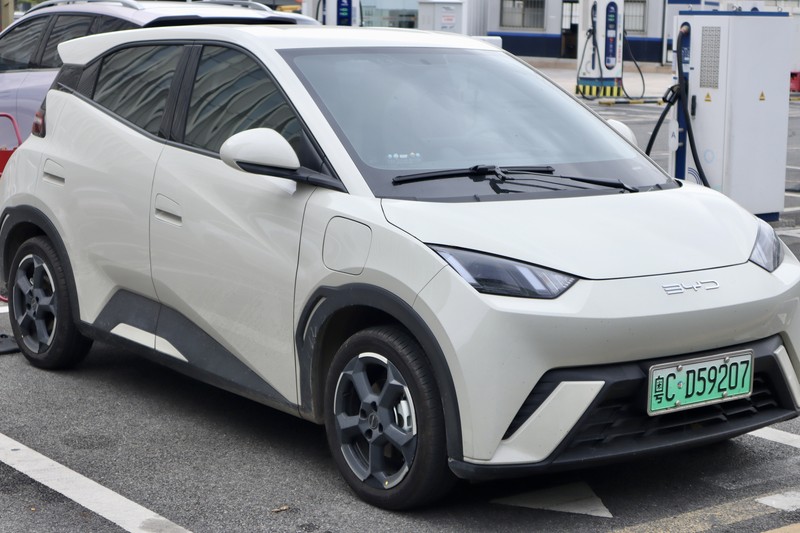
The average new car in the United States carries a sticker price of $51,456. In China, you could buy five best-selling electric vehicles for roughly the same money.
This is not a thought experiment — it’s arithmetic. The Wuling Hongguang MiniEV starts at $6,560. The BYD Seagull at $10,200. Add in the Geely EX2 ($10,060), the BYD Yuan UP ($10,945), and the BYD Qin Plus DM ($11,675), and the total comes to $49,440 — just under the average US manufacturer’s suggested retail price, according to Kelley Blue Book data from March 2026.
None of these cars will appear in an American showroom. A 100% tariff wall handles that. But the price gap they represent is reshaping the global auto industry, and not every market has a wall.
The Cost Gap Is Structural
The Beijing Auto Show, which opened to the public this week, puts the disparity on full display. More than 200 battery-powered models, including hybrids, are available in China for under $25,000, according to trading platform DCar.
Chinese prices reflect a convergence of advantages: vertically integrated manufacturers who build their own batteries and chips, domestic supply chains that avoid import costs, government backing at national and local levels, and production volumes no other market matches. BYD, China’s largest EV maker, accounted for 700,000 sales across just three sub-$12,000 models over the past year.
The competition at home is savage. Gavekal Dragonomics analyst Ernan Cui told AFP that “there are still too many players in the market with too much investment behind them,” with local governments and investors propping up companies that should have exited long ago. The resulting price war is crushing margins. BYD sold a record 2.26 million EVs in 2025 — and watched net profit fall 19%.
What Tariffs Can’t Fix
The United States has effectively sealed its market with 100% tariffs on Chinese EVs. The European Union imposed duties of up to 35.3%, though Brussels and Beijing agreed in January to a minimum-price arrangement that lets Chinese manufacturers sell into the bloc without triggering the full levy.
Neither barrier addresses the underlying economics. Chinese automakers are building factories inside tariff borders — BYD in Hungary, Leapmotor in Spain, Chery pursuing European production of a small electric vehicle. Local assembly rewrites the tariff math entirely.
Then there are the markets without walls. Chinese brands already control roughly a fifth of Latin America’s auto market, according to AlixPartners, and plan to boost overseas production to 3.4 million vehicles by 2030 — nearly triple 2025 levels. Geely has begun selling the EX2 in Brazil, Indonesia, and Thailand. These are the markets where the next billion car buyers live, and Chinese manufacturers are already there at prices no Western competitor can match.
The Collateral Damage
The casualties are piling up among the names that once dominated China. Volkswagen is cutting 50,000 domestic jobs by 2030 after post-tax earnings fell 44% last year. Mercedes-Benz saw China sales plunge 19%. BMW hit its lowest Chinese sales since 2017.
Legacy automakers are scrambling to adapt — BMW partnering with battery maker CATL, Audi using Huawei’s driving assistance systems, Volkswagen co-developing EVs with Chinese upstart Xpeng. Bill Russo, founder of Shanghai consultancy Automobility, describes the shift plainly: “The basis of competition in China has fundamentally shifted from hardware and brand to software, speed, and ecosystem integration.”
The Export Machine
China exported more than 2.6 million new energy vehicles in 2025, more than double the prior year, according to the China Association of Automobile Manufacturers. In March 2026, EV exports were up more than 100% year over year across all manufacturers, per the China Passenger Car Association — even as overall Chinese passenger car sales fell 17.4% in the first quarter.
The domestic squeeze is pushing exports harder. As Russo put it, Chinese brands “are increasingly treating overseas markets as a strategic growth pillar rather than simply an outlet for excess capacity.”
The average American EV transaction price in March was $54,508, according to Kelley Blue Book. BYD sells a Seagull starting at $10,200, with optional lidar, fast charging, and a 505-km range on the premium version. The gap between those two numbers — more than $44,000 — is the single most important fact in the global auto industry right now. Tariffs can keep the Seagull out of Ohio. They can’t keep it out of São Paulo, Jakarta, or Bangkok.
Sources
- For the average price of a car in the US, you could buy 5 new Chinese EVs — The Business Times (Reuters)
- New-Vehicle Price Increases Accelerate in March As Large Trucks and SUVs Gain Share — Cox Automotive / Kelley Blue Book
- Chinese EVs look to sideline foreign brands at Beijing auto show — France24 (AFP)
Discussion (10)