 lop News
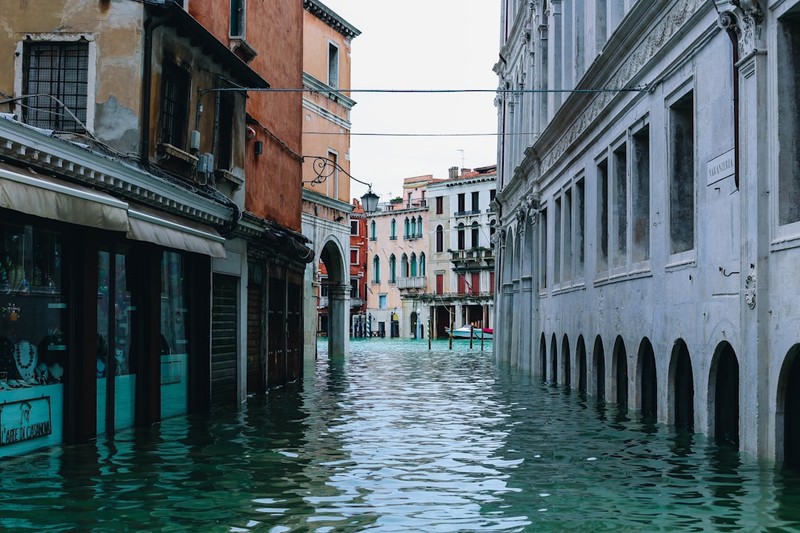
Venice has spent €6 billion on a flood barrier system that was activated 30 times in the first two months of 2026 alone. The sea keeps coming. A comprehensive analysis published this week in the journal Scientific Reports evaluates every major strategy for the city’s long-term survival and reaches a blunt conclusion: none of them preserve Venice in its current form.
The study, led by researchers including Professor Robert Nicholls of the Tyndall Centre for Climate Change Research at the University of East Anglia, maps four adaptation pathways against sea-level rise projections drawn from the IPCC’s Sixth Assessment Report. Each pathway works — up to a point. Beyond that point, Venice becomes something else entirely.
A City Already Running Out of Room
The figures frame the urgency. More than half of Venice’s urban area sits between 0.80 and 1.20 metres above current mean sea level, with a tidal range of roughly one metre. Eighteen of the 28 worst flood events in the city’s recorded history — those inundating more than 60% of the city — have occurred since 2003.
Relative sea-level rise in Venice is driven in roughly equal measure by global sea-level rise and local land subsidence. The city’s ground level continues to sink by approximately 1mm per year. Historical groundwater extraction from beneath the lagoon, now banned, compounded the problem.
The Four Futures
Venice’s present defence relies on MoSE — Modulo Sperimentale Elettromeccanico — a system of mobile steel barriers installed at the three lagoon inlets. Operational since 2022, the gates lie flat on the seabed and rise during storm surges to seal off the lagoon from the Adriatic. In its first five years of use, from 2020 through 2025, the system was deployed 108 times. In the first two months of 2026, it was activated another 30 times.
The study estimates MoSE’s effective ceiling at roughly 0.50 to 0.75 metres of additional sea-level rise. Supplementary measures could extend that window: injecting seawater into deep aquifers to physically raise the city by up to half a metre, and elevating streets and building foundations. Combined costs for these add-ons range from roughly €2.3 billion to €6.4 billion. Even then, the system maxes out around 1.25 metres of rise.
Beyond that threshold, the options grow radical. A ring of dykes could isolate the city centre from the lagoon, preserving buildings but severing Venice from the tidal environment that defines it. Construction costs: €500 million to €4.5 billion. A fully closed lagoon, walled off by a reinforced “super levee” backed by continuous pumping, could theoretically protect against up to 10 metres of sea-level rise — but would convert the largest lagoon in the Mediterranean into a stagnant coastal lake. Initial cost: more than €30 billion.
Under extreme projections — more than 4.5 metres of rise, which current models place beyond the year 2300 under high emissions — the only remaining option is retreat. Relocating monuments, abandoning the rest. Estimated cost: up to €100 billion. The researchers note that even this figure cannot capture what would be lost.
No Optimal Answer
“Our analysis shows that there is no optimal strategy for Venice,” Nicholls said. Every pathway forces trade-offs among resident safety, ecological health, cultural heritage, and economic viability. A city that UNESCO recognised in 1987 as inseparable from its lagoon cannot remain inseparable from it and survive.
Construction timelines compound the urgency. Major coastal interventions require 30 to 50 years from planning to completion. Under current emissions policies, sea-level rise is projected to reach 0.42 metres under a low-warming scenario and 0.81 metres under a high-warming scenario by 2100 — with up to 1.80 metres not excluded. The study warns that MoSE’s open-lagoon approach “is likely to encounter hard limits within the current century.”
The City Everyone Is Watching
Venice’s resident population has collapsed from 170,000 in the early 1950s to fewer than 50,000 today, even as visitor numbers exceed 22 million per year. A city increasingly hollowed out by tourism now faces the prospect of being physically hollowed out by the sea.
The researchers stress that Venice’s predicament is a preview, not an outlier. Low-lying coastal regions worldwide face the same narrowing range of viable options, and most are not planning at all — continuing to build and attract population even as the mathematics of survival grow less forgiving. Venice at least has the advantage of having started the conversation.
That conversation now has a clearer answer than anyone wanted. The city can be adapted, re-engineered, or ultimately abandoned, but it cannot be kept as it is. The sea will have its say. The question is how much of Venice remains recognisable when it does.
Sources
- Long-term adaptation pathways for Venice and its lagoon under sea level rise — Nature Scientific Reports
- Venice is sinking – we analysed every plan to save it, and none would preserve the city as we know it — The Conversation
- Venice is threatened by rising sea levels. Will the city be forced to relocate? — Euronews
Discussion (9)