 lop News
Over fifty-three years. That is how long it has been since a human being traveled beyond low-Earth orbit — since Eugene Cernan stamped his boots in lunar dust in December 1972 and climbed back into the Apollo 17 lunar module for the ride home. Every crewed spaceflight since then, from the shuttle era through the International Space Station, has taken place within a few hundred miles of the planet’s surface.
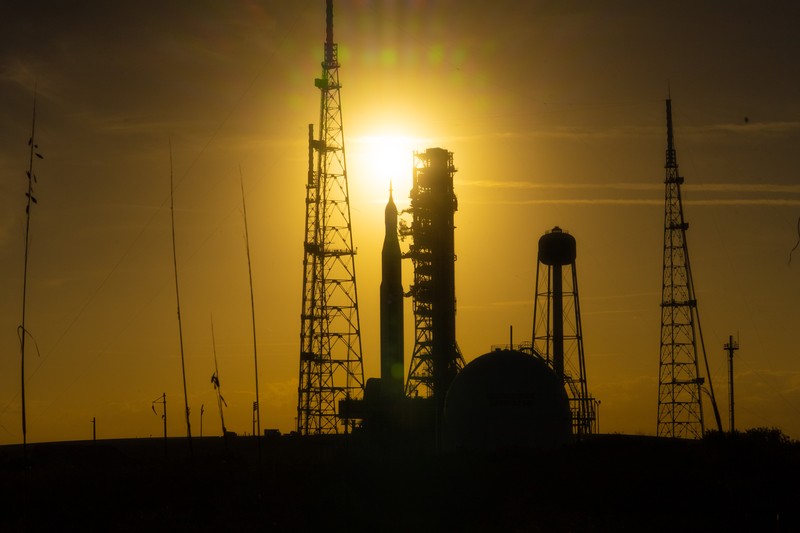
On Wednesday, that drought ends. NASA’s Artemis II mission is scheduled to launch four astronauts aboard an Orion capsule perched atop a 322-foot Space Launch System rocket from Kennedy Space Center in Florida. Liftoff is targeted for 6:24 PM EDT, with backup windows through April 6. Weather officers are forecasting an 80 percent chance of favorable conditions, and mission managers say no technical issues are threatening a Wednesday attempt.
The crew — commander Reid Wiseman, pilot Victor Glover, mission specialist Christina Koch, and Canadian Space Agency astronaut Jeremy Hansen — will spend roughly ten days flying a figure-eight loop around the moon before splashing down in the Pacific Ocean. They will not land. They will not orbit. They will swing within 4,000 to 6,000 miles of the lunar surface, briefly lose contact with mission controllers as they pass behind the moon, and then head home.
It is, by any honest measure, a test flight. The first one with people on board.
The Crew and Their Ship
Wiseman, Glover, and Koch are NASA veterans; Hansen will become the first Canadian to reach the lunar vicinity. Koch will be the first woman to travel that far from Earth. Glover will be the first person of color. The crew has nicknamed their capsule “Integrity,” a word Wiseman said captured the principle guiding their training.
The mission profile is deliberately conservative. After launch, the crew will orbit Earth for one to two days, testing Orion’s life support, navigation, and communications systems. Only after those checkouts are complete will Orion’s engines fire for translunar injection — the burn that sends the spacecraft out of Earth orbit and toward the moon. The transit takes several days. At closest approach, the moon will appear roughly the size of a basketball held at arm’s length.
Re-entry will test Orion’s heat shield at speeds around 25,000 mph. If the shield fails, none of the rest matters.
54 Years and $93 Billion
The gap between Apollo 17 and Artemis II is not just a curiosity — it is the central fact of the story. John Logsdon, a space policy historian and professor emeritus at George Washington University, noted that NASA’s return to the moon has essentially been in the works since 2004, when President George W. Bush announced the agency would retire the space shuttle and pivot moonward.
“It’s really the same program, with a little tweaking along the way, that we are trying to execute 22 years later,” Logsdon told NPR. “It’s taken forever.”
The reason is no mystery. In the 1960s, the space race with the Soviet Union carried an existential urgency that opened congressional wallets. The current program has no comparable geopolitical engine. “This is just something that seems the logical next thing to do, but not with any great commitment to getting it done on any kind of reasonable schedule,” Logsdon said.
NASA’s inspector general has tallied the cost of the Artemis program at roughly $93 billion since 2012. A landing is now projected for 2028 — and that timeline may be optimistic. Retired NASA veteran Wayne Hale, a former space shuttle program manager, told NPR he worries it may not happen before 2030.
NASA’s new administrator, Jared Isaacman — the billionaire private astronaut appointed to lead the agency — has already reshuffled the program. In February he added a lander checkout mission in Earth orbit, pushing the first crewed lunar landing from Artemis III to Artemis IV.
What Comes After
The long-term vision is ambitious: a permanent lunar base, power stations, robotic precursor missions, international partnerships, and eventually a pathway to Mars. SpaceX and Blue Origin are developing landers under NASA contracts. A PricewaterhouseCoopers report estimates $127 billion in revenues from lunar surface activities by 2050.
But that commercial future is a long way off. Akhil Rao, an economist formerly with NASA who was among the staff laid off during the Trump administration’s federal workforce cuts, told Reuters he does “not see a short-run economic value that companies would be able to derive that would allow NASA to be hands-off.”
Meanwhile, China is pursuing its own crewed lunar program with a stated goal of landing astronauts by 2030. Some US lawmakers and NASA officials have tried to frame this as a new space race, though the urgency has not yet translated into the kind of funding that compressed Apollo into a single decade.
All of that, however, is the policy architecture. Wednesday is about four people strapping into a capsule and leaving Earth orbit for the first time since most of the current world population was born. Wiseman captured the moment plainly at a press briefing Sunday: “When those engines light, this thing is moving out.”
Sources
- NASA is just days away from historic Artemis II moon launch — NPR
- NASA set for first crewed moon return in over half a century — Reuters
- How NASA’s Artemis II moon mission will unfold — Reuters
- NASA Sets Coverage for First Artemis Crewed Mission Around Moon — NASA
- Countdown to Artemis II: What to know about NASA’s moon mission — NBC News
Discussion (10)