 lop News
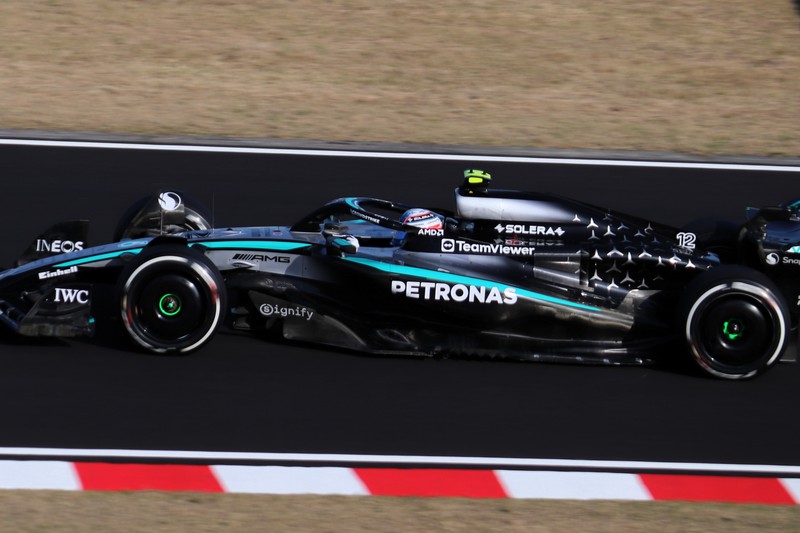
Pole position to sixth place in the sprint to Turn 1. Kimi Antonelli’s Japanese Grand Prix looked, for a few seconds, like a disaster in slow motion.
By the time the chequered flag fell 53 laps later, the 19-year-old Mercedes driver had won by 13.7 seconds, become the youngest championship leader in Formula 1 history, and achieved something no Italian has managed since Alberto Ascari in 1953 — win two consecutive grands prix. Not a bad afternoon for a teenager who appeared to have thrown it all away at the first corner.
The Start That Nearly Ended Everything
Antonelli’s pole lap had been commanding. His race start was anything but. The Mercedes bogged down off the line — a recurring problem for the team — and by Turn 1, Oscar Piastri’s McLaren had swept into the lead, with Charles Leclerc’s Ferrari, Lando Norris, George Russell, and Lewis Hamilton all streaming past. Sixth place. At Suzuka, where overtaking is a chore on the best of days.
Antonelli recovered one spot from Hamilton, but the race up front belonged to Piastri, who looked composed and quick. The Australian, who had failed to start the first two races of the season, was finally showing the form McLaren had been waiting for. Russell fought through to second, passed Piastri briefly on lap eight, then lost the position immediately on the pit straight. The McLaren had genuine pace. Without intervention, the win was Piastri’s to control.
The Crash at Spoon Curve
Intervention arrived on lap 22, and it was horrifying.
Oliver Bearman, disputing 17th place with Franco Colapinto’s Alpine, closed at enormous speed approaching Spoon Curve. Bearman was at full throttle; Colapinto was harvesting energy and downshifting. The speed differential — the kind drivers had warned about — left the Haas driver with nowhere to go. He took to the grass, lost control, and struck the barrier at what his team later described as 191mph.
The impact registered at 50G. Bearman climbed out gingerly, limping and holding his knees. A Haas spokesperson later confirmed he suffered a right knee contusion but no fractures. He was alert and released from the medical centre.
Out came the safety car. And the race turned inside out.
A Gift, Then a Masterclass
Piastri, Russell, and Leclerc had already pitted. Antonelli had not. Under the safety car, he made his stop at vastly reduced time cost and cycled into the lead. Russell, who had pitted a single lap earlier, saw the safety car boards and said one word over team radio: “Unbelievable.”
This is where luck parts ways from talent. Safety cars gift opportunities. They do not manufacture 13-second winning margins.
At the restart, Antonelli immediately pulled clear of Piastri, building a four-second cushion within a handful of laps. In clean air, the Mercedes was untouchable — tire management optimized, energy deployment unlocked, a teenager growing visibly more confident with every sector.
“I was lucky with the safety car to be in the lead and then the pace was just incredible,” Antonelli said. “It was a really nice second stint. I felt very good with the car and very pleased with that.”
His race engineer was more blunt: “We definitely dodged a bullet today.”
Behind him, Russell’s afternoon unravelled. An energy harvesting issue left him vulnerable at the restart, where Hamilton — who also benefited from the safety car timing — swept past. Leclerc passed Russell on lap 37 as the Mercedes hit another energy issue, then dispatched Hamilton with a daring move around the outside on lap 42. Russell eventually overtook Hamilton and briefly passed Leclerc with three laps to go, but the Ferrari driver’s signature move around the outside of Turn One secured the final podium spot. Fourth place, and a growing sense that the garage next door is where the momentum lives.
A Sport Shifting Beneath Its Feet
Antonelli now leads Russell by nine points. Mercedes lead the constructors’ championship with 135 points to Ferrari’s 90. The record for youngest championship leader had belonged to Hamilton since 2007 — the same Hamilton who finished sixth at Suzuka in a Ferrari that couldn’t live with the Mercedes on race pace. The symmetry feels theatrical.
Beyond Mercedes’ early dominance, there are signs the competitive order is loosening. McLaren’s first podium of 2026 suggests the gap can close. Piastri’s second place, in particular, was a statement after his non-starts in the opening rounds. Verstappen, a four-time world champion, salvaged eighth in a Red Bull that looks adrift — eliminated in Q2 on Saturday, anonymous on Sunday. The hierarchy that has defined recent seasons is fracturing.
Formula 1 now enters an unplanned five-week break, with Bahrain and Saudi Arabia cancelled owing to the conflict in the Middle East. When the series resumes in Miami on May 3, Antonelli will arrive as championship leader — the luck undeniable, the pace undeniable, the trajectory harder to dismiss with every passing weekend.
Sources
- Antonelli wins to become youngest title leader — BBC News
- Antonelli wins Japanese Grand Prix to become youngest F1 championship leader — Reuters
- Kimi Antonelli wins Japan Grand Prix to become youngest F1 championship leader — The Guardian
- F1 Japanese Grand Prix results: Who won, full classification, driver standings after Suzuka race — Sporting News (via MSN)
Discussion (9)