 lop News
The promotional video was polished and deliberately provocative. According to The War Zone, the accompanying footage depicted the Yıldırımhan in a road-mobile configuration. The country presenting this footage was not a strategic rival of Washington. It was a NATO ally.
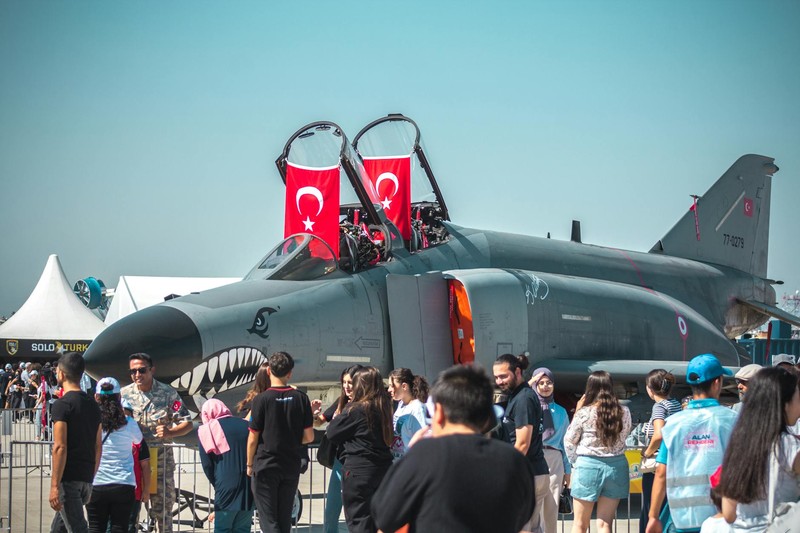
Turkey unveiled the Yıldırımhan — from the Turkish word for lightning — at the SAHA 2026 defense expo in Istanbul this week, accompanied by a promotional video. A full-scale model stood on the exhibition floor. The technical specifications displayed beside it were ambitious: a claimed range of 6,000 kilometers, speeds up to Mach 25, four liquid-fuel rocket engines, and a 3,000-kilogram warhead capacity. Defense Minister Yaşar Güler was unequivocal. “Let no one have any doubt that, if necessary, we will use it without hesitation,” he said, according to Defence Security Asia.
A Mockup, Not a Missile
The gap between the spectacle at SAHA 2026 and an operational weapon system is vast — and that gap is central to understanding what Ankara is actually doing.
Burak Yıldırım, an Istanbul-based security and defense analyst, told Al Jazeera that what was unveiled amounts to “a concept, presented in mock-up form.” He added: “There are no confirmed flight tests, technical specifications remain limited, and critical subsystems have not been publicly accounted for in any consistent detail. Even the most likely future test facility — a base in Somalia — has not yet been constructed.”
Turkey’s existing missile test range on the Black Sea covers less than 1,000 kilometers east to west. Testing a missile with six times that reach would require either steep parabolic trajectories — the same workaround North Korea uses — or a facility Turkey does not yet possess.
The missile’s liquid-fuel design raises further questions about operational viability. According to The War Zone, the Yıldırımhan burns a combination of nitrogen tetroxide and a hydrazine derivative, propellants that must be loaded before launch. This reduces response time and makes the system more vulnerable to preemptive strikes than solid-fuel alternatives favored by established nuclear powers. Turkey’s Defense Ministry confirmed Thursday that laboratory testing has been completed and field testing activities are “being carried out in accordance with the planned schedule,” according to spokesperson Rear Admiral Zeki Akturk. But lab tests are a preliminary step for a country that has never built a missile approaching this range.
Turkey’s missile pedigree is real, just shorter. The Tayfun short-range ballistic missile family, developed by manufacturer Roketsan, has progressed to a Block IV variant tested in late 2025 with an estimated range of roughly 1,000 kilometers. A medium-range system called Cenk, targeting 2,000 kilometers, is also in development. The Yıldırımhan represents a leap of another order entirely.
Sovereignty Over Alliance
President Recep Tayyip Erdoğan has spent two decades pushing Turkey toward defense self-sufficiency, and the Yıldırımhan is the most dramatic expression of that project to date. “As Turkey, we are located in a geography of high strategic importance, located in the heart of three continents, where global arm wrestling is never lacking,” Erdoğan said, according to The War Zone. “The first condition for survival in such a geography is deterrence.”
The timing is not accidental. In March, during the US-Israel military campaign against Iran, NATO air defense systems intercepted ballistic missiles over Turkish territory. Tehran denied firing at Turkey. Ankara was unsettled regardless. Israeli politicians, including former Prime Minister Naftali Bennett, have publicly framed Turkey as a growing threat. The Middle East is thick with unresolved conflicts — and Turkey sits at the center of several of them.
“Turkey is encircled by instability, and it is drawing the conclusion that abstract alliance guarantees are insufficient,” analyst Yıldırım told Al Jazeera. “It wants hard, sovereign deterrence.”
The Yıldırımhan, he argued, is “less about a specific threat and more about Turkey declaring that it intends to be the kind of country that cannot be coerced by anyone, from anywhere.”
That is a remarkable statement of intent from a NATO member. It suggests that Ankara views alliance membership not as a substitute for independent deterrence, but as one layer in a broader strategic architecture — one in which Turkey holds its own leverage, even against fellow members.
The Alliance That Contains Its Own Adversary
And that brings the problem into focus. A promotional video for an ICBM with intercontinental reach is not a routine defense exhibition. It is a deliberate signal, and the signal says: Turkey can threaten you.
This raises a question that NATO’s founding treaty was never designed to address. Article 5 of the Washington Treaty declares that an armed attack against one member shall be considered an attack against all. It presupposes that the threat comes from outside the alliance. What happens when one member implicitly positions another as a hypothetical target?
NATO has survived plenty of internal friction — France’s withdrawal from the military command structure, Greece and Turkey’s decades of mutual hostility, Turkey’s own purchase of Russian S-400 air defenses. But those were disputes about alignment, posture, or procurement. Developing an ICBM whose range implicitly covers an ally’s territory is something different. It reframes the relationship from tension to threat.
Official reaction from Washington and Brussels has been muted so far. This may reflect the reality that the Yıldırımhan is, at present, a model without a proven flight record. Dismissing it as theater is tempting. But the strategic logic behind it — Ankara’s pursuit of sovereign deterrent capability that does not depend on NATO’s nuclear umbrella — is real, and the missile program will mature whether or not the current prototype does.
Özgür Ünlühisarcıklı, regional director at the German Marshall Fund, noted to Al Jazeera that Turkey is “doing what all NATO allies have agreed to do at The Hague Summit — to increase defence spending to 5 percent of their GDPs.” He added: “A stronger Turkey means a stronger NATO.”
That is the generous reading. The less generous one is that Turkey is building the capacity to act independently of NATO — and, if the promotional video is any indication, to threaten its own allies when it suits. The Yıldırımhan may be years from operational capability. The diplomatic damage is already done.
Sources
- Turkiye unveils its first intercontinental ballistic missile: What we know — Al Jazeera
- What Is Behind Turkey’s Pursuit Of An ICBM? — The War Zone
- Türkiye Unveils 6,000km Yıldırımhan ICBM — Mach 25 Strike Capability Reshapes NATO Power Balance — Defence Security Asia
- Türkiye completes Yildirimhan missile’s lab tests, field tests underway — Türkiye Today
Discussion (12)