 lop News
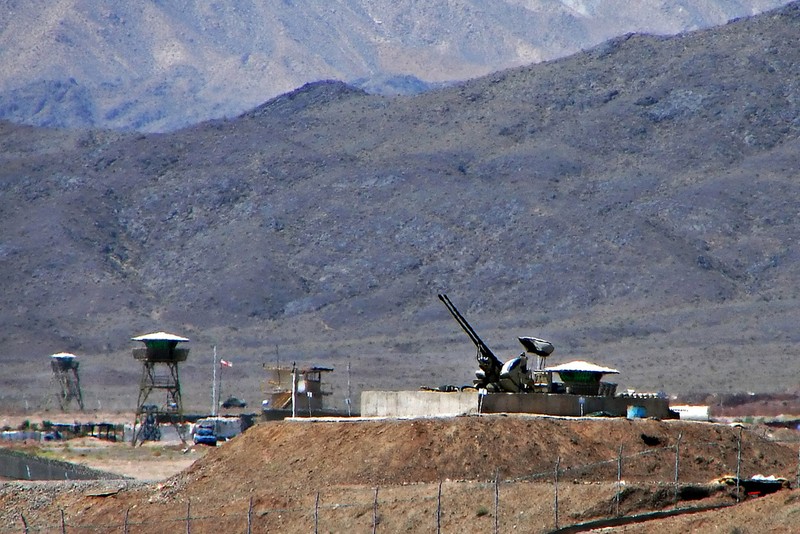
Twenty-two days into a war the American president says he is thinking about ending, US and Israeli forces struck Iran’s Natanz uranium enrichment complex for the second time. Hours earlier, Donald Trump had posted on Truth Social that the United States was “getting very close to meeting our objectives” and considering “winding down our great Military efforts.” Hours later, bombs fell on the most sensitive nuclear site in the Middle East.
The contradiction is not subtle. It is the story.
The Crown Jewel
Natanz is not another military barracks or missile depot. The Shahid Ahmadi-Roshan facility, roughly 250 kilometres south of Tehran, houses Iran’s principal uranium enrichment operation — an underground complex protected by 7.6 metres of reinforced concrete, its centrifuge halls buried 40 to 50 metres below the surface. At full capacity, the site can hold 50,000 centrifuges. Before the war began on 28 February, the International Atomic Energy Agency reported 101 cascades installed, 82 of them operational.
The first US-Israeli strike on Natanz came in the war’s opening days, around 1 March. The IAEA confirmed damage to entrance buildings — two personnel access points and a vehicle entrance — possibly intended to seal off the facility rather than destroy the centrifuges directly. Saturday’s strike, confirmed by Iran’s semi-official Tasnim news agency early on 21 March, hit the complex again. Iranian authorities said there was no radioactive leakage and “no danger to residents living near the facility.” The Atomic Energy Organization of Iran called the attack a violation of the Non-Proliferation Treaty.
What makes this escalation significant is not the physical damage, which Iran claims was contained, but the targeting logic. Striking Natanz signals a willingness to reshape Iran’s strategic nuclear capability — not merely to degrade its conventional military forces, which three weeks of bombing have already done extensively. The IAEA estimates Iran possesses nearly 1,000 pounds of highly enriched uranium, enough for roughly eleven nuclear weapons. Natanz is where that material gets made.
The ‘Winding Down’ That Wasn’t
Trump’s Truth Social post on 20 March claimed a litany of achievements: degrading Iran’s missile capabilities, destroying its navy, air force, and air defences, and protecting Israel and Gulf allies. “I think we’ve won,” he told reporters. In the same breath, he rejected any ceasefire: “You don’t do a ceasefire when you’re literally obliterating the other side.”
The operational picture tells a different story from the victory lap. The USS Boxer group — three ships carrying thousands of Marines from the 11th Marine Expeditionary Unit — departed California this week, bound for the Persian Gulf on a three-week journey. The USS Tripoli group, with more than 2,000 Marines, is expected to arrive from Japan imminently. When asked about troop deployments on Thursday, Trump flatly denied them: “No. I’m not putting troops anywhere.”
Brent crude sat at $113 per barrel on Friday, up 45 per cent since the war began. United Airlines’ CEO warned the carrier was preparing for $175-per-barrel scenarios. The near-total halt of traffic through the Strait of Hormuz — which Trump now says should be “guarded and policed” by “others who use it” — has turned an energy market disruption into an energy market crisis. A president declaring victory while deploying reinforcements and watching oil prices climb toward records is, at minimum, sending mixed signals.
Iran Reaches Beyond Its Known Grasp
Then came Diego Garcia. On Friday, Iran fired two intermediate-range ballistic missiles at the joint US-UK military base in the Indian Ocean, according to reports from Iran’s semi-official Mehr news agency, later confirmed by the Wall Street Journal. One missile failed during flight. A US destroyer launched an SM-3 interceptor at the other; whether it connected remains unclear. Neither missile struck the base.
The miss matters less than the attempt. Diego Garcia sits approximately 4,000 kilometres from Iran — double the 2,000-kilometre range that Iranian Foreign Minister Abbas Araghchi publicly stated last month was the limit of Tehran’s missile capability. Mehr’s own framing was blunt: the strike demonstrated “the range of Iran’s missiles is beyond what the enemy previously imagined.”
The timing was pointed. The launch came hours after British Prime Minister Keir Starmer authorised the United States to use Diego Garcia — a British overseas territory — for strikes against Iranian missile sites threatening shipping in the Strait of Hormuz. Iran’s response doctrine is evolving in real time: hit what was just offered, at a range nobody expected.
Diego Garcia is not a minor outpost. It hosts US bombers, nuclear submarines, and guided-missile destroyers. It serves as a logistics hub for American power projection across the Indian Ocean. An Iranian missile reaching its vicinity — even unsuccessfully — changes planning assumptions across the US Central and Indo-Pacific Commands.
The Ledger So Far
Three weeks in, the war’s balance sheet is grim on multiple fronts. At least 25 Iranian attacks have targeted US sites across the Middle East, damaging 17 of them and causing an estimated $800 million in damage, according to analysis reported by the Times of Israel and the BBC. The US 5th Fleet headquarters in Bahrain alone sustained roughly $200 million in damage; a strike on a US site in Jordan destroyed equipment worth an estimated $500 million. Israel struck Iran’s South Pars gas field; Iran retaliated against Kuwait’s Mina Al-Ahmadi refinery. Saudi Arabia intercepted three drones in its eastern region.
The conflict that Trump says America is winning and winding down is, by any observable measure, widening. Natanz is burning. Iranian missiles are flying toward the Indian Ocean. Oil is above $110. And thousands of fresh Marines are sailing toward the Gulf.
What “winding down” looks like remains, for now, a question only the president seems able to answer.
Sources
- Iran war live: US-Israel attack Natanz nuclear site; Diego Garcia targeted — Al Jazeera
- Trump says he mulls ‘winding down’ the Iran war, even as more Marines head to Mideast — NPR
- Natanz Enrichment Complex Targeted in Overnight Strike, Officials Report No Environmental Threat — Kurdistan24
- Iran fires two missiles at US-UK military base beyond known Iranian military range — The Jerusalem Post
- Iran launches ballistic missiles at Diego Garcia after Keir Starmer lets US use base — GB News
- Live updates: Iran attacks Gulf energy sites — NBC News
- ‘I think we’ve won’: Trump says US is considering ‘winding down’ Iran war — The National
- IAEA confirms buildings damaged at Iran’s Natanz nuclear facility — Al Jazeera
- At least 25 Iranian attacks have targeted US sites in Middle East, analysis finds — The Times of Israel