 lop News
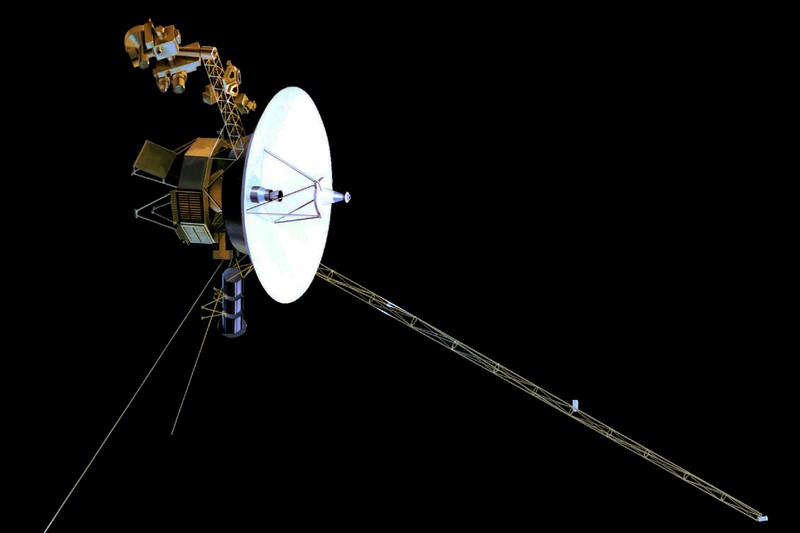
The command left Earth on April 17. It traveled for more than 23 hours at the speed of light, crossing 15 billion miles of void, before reaching the most distant object humanity has ever built. Over the next three hours and 15 minutes, a detector that had been running almost without interruption for nearly 49 years went silent.
NASA had just switched off Voyager 1’s Low-Energy Charged Particle experiment — not because the instrument was broken, but because the spacecraft is slowly running out of power, and something had to be sacrificed so the rest could survive.
A power crisis in interstellar space
Voyager 1 runs on heat from decaying plutonium. Its radioisotope thermoelectric generators convert that nuclear warmth into electricity — no solar panels, no rechargeable batteries, just the slow, steady decline of a radioactive element. The spacecraft loses roughly 4 watts of generating capacity each year. After nearly five decades, the margins have become razor-thin.
During a routine roll maneuver on February 27, Voyager 1’s power levels dropped unexpectedly, pushing the probe dangerously close to triggering an automatic fault-protection shutdown — a self-preservation routine that would have forced engineers at NASA’s Jet Propulsion Laboratory into a lengthy and risky recovery. The team needed to act first.
They already had a plan. Years earlier, the Voyager science and engineering teams had jointly agreed on the order in which instruments would be powered down, balancing scientific value against power consumption. The LECP was next on the list. Its counterpart on Voyager 2 had been shut down in March 2025.
“While shutting down a science instrument is not anybody’s preference, it is the best option available,” said Kareem Badaruddin, Voyager mission manager at JPL, in a NASA blog entry.
What the LECP measured — and what humanity loses
Built by the Johns Hopkins University Applied Physics Laboratory, the LECP detected ions, electrons, and cosmic rays originating from both the solar system and the galaxy beyond. It had the broadest energy range of Voyager’s three particle detectors and provided critical data about the structure of interstellar space: pressure fronts, regions of varying particle density, the invisible weather between the stars.
The instrument was one of two that detected the shift from solar-system particles to galactic cosmic rays when Voyager 1 crossed the heliopause in August 2012, becoming the first human-made object to enter interstellar space. It had also sensed the termination shock in December 2004 — the boundary where the Sun’s solar wind slows to subsonic speeds before yielding to the interstellar medium.
No other operating spacecraft can take these measurements. The Voyagers are simply too far from Earth for any other probe to replicate this work.
A small motor that spins the LECP’s sensor remains powered at half a watt, kept alive so that engineers might one day find enough spare electricity to switch the instrument back on.
Two instruments remain — and a gamble called “the Big Bang”
Voyager 1 now carries two operational science instruments: a plasma wave subsystem that listens for electromagnetic oscillations in space, and a magnetometer that measures magnetic fields. Both continue to function and transmit data.
Engineers expect the shutdown to buy roughly another year. A more ambitious plan, informally called “the Big Bang,” would swap multiple powered components for lower-power alternatives in one coordinated maneuver. The team will test it on Voyager 2 — closer to Earth, with slightly more power — in May and June 2026, then attempt it on Voyager 1 no sooner than July. If it works, the LECP could potentially be revived.
The hope is to keep at least one instrument running on each spacecraft into the 2030s. Linda Spilker, Voyager project scientist at JPL, framed the stakes plainly: “Every minute of every day, the Voyagers explore a region where no spacecraft has gone before. That also means every day could be our last.”
Voyager 1 launched from Cape Canaveral on September 5, 1977, designed for a five-year mission to Jupiter and Saturn. It discovered the first active volcanoes beyond Earth on Jupiter’s moon Io and studied Saturn’s rings and the atmosphere of Titan in unprecedented detail. It has been sailing outward ever since — a machine of 1970s technology, reporting from a place where nothing else has ever been.
The instruments going dark one by one are not failures. They are deliberate sacrifices, made by engineers across 15 billion miles, to squeeze a few more years from a spacecraft that was never supposed to last this long.
Sources
- The Little Probe That Could: Why Voyager 1 Matters, and Why NASA Just Switched Part of It Off — NPR
- NASA Shuts Off Instrument on Voyager 1 to Keep Spacecraft Operating — NASA Science Blogs
- NASA switches off Voyager instruments to extend life of the two interstellar spacecraft ‘Every day could be our last.’ — Space.com
- LECP | Johns Hopkins University Applied Physics Laboratory — Johns Hopkins University Applied Physics Laboratory
- Instruments - NASA Science: Voyager — NASA Science
Discussion (10)