 lop News
An oil tanker burned in Qatari waters. Fuel tanks caught fire at Kuwait’s international airport. A missile slammed into a facility in Bahrain. And from his social media platform, US President Donald Trump announced that Iran wanted a ceasefire.
The gap between the battlefield and the podium has rarely been wider. On day 33 of the US-Israeli war with Iran, the conflict is drawing more Gulf states directly into the crossfire even as Trump signals he may wind down the campaign within weeks.
Missiles across the Gulf
Iran’s Islamic Revolutionary Guard Corps (IRGC) confirmed it had struck the Aqua 1, an oil tanker leased to state-owned QatarEnergy, in Qatari territorial waters on Wednesday. Qatar’s Defense Ministry said three cruise missiles were fired from Iran; two were intercepted, and the third hit the vessel. The 21-member crew was evacuated with no casualties. The tanker was located 17 nautical miles north of Ras Laffan — the site of the world’s largest gas processing plant.
The IRGC said it targeted the tanker because of its ties to Israel. QatarEnergy has not publicly responded to that claim.
Hours earlier, an Iranian drone struck fuel tanks operated by the Kuwait Aviation Fueling Company at Kuwait International Airport, sparking a large fire, according to Kuwait’s state news agency KUNA. No casualties were reported. Bahrain’s Interior Ministry also announced a fire at a company facility following an Iranian missile attack, though it provided no further details on the target or extent of damage.
Israeli forces struck Tehran in what the Israel Defense Forces called a “wide-scale wave of strikes” targeting government infrastructure. Iranian state television reported explosions in the north, east, and center of the capital. Iran retaliated with missile fire on central Israel that wounded 14 people, including an 11-year-old girl left in serious condition from shrapnel injuries, according to Israel’s Magen David Adom emergency service.
A ceasefire claim — from one side
Trump posted on Truth Social that “Iran’s New Regime President” had “just asked the United States of America for a CEASEFIRE!” He said the request would be considered only once the Strait of Hormuz was “open, free, and clear.” Until then, he added, “we are blasting Iran into oblivion or, as they say, back to the Stone Ages!!!”
Tehran has not confirmed any ceasefire request. Iran’s Foreign Minister Abbas Araghchi told Al Jazeera on Wednesday that “there are no grounds for negotiations” with Washington. While acknowledging that messages had been exchanged — including with US special envoy Steve Witkoff — Araghchi insisted the contacts did not amount to talks. “There is no truth to the claim of negotiations with any party in Iran,” he said, according to Al Jazeera.
Trump’s reference to “Iran’s New Regime President” also caused confusion. Iran still has the same president, Masoud Pezeshkian. The leadership change has been at the top: after Ayatollah Ali Khamenei was killed, his 56-year-old son Mojtaba Khamenei was appointed Supreme Leader. The younger Khamenei has not been seen or heard in public since his appointment more than three weeks ago.
Pezeshkian separately told European Council President Antonio Costa that Iran had the “necessary will” to end the war, provided its enemies guaranteed hostilities would not resume, according to Deutsche Welle.
The Hormuz squeeze
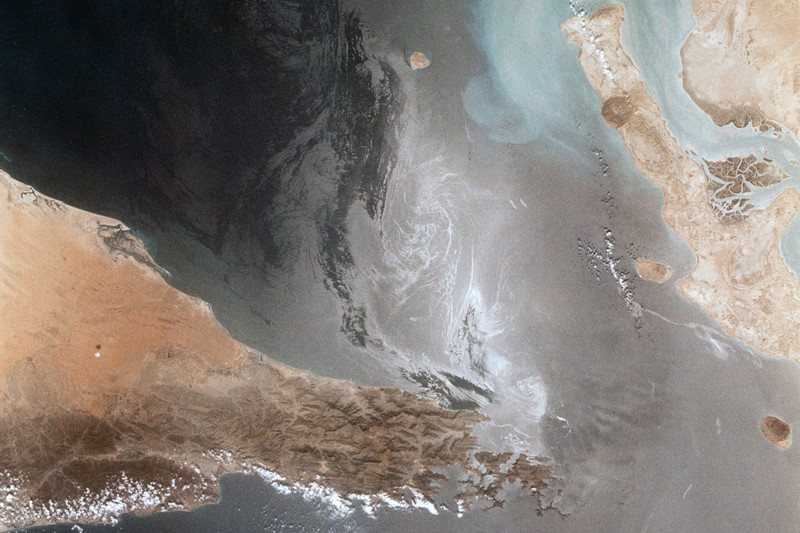
The Strait of Hormuz — through which roughly a fifth of the world’s traded oil and liquefied natural gas passes in peacetime — has been virtually closed since the war began on February 28. According to maritime analytics firm Lloyd’s List, only 142 vessels transited between March 2 and March 25, roughly equal to what the waterway handled in a single day before the conflict. Two-thirds of that traffic was affiliated with Iran.
Iran has implemented what amounts to a toll system, requiring ship operators to submit to a vetting procedure before transit. Bloomberg reported that payments of up to $2 million per voyage have been sought on an ad hoc basis, with at least two payments settled in Chinese yuan. Iran denies charging tolls.
The economic fallout is now global. US gas prices hit $4.06 a gallon, up more than $1 in a single month — a steeper climb than any period after Hurricane Katrina or the sanctions imposed on Russia in 2022, according to AAA data cited by CNN. Australia’s prime minister made a rare national address urging citizens to use public transport and avoid hoarding fuel. The Philippines declared a national energy emergency.
What comes tonight
Trump is scheduled to deliver a national address at 9 pm Eastern that the White House has described as “an important update on Iran.” He told reporters on Tuesday that he expected the war to end “very soon” and suggested the US could walk away in two to three weeks — even without a ceasefire agreement.
Whether Israel would follow the US out of the conflict remains an open question. Prime Minister Benjamin Netanyahu declared on Tuesday that the war had removed “two existential threats” to Israel by crippling Iran’s nuclear and ballistic missile programs. He made no mention of winding down operations.
The death toll continues to climb. The Human Rights Activists News Agency reports at least 1,598 civilians killed in Iran, including 244 children. In Lebanon, the Health Ministry says more than 1,260 people have been killed. Iranian strikes on Gulf states have killed at least 50. In Israel, 17 have been killed, and 13 US service members have died, according to the New York Times.
On the same day Trump declared peace was close, the IRGC issued its own statement: the Strait of Hormuz is “fully” under their control.
Sources
- Drone attack sparks fire at Kuwaiti Airport, tanker off Qatar hit as Iran strikes Gulf states — Jerusalem Post
- Trump considers quitting NATO, says Iran war could end soon — CNN
- Iran War Live Updates: Trump Berates Allies While Signaling He Will Wind Down the War — New York Times
- Energy security versus geopolitics: ASEAN states face tough choices over Iran’s Strait of Hormuz passage — Channel News Asia
Discussion (8)