 lop News
Mexico City is losing nearly 10 inches of elevation every year, and you no longer need a surveyor’s tools to notice. A satellite orbiting hundreds of miles overhead can see it plainly.
New imagery from NISAR, a NASA-ISRO radar satellite launched in July 2025, confirms that parts of the Mexican capital are subsiding at roughly 2 centimeters per month. The data, collected between October 2025 and January 2026, shows a 22-million-person metropolis slowly compacting into the drained lakebed beneath it.
The mechanism is straightforward and effectively irreversible. Mexico City sits on an ancient aquifer that has been pumped for over a century. As groundwater is removed, the clay-rich lakebed compresses and hardens — like a wet sponge wrung flat. It does not rebound.
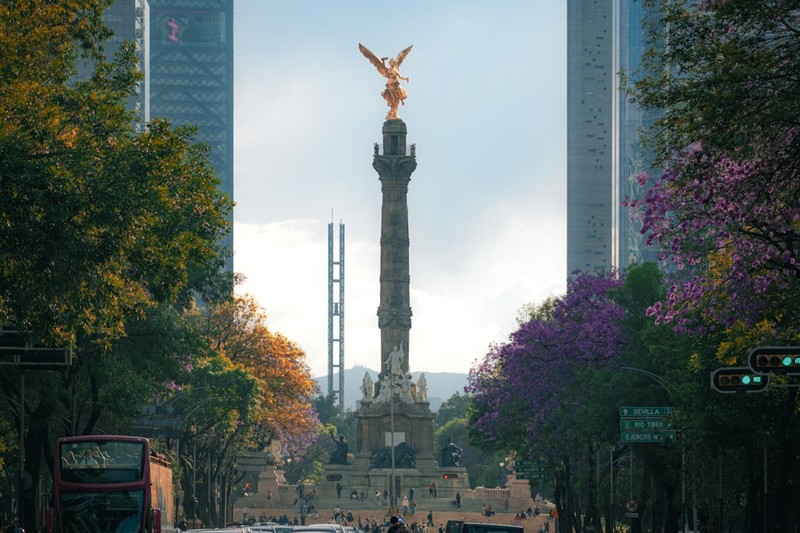
By the 1950s, parts of the city were losing 18 inches of elevation per year, according to a National Academies of Sciences report. Over the full span of documented subsidence, some areas have dropped more than 39 feet, according to Enrique Cabral, a geophysics researcher at the National Autonomous University of Mexico. The Angel of Independence, a 114-foot monument on Paseo de la Reforma, has had 14 additional steps added to its base since 1910 as the ground around it fell away.
“It damages part of the critical infrastructure of Mexico City, such as the subway, the drainage system, the water, the potable water system, housing and streets,” Cabral told the Associated Press.
For decades, the government response was largely limited to stabilizing foundations beneath historic structures. Following recent flare-ups of the city’s chronic water crisis, officials have begun funding more research.
NISAR, which carries the largest radar antenna reflector NASA has ever launched, can track ground movement every 12 days — day or night, through cloud cover. Previous satellites collected data only annually. The difference is a matter of resolution in time: researchers can now watch the city sink in near real-time.
Understanding the problem, Cabral noted, is the prerequisite to addressing it. For now, the satellite keeps watching.
Discussion (6)