 lop News
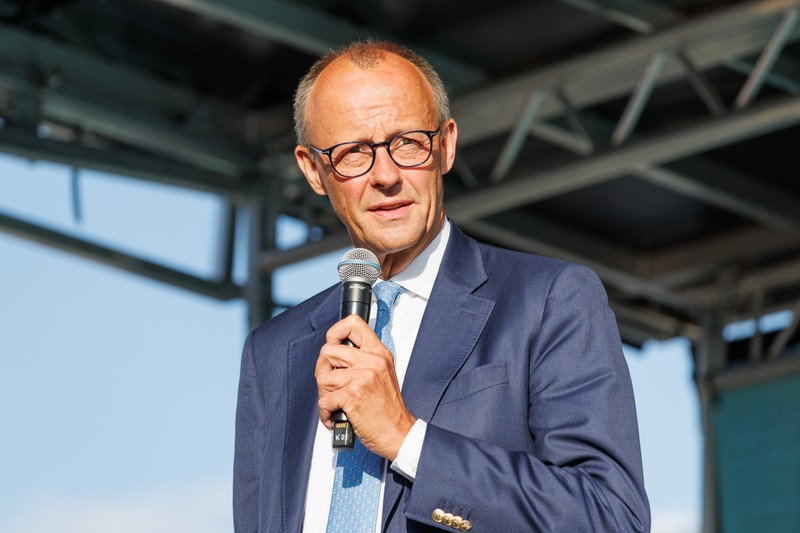
The United States is being humiliated by Iran. Ukraine should prepare to surrender territory to join the European Union. Both verdicts came from the same person, on the same day, to the same unlikely audience: teenagers at a school in the German town of Marsberg.
Chancellor Friedrich Merz walked into the Carolus-Magnus-Gymnasium — an EU Project Day event in his home region of Sauerland — and walked out having reframed two of the world’s most consequential debates in under an hour.
“An Entire Nation Humiliated”
On Iran, Merz abandoned any pretense of allied solidarity. “The Iranians are clearly stronger than expected and the Americans clearly have no truly convincing strategy in the negotiations either,” he told students, according to Deutsche Welle.
He reached for America’s recent history. “The problem with conflicts like this is always: you don’t just have to get in, you have to get out again. We saw that very painfully in Afghanistan for 20 years. We saw it in Iraq.”
Merz said he saw no sign of a US exit strategy, “especially since the Iranians are clearly negotiating very skillfully — or very skillfully not negotiating.” He described “an entire nation is being humiliated by the Iranian leadership, particularly by the so-called Revolutionary Guards.”
This is not a diplomat expressing private concerns through discreet channels. The leader of Europe’s largest economy went on the record to declare American power failing — while that failure is still unfolding.
A Conditional Door for Kyiv
On Ukraine, Merz was equally unsparing. He dismissed President Volodymyr Zelenskyy’s proposed EU accession timeline outright. “Zelenskyy had the idea of joining the EU on January 1, 2027. That will not work. Even January 1, 2028, is not realistic,” he said, according to Euronews.
Then he went further, linking territorial concessions directly to the membership question in terms no senior Western leader has used publicly. “At some point, Ukraine will sign a ceasefire agreement. At some point, hopefully, a peace treaty with Russia. Then it may be that part of Ukraine’s territory is no longer Ukrainian,” Merz said.
He suggested Zelenskyy might need a referendum to secure public backing for territorial concessions, while at the same time telling voters: “I have opened the way to Europe for you.”
Russia currently occupies roughly 20% of Ukrainian territory and is demanding Kyiv cede additional land in Donetsk Oblast. Zelenskyy has rejected those demands, pushing back later on Monday: “Russia wants our territory so that it can seize the territories of others as well. If it succeeds with one state, with one neighbor, then it will do the same with others.”
At last week’s informal EU summit in Cyprus, Zelenskyy pressed leaders directly. “We seek the same full membership that every EU nation has — from Cyprus to Poland,” he said. The bid has been stalled by Hungary’s veto for nearly two years, though Brussels hopes Viktor Orbán’s electoral defeat on April 12 may finally open the first cluster of negotiations.
Merz floated an interim alternative — observer status in EU institutions, without voting rights — that he said gained “some support” in Cyprus. The idea has never been tried. European Commission President Ursula von der Leyen praised Ukraine’s reforms but warned against artificial deadlines, noting that accession is “a two-way contract” requiring “hard reforms.”
The Signal Between the Lines
Read together, the two statements sketch a coherent worldview. American power cannot be relied upon; Europe must think for itself. Ukrainian membership is possible, but the price may be land — and Berlin, not Kyiv, will help define that price.
The economic pressure driving Merz’s calculus is real. He acknowledged that the Iran conflict “has a direct impact on our economic output.” Berlin remains ready to deploy minesweepers to the Strait of Hormuz, but only after hostilities cease. German Foreign Minister Johann Wadephul separately warned at the United Nations that nuclear threats continue to shape the security environment, saying Berlin needs “a credible deterrent” as long as such threats persist.
Merz closed with a pitch for European ambition. The EU has 100 million more inhabitants than the United States, he told students. “If we were to unite more effectively and do more together, we could be at least as strong as the United States of America.”
A chancellor who publicly calls American power humiliated while demanding European self-reliance is not just analyzing events. He is preparing for what comes after.
Discussion (9)