 lop News
Bamako. Kati. Gao. Kidal. Sevare. Before dawn on Saturday, they all came under fire at once.
Unidentified armed groups launched coordinated assaults on military positions across Mali in the early hours of April 25, hitting the capital’s international airport, the country’s main military base, and towns spanning hundreds of kilometers of the Sahel. As of late morning, fighting was still ongoing, and the full scale of the attack — and the government’s ability to contain it — remained unclear.
Mali’s army said in a statement that “unidentified armed terrorist groups” had “targeted certain points and barracks in the capital and the interior” shortly after 5 am local time. The military said soldiers were “currently engaged in eliminating the attackers” and called on the civilian population to remain calm.
From the airport to the desert
The geography of the assault tells its own story. In Bamako, an Associated Press journalist reported sustained heavy-weapons and automatic-rifle fire coming from Modibo Keïta International Airport, approximately 15 kilometers from the city center, along with at least one helicopter patrolling overhead. A resident living near the airport corroborated the account, reporting gunfire and three helicopters in the air.
The airport sits adjacent to the Senou military camp, which also houses Russian mercenary forces. A resident told Reuters the gunfire appeared to come from the camp rather than the civilian terminal. “We hear gunfire towards the military camp. It’s not the airport itself, but the camp that secures the airport,” the resident said, speaking anonymously for safety reasons.
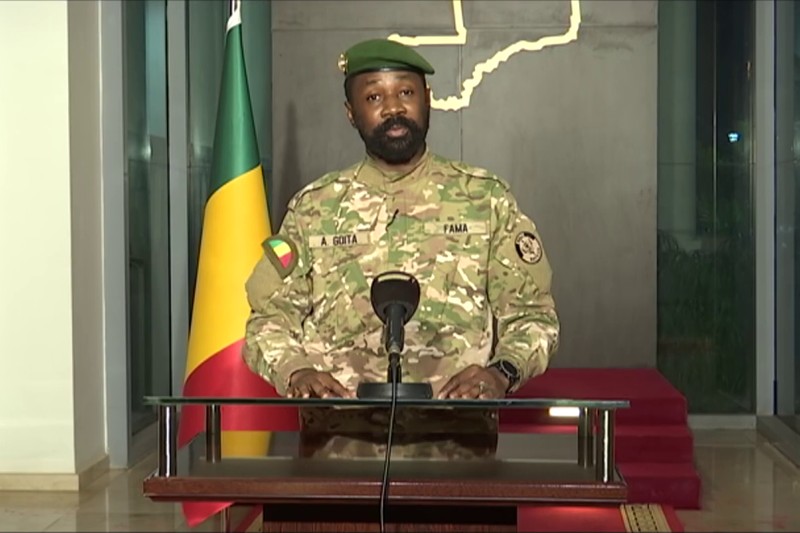
In Kati, a town just outside Bamako that is home to Mali’s main military base and to the residence of military ruler General Assimi Goïta, a Reuters witness heard two loud explosions and sustained gunfire shortly before 6 am. Soldiers were deployed to block off roads in the area.
Hundreds of kilometers to the northeast, simultaneous reports emerged from Gao, where a resident said gunfire and explosions began in the early hours and continued into the late morning. “The force of the explosions is making the doors and windows of my house shake. I’m scared out of my wits,” the resident told the AP by phone. The gunfire came from the direction of the army camp and the airport, which sit side by side.
In Kidal, a former mayor told the AP that gunmen had entered the city and taken control of some neighborhoods, leading to firefights with the army. Fighting was also reported in Sevare and Mopti in central Mali.
“There’s gunfire everywhere,” a witness in Sevare told Reuters.
Multiple groups, one assault
The breadth of the coordination suggests the involvement of more than one armed faction — and reporting from multiple sources points in that direction. Four security sources told Reuters that Jama’at Nusrat al-Islam wal-Muslimin (JNIM), the regional al-Qaeda affiliate, was involved in Saturday’s attacks. France 24 journalist Wassim Nasr posted videos showing JNIM fighters operating near Bamako and Kati. JNIM has not formally claimed responsibility.
At the same time, a spokesperson for the Azawad Liberation Front (FLA), a Tuareg-dominated rebel alliance, claimed on social media that its forces had seized control of multiple positions in Kidal and Gao. Neither France 24, the AP, nor Reuters could independently verify the claim.
If both groups participated simultaneously, it would mark a striking convergence. JNIM is a jihadist organization with roots in the al-Qaeda network. The FLA is a separatist coalition driven by ethnic Tuareg nationalism in northern Mali. Their goals differ — one seeks an Islamic state, the other an independent Azawad — but they share an enemy in the Bamako government, and Saturday’s attacks suggest at least tactical coordination, if not a formal alliance.
A junta tested on its central promise
The attacks are a direct challenge to the military government that seized power in coups in 2020 and 2021, promising to restore the security that civilian leaders had failed to deliver. General Goïta has been the country’s de facto leader since the second coup, and in July 2025, the junta granted him a five-year presidential term — renewable “as many times as necessary” and without an election.
The strategy of turning away from the West and toward Russia has not delivered the stability the junta promised. Wagner Group mercenaries, who had been fighting alongside Malian forces since 2021, ended their mission in June 2025, transitioning into the Africa Corps under the direct control of Russia’s defence ministry. The security picture has continued to deteriorate.
Since September 2025, JNIM has targeted fuel tanker convoys supplying Bamako, bringing the capital to a standstill at the height of the crisis in October. Despite months of relative calm, Bamako residents faced diesel shortages as recently as March 2026, with fuel rationed for the energy sector.
Saturday’s assault is the most dramatic escalation since a 2024 attack on Bamako’s airport and a military training camp, claimed by an al-Qaeda-linked group, that killed scores of people.
‘Too soon to tell’
France 24’s Nasr assessed that it was “too soon to tell” whether the junta could fall. That judgment — cautious, hedged, from a journalist with deep sourcing in the region — captures the uncertainty of a fast-moving situation. The attacks are still hours old. Casualty figures are unavailable. Government communications have been limited to a single army statement.
But the fact that the question is being asked at all is itself a measure of how far Mali’s security has eroded under military rule. A coordinated nationwide assault reaching the capital’s airport and the base where the head of state resides is not a border skirmish or a rural ambush. It is a direct challenge to the state’s ability to project authority over its own territory.
The US embassy in Bamako said it was following reports of explosions and gunfire near Kati and the airport, and advised American citizens to shelter in place. Reuters reported in March that Mali and the US were nearing a deal that would allow Washington to resume intelligence-gathering flights over Malian airspace — a tentative diplomatic opening that now faces a severe stress test.
A regional unraveling
Mali is not alone in its deterioration. Neighboring Niger and Burkina Faso have followed the same trajectory: military coups, severed ties with France, alignment with Russia, and worsening insurgencies. All three countries have seen record numbers of militant attacks in recent months, according to analysts. Government forces across the Sahel have also been accused of killing civilians suspected of collaborating with militants, deepening the cycle of grievance and violence.
Saturday’s attacks did not emerge from a vacuum. They are the product of more than a decade of jihadist conflict dating to 2012, compounded by the collapse of a 2015 peace deal with Tuareg separatists in the north, and accelerated by the political instability that military rule was supposed to resolve.
As of this writing, the outcome in Mali remains uncertain. What is clear is that the groups arrayed against the Bamako government have demonstrated a reach and coordination that few anticipated — and that the junta’s core promise, to bring security, looks emptier than ever.
Sources
- Mali live: Army says armed ‘terrorist’ groups launch attacks on military positions nationwide — France 24
- Mali army says armed ‘terrorist’ groups attacked military positions — France 24 (with AFP and AP)
- Gunfire and blasts rock Mali as attackers hit capital and other cities, residents say — Associated Press
- ‘There’s gunfire everywhere’: Gunmen stage simultaneous attacks in Mali capital and northern towns, army says — Reuters (via Malay Mail)
- Coordinated attacks hit Mali, fighting ongoing near Bamako airport — Anadolu Agency
Discussion (14)