 lop News
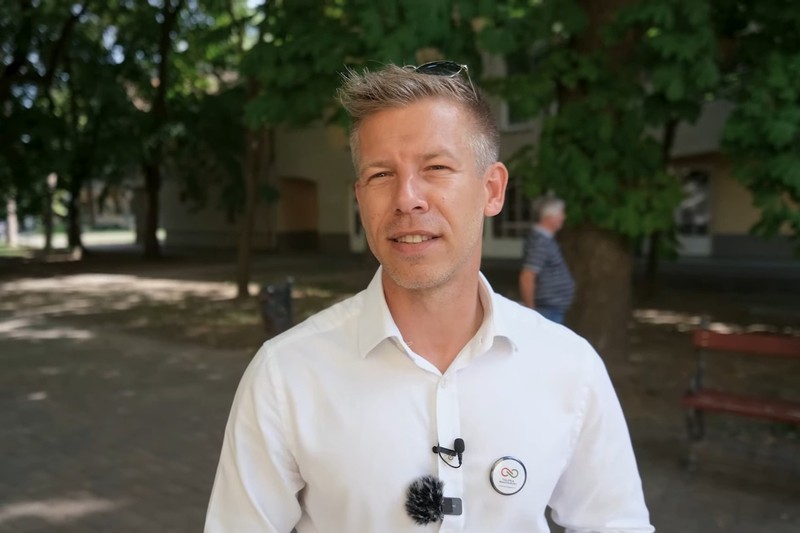
On Wednesday morning, Péter Magyar sat down in the studios of Hungarian state television for the first time in 18 months. He had won the country’s election three days earlier — a landslide so decisive that Viktor Orbán phoned to concede before a third of the votes were even counted. But the broadcaster that had spent years pretending Magyar didn’t exist was still transmitting.
It did not go smoothly. Magyar called MTVA a “factory of lies,” compared its output to something “Goebbels or the North Korean leadership would admire,” and pledged to suspend its signal upon taking office. He accused the network of spreading false claims that his minor children refused to speak to him. The presenter denied the allegations.
The confrontation was the most vivid illustration yet of what Magyar means when he promises “system change” — and the numbers suggest he may have the mandate to deliver.
A Supermajority Built on Exhaustion
Preliminary results, with more than 98% of votes counted, put Magyar’s Tisza party on course for 138 of 199 parliamentary seats, according to the BBC. Orbán’s Fidesz managed just 55. The far-right Our Homeland picked up six. Turnout hit a record 79.5%.
“Never before in the history of democratic Hungary have so many people voted — and no single party has ever received such a strong mandate,” Magyar told supporters gathered beside the Danube on Sunday night. He likened the moment to the revolutions of 1848 and 1956.
What made it extraordinary was the constituency that delivered it. Magyar, who describes himself as conservative, drew support from voters who had backed Fidesz for years. According to Chatham House analysis, Orbán lost because he asked voters to think geopolitically — war or peace, Brussels or sovereignty — while they were preoccupied with economic stagnation, inflation, and falling living standards. The populist instinct that had defined his career misfired.
What Tearing Down the System Actually Looks Like
Magyar’s agenda is sweeping. He has pledged to draft a new constitution replacing one he describes as a “conglomerate of propagandistic articles and provisions” designed to entrench Fidesz power. The document would include term limits for prime ministers and restore checks on executive authority. He intends to reform electoral laws tailored to favor Fidesz, restore judicial independence, and relinquish personal control of the intelligence services, returning them to the Interior Ministry.
On corruption — the issue that arguably cost Orbán the election — Magyar plans to establish an anti-corruption authority and a restitution body tasked with investigating all public tenders worth more than €25 million from the past 16 years. Hungary would also join the European Public Prosecutor’s Office.
The state media overhaul follows the blueprint of his ally, Polish Prime Minister Donald Tusk, who dismissed the management of Poland’s state broadcaster and cut its signal after taking office in 2023.
The Map Redrawn
The implications reach well beyond Budapest. Orbán had been Russia’s closest ally within the EU, a consistent obstructionist on sanctions and Ukraine aid, and a beneficiary of enthusiastic support from the Trump administration — US Vice President JD Vance flew to Budapest days before the vote to campaign for him.
Magyar has pledged that his first foreign trip will be to Warsaw. His second will be to Brussels, where he aims to persuade the European Commission to release up to €17 billion in funds frozen over rule-of-law concerns. European Commission President Ursula von der Leyen responded to the result: “Europe is Hungarian today.”
On Ukraine, Magyar has called for normalized relations and affirmed that Ukraine’s sovereignty is inviolable — a sharp break from Orbán’s rhetoric. But he has not committed to reversing Orbán’s veto of the EU’s €90 billion loan package for Kyiv and opposes fast-tracking Ukrainian EU membership. He also rules out Hungarian troop deployments or a return to conscription.
The Kremlin was measured. Spokesman Dmitry Peskov said Moscow respects the choice and expects to continue pragmatic contacts with the new government, while noting that Hungary remains on Russia’s list of unfriendly countries.
The Question Orbán Leaves Behind
Orbán has not resigned as Fidesz leader and will serve in a caretaker role during the transition. Chatham House warns that this is not a clean break. Fidesz remains embedded in local networks, institutions, and media ecosystems. Orbán himself suffered an electoral defeat in 2002, only to return stronger in 2010. “It is the beginning of a new phase in which Orbánism may yet survive in opposition as a source of resistance, political sabotage and narrative warfare,” the think tank concluded.
Magyar’s promises — shutting down state media, rewriting the constitution, investigating 16 years of corruption — seemed impossible a year ago. On Sunday, voters made them politically feasible. The hard part starts now.
Sources
- Orbán era swept away by Péter Magyar’s Hungary election landslide — BBC News
- After his landslide victory, what will Peter Magyar do next? — Deutsche Welle
- Magyar vows to shut down Hungarian state TV accusing it of ‘North Korean’ propaganda — Euronews
- In their words: How leaders reacted to Viktor Orbán’s defeat in Hungary’s election — Associated Press
- Hungary election: Orbán has been defeated – but will Orbánism survive? — Chatham House
Discussion (10)