 lop News
Lai Ka-ying gets carsick. She can’t stand hot weather. She was not a top student, didn’t speak Mandarin, and figured she’d throw her name in the ring with a “let’s give it a try” attitude.
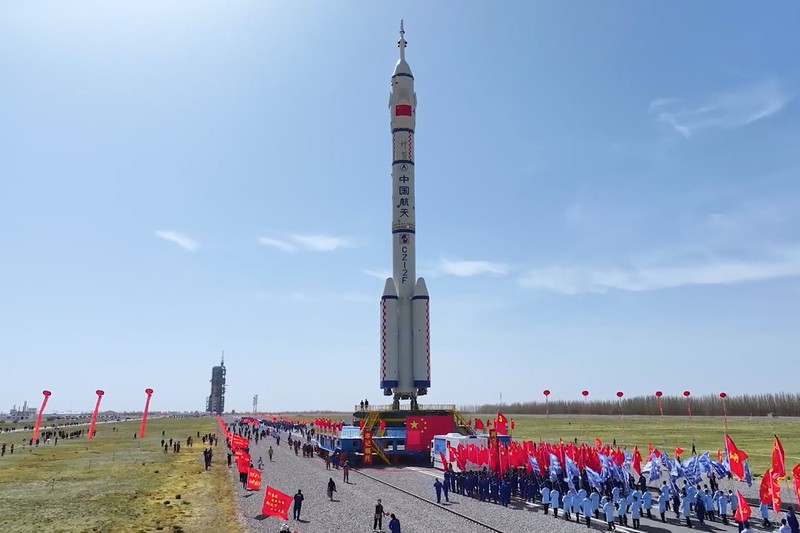
On Sunday night, the 43-year-old mother of three will blast off aboard China’s Shenzhou-23 mission as Hong Kong’s first astronaut.
Lai, a computer data specialist who previously worked in the Hong Kong Police Force, was selected as a payload specialist after nearly two years of gruelling training. The selection process tested every weakness she thought she had. The rotating chair — a classic astronaut gut-check — turned out to be no problem. The centrifuge was harder. “I was in total confusion, everything went blurry,” she told state media. “But I persevered through sheer willpower.”
Long, irregular shifts in the police force prepared her for one of the more unpleasant training exercises: 72 hours without sleep.
Lai will spend at least six months aboard China’s Tiangong space station, operating a locally developed instrument called the Multi-Spectral Imaging Carbon Observatory. Built by a Lingnan University team, the device measures carbon dioxide and methane emissions from orbit — billed as the world’s first lightweight, high-resolution space-based greenhouse gas observatory. Professor Li Jia of Lingnan University said the data could help pinpoint and reduce emissions in the Greater Bay Area and across mainland China.
Lai’s crewmates are commander Zhu Yangzhu, a veteran of the 2023 Shenzhou-16 mission, and pilot Zhang Zhiyuan, making his first flight. The China Manned Space Agency also announced that one crew member will remain on the station for a full year — a stepping stone toward Beijing’s goal of landing astronauts on the Moon by 2030.
For Hong Kong, the mission marks a first inclusion in China’s crewed space programme. Chief Executive John Lee called it a “historic day” and thanked Beijing for its trust in the city’s scientists.
Shenzhou-23 is scheduled to launch at 11:08pm local time from the Jiuquan Satellite Launch Centre in northwestern China.
Sources
- ‘Let’s give it a try’: motion sickness no barrier for Hong Kong’s first astronaut — South China Morning Post
- Hong Kong’s astronaut to gather data using observatory created by local teams — South China Morning Post
- China set for latest space launch, with Hong Kong astronaut aboard — AFP via RFI
- Lai Ka-ying named as first HKSAR astronaut — RTHK
Discussion (5)