 lop News
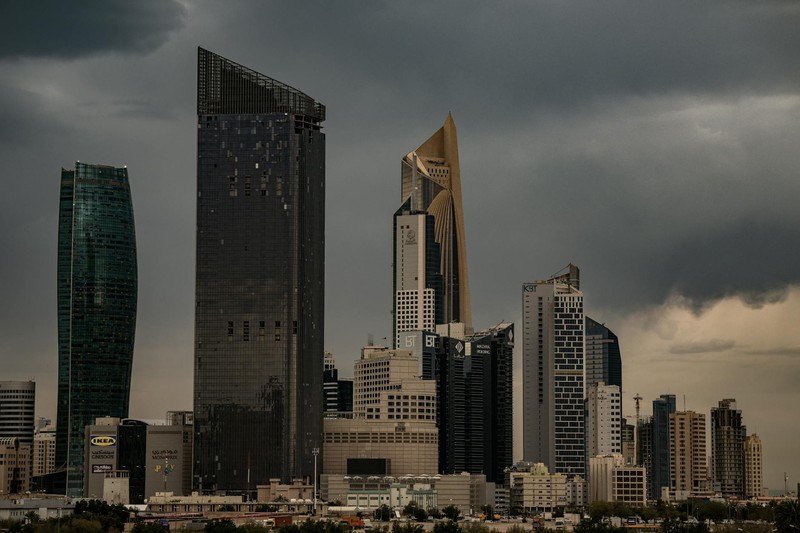
Air raid sirens sounded across Kuwait before dawn on Monday as the emirate’s military said its air defences were intercepting incoming missiles and drones — drawing a third country into a confrontation that both Washington and Tehran insist is under control.
“The General Staff of the Army wishes to advise that any sounds of explosions heard are the result of air defense systems intercepting these hostile attacks,” the Kuwait Army said in a statement on its official X account. State news agency KUNA reported sirens ringing across the Gulf nation.
Iran’s Islamic Revolutionary Guard Corps said in a statement carried by Iranian media that it had targeted an airbase used by US forces to launch an attack on Sirik Island, a landmass in the Strait of Hormuz. The IRGC did not name the base’s location, but the timing — and Kuwait’s own announcement — points to the emirate as the receiving end.
A Base Worth Hitting
Kuwait is not a random target. The country hosts US Army Central, the forward command for American ground forces across the Middle East. Any strike on Kuwaiti territory is, in practical terms, a strike at a critical node in the US military architecture — and Iran knows it.
Kuwait was among several Gulf states hit by Iranian reprisals during the initial phase of the war in February and March, before a ceasefire took hold in April. Monday’s attack suggests that whatever restraint Iran exercised toward its neighbours during the truce is now fraying.
The choice of target also carries a message. According to NPR, Iranian state television aired footage of a ballistic missile launch bearing a sticker depicting a bruised image of US President Donald Trump overlaid on a “closed” Strait of Hormuz, with the caption: “Until the last American soldier leaves the region.”
The Trigger
Hours before the Kuwait attack, US Central Command announced it had struck Iranian radar and drone command sites around the city of Goruk and on Qeshm Island over the weekend. Centcom described the action as “self-defence,” carried out in response to Iran’s shootdown of a US MQ-1 Predator drone.
The US said the drone was operating over international waters. Iran’s IRGC said it had entered Iranian territorial waters.
Centcom said US fighter aircraft destroyed Iranian air defences, a ground control station, and two one-way attack drones that “posed clear threats to ships transiting regional waters.” No American personnel were reported hurt.
A Ceasefire That Keeps Breaking
This marks the third major violation of the ceasefire agreed in early April, according to The Guardian’s count. On both previous occasions — on 7 May and again last week — Washington and Tehran played down the exchanges and the truce technically survived.
The pattern is familiar enough to be predictable, which is precisely what makes it dangerous. Danny Citrinowicz, a former head of an Iran branch of Israeli military intelligence and now a nonresident fellow at the Atlantic Council, warned that neither side appears to want a full-scale war. But the cycle of incident and retaliation risks “a crisis neither side originally intended.”
In Citrinowicz’s analysis, the greatest danger may not be a deliberate decision to go to war but a gradual escalation driven by recurring incidents in an increasingly volatile environment.
The Costs Keep Climbing
The economic damage continues to compound. Iran’s blockade of the Strait of Hormuz remains in place, disrupting a shipping lane that once carried roughly a fifth of all globally traded oil and natural gas. Oil prices rose about 2% in Asian trading on Monday, with Brent crude reaching $93.02 a barrel, according to The Guardian.
Trump, under pressure over petrol prices ahead of November’s midterm elections, struck an optimistic tone on Truth Social. “Iran really wants to make a deal, and it will be a good one for the U.S.A. and those that are with us,” he wrote, adding: “Just sit back and relax, it will all work out well in the end — It always does!” His post made no mention of the attack on Kuwait.
Iran’s chief negotiator Mohammad Bagher Ghalibaf offered a starkly different reading. “We will not approve any agreement until we are certain that the rights of the Iranian people have been upheld,” he said on state television. Tehran has demanded the release of $12 billion in frozen assets before engaging in substantive talks on its nuclear programme.
The ceasefire is now three violations deep and the target list has expanded. Each side frames its actions as defensive. Each action makes the next one more likely.
Discussion (9)