 lop News
Simon Weston has lived with the Falklands War for 44 years. The burns covering nearly half his body, sustained when Argentine bombs struck the Sir Galahad on 8 June 1982, have required surgeries as recently as last month. Forty-eight men died on that ship alone. Most of them were his friends.
So when reports emerged this week that the Pentagon had proposed reviewing American support for Britain’s claim to the Falkland Islands — as punishment for the UK’s refusal to join the bombing campaign against Iran — Weston’s reaction was immediate.
“It makes our sacrifice feel slightly irrelevant,” he told BBC Newsnight. Writing in The Independent, he called it “a cruel joke” and described the islanders as “innocent pawns in a political game.”
A Memo Designed to Send a Message
The proposal came in an internal Pentagon email, reported by Reuters, which argued that the US should reassess its policy of endorsing European claims to longstanding “imperial possessions.” The Falklands were specifically named. The same memo reportedly suggested suspending Spain from NATO for refusing to allow US warplanes to operate from its territory during the 38-day Iran bombing campaign.
A State Department spokesperson told AFP that the US position remained one of “neutrality,” acknowledging “conflicting claims of sovereignty between Argentina and the UK” while recognising “de facto United Kingdom administration” of the archipelago.
But the purpose of the leak was never really about the Falklands. It was about signalling what happens to allies who decline to follow Washington into a war of choice.
Allies as Leverage
The Falklands proposal fits a broader pattern. Trump has repeatedly complained about British military support during the Iran campaign, dismissing Royal Navy aircraft carriers as “toys” and comparing Prime Minister Keir Starmer to Neville Chamberlain. Pentagon press secretary Kingsley Wilson said the Department of Defense would “ensure that the president has credible options to ensure that our allies are no longer a paper tiger.”
Starmer kept the UK out of the Iran war but allowed American bombers to fly from British bases on defensive missions. For Trump, this was insufficient.
Peers in the House of Lords have described the US-UK relationship as “under greater strain today than at any point since the Second World War.” George Robertson, chair of the international relations and defence committee, warned that Britain’s military dependence on the United States was “no longer tenable.”
Buenos Aires Sees an Opening
Argentina noticed. President Javier Milei, a Trump ally, posted in capital letters on social media: “The Malvinas were, are, and always will be Argentine.” Foreign minister Pablo Quirno reiterated Argentina’s willingness to resume bilateral negotiations and called the islands’ current status a “colonial situation.”
Argentina has claimed the Falklands since before Britain established control in 1833. The 1982 war ended with Argentine surrender after 74 days of fighting that killed 255 British personnel, 649 Argentines, and three islanders. Buenos Aires never abandoned its claim.
Weston warned that the rhetoric could embolden Milei. “What we don’t need is Mr Milei to raise his sleeves and believe that aggression may work, because that would just cost more lives,” he said.
The islanders have already spoken. In a 2013 referendum, 99.8 per cent of voters chose to remain a British Overseas Territory, on a turnout of 92 per cent. The Falklands’ government said it retained “complete confidence” in Britain’s commitment to uphold that right.
The King’s Toughest Test
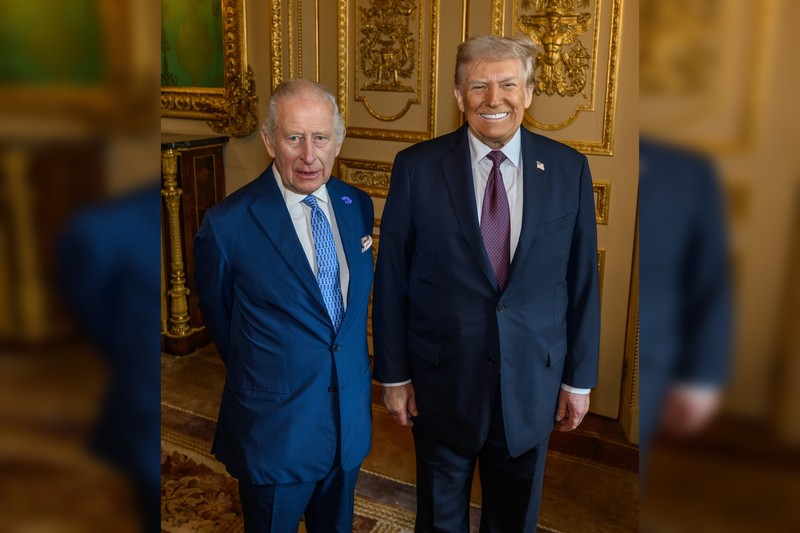
All of this unfolds days before King Charles and Queen Camilla arrive in Washington for a state visit that royal sources describe as “high risk, high stakes and high opportunity.” On Tuesday, the King will address both houses of Congress — the first British monarch to do so since Queen Elizabeth II in 1991 — before attending a state dinner at the White House.
The visit was planned long before the current crisis. Royal historian Ed Owens describes the timing as one of “very unusual” political tensions, set against the backdrop of the Iran conflict and a fragile ceasefire.
Trump has been consistent in his admiration for the monarchy. “He’s a brave man, and he’s a great man,” the president told the BBC last week. Royal sources hope that personal regard can be leveraged into diplomatic breathing room.
Whether it will be enough is another matter. “The Trump show doesn’t get turned off because the King is in town,” cautioned Max Bergmann, a former senior State Department adviser.
The contrast with 1982 is difficult to ignore. When Argentina invaded the Falklands that year, Ronald Reagan wrote privately to Margaret Thatcher: “We will do what we can to assist you. Sincerely, Ron.” America provided satellite intelligence and Stinger missiles to support the British campaign.
Four decades on, Trump is floating a review of the outcome — not because facts changed, but because an ally sat out a different war. As Weston put it: “That’s not how grown-ups behave.”
Discussion (10)