 lop News
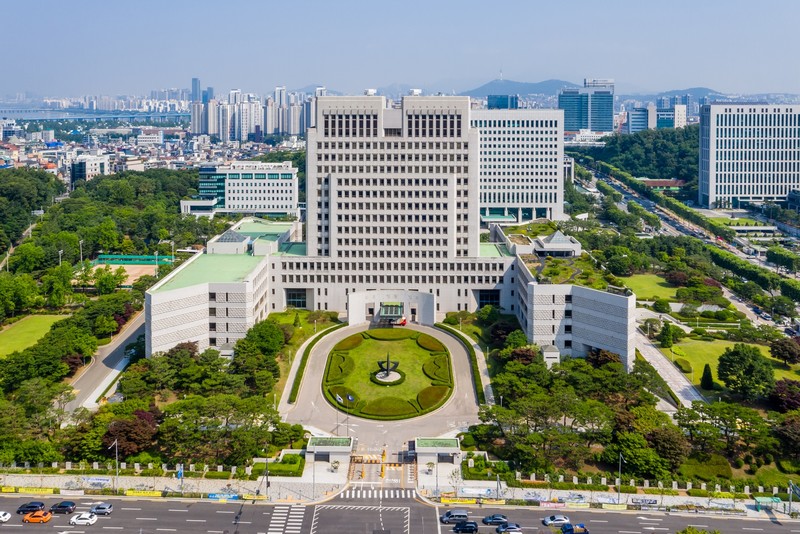
Eight days after overturning a not-guilty verdict and sending South Korea’s former first lady to prison for four years, Judge Shin Jong-oh was found dead in a flower bed outside his own courthouse.
The 55-year-old presiding judge of the Seoul High Court’s Criminal Division was discovered at approximately 1 a.m. on Wednesday by police who had been dispatched following a report from his family, according to the Seocho Police Precinct. He was pronounced dead at a nearby hospital.
Police said there were no signs of foul play and are investigating on the assumption that Shin fell from an upper floor of the court building in Seocho district, southern Seoul. The picture around a suicide note is less clear: the South China Morning Post, citing a Seocho police officer, reported that a note was found in Shin’s pocket containing the phrases “I am sorry” and “I am leaving of my own accord” and making no mention of the case or his judicial duties. But an investigator who spoke to AFP said no note was recovered at all. The contradiction between police sources remains unresolved.
A Verdict That Reshaped the Case
Shin presided over the appellate trial of Kim Keon-hee, wife of former President Yoon Suk Yeol, who faced charges spanning stock manipulation, bribery, and violations of political funding laws. The case had been assigned to Shin’s panel on February 6.
On April 28, the three-judge panel overturned a lower court ruling that had acquitted Kim of manipulating the stock price of Deutsch Motors. The appellate court found that Kim had entrusted 2 billion won to an entity called Black Pearl Invest between October and November 2010, facilitating the sale of 180,000 shares — conduct the judges deemed participation in a market manipulation scheme.
The court also found Kim guilty on all counts related to luxury gifts from the Unification Church — two Chanel bags, a Graff diamond necklace valued at 62.2 million won, and ginseng extract tea — handed to her by a church official requesting favors between April and July 2022. The lower court had convicted her on only some of these charges.
The new sentence: four years in prison, a 50 million won ($34,300) fine, confiscation of the necklace, and an additional forfeiture of 20.94 million won. It more than doubled the original sentence of one year and eight months. It fell well short of the 15-year term sought by Special Prosecutor Min Joong-ki’s team, which has since appealed to the Supreme Court. Kim, jailed since August, has also appealed.
Shin told the court that Kim had “failed to acknowledge her culpability and has instead consistently resorted to excuses,” according to reports of the sentencing.
An Institution Under Strain
Shin’s death has left the judiciary in shock, the Korea JoongAng Daily reported, with some colleagues suggesting the heavy workload of handling such high-profile trials may have compounded his stress. The observation, likely meant sympathetically, points to a wider reality: judges tasked with adjudicating politically explosive cases in South Korea operate under enormous and unrelenting pressure.
The political backdrop only sharpens that pressure. Kim’s conviction is part of a sprawling accountability process linked to her husband’s collapsed presidency. Special counsel investigations, detention, and appellate reversals have become familiar features of South Korean political life, and public trust in institutions has been tested repeatedly.
Shin’s family has requested privacy. Police continue to investigate the exact cause and time of death.
The Timeline Nobody Can Explain Away
The known facts point toward suicide. A judge found with severe injuries consistent with a fall, discovered in the early hours by officers alerted by his own family. A note — or no note, depending on which police source speaks — that reportedly says nothing about the case dominating his professional life.
But the gap is eight days. Between one of the most consequential corruption rulings in recent South Korean history and the death of the man who delivered it. In a country where institutional credibility has been worn thin by successive crises, whatever conclusion police reach will have to clear a bar that gets higher every time.
Whether the public trusts that conclusion may matter as much as the conclusion itself.
Sources
- South Korean judge who handed Kim Keon-hee 4-year term found dead days after verdict — South China Morning Post
- Presiding judge in ex-first lady Kim Keon Hee’s stock manipulation case found dead — Korea JoongAng Daily
- Judge Who Convicted Kim Keon-hee in Deutsch Motors Appeal Found Dead — Seoul Economic Daily
- Judge who doubled ex-South Korean first lady’s jail sentence found dead, police say no sign of foul play — Malay Mail (AFP)
- Special counsel appeals ex-first lady’s 4-year corruption sentence to Supreme Court — The Korea Times (Yonhap)
Discussion (9)