 lop News
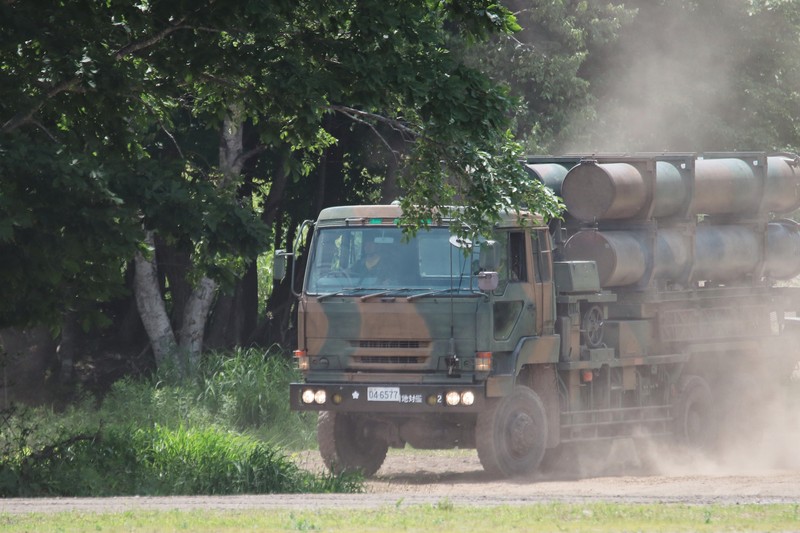
On Philippine soil, a Japanese military unit launched an offensive missile this week — the first time Tokyo has fired what Beijing describes as an “offensive” weapon abroad since World War II ended 81 years ago.
The missile was tested overseas for the first time in eight decades, according to the South China Morning Post. Japanese forces participated in the drill, and Wednesday’s launch represented a crossing of the sort of threshold that Japan’s post-war constitution was designed to prevent.
China’s response was swift and unequivocal. Foreign ministry spokesman Lin Jian called the test evidence of Japan’s “neo-militarism” — a term Beijing described as a “scourge” threatening regional peace and stability.
“The former aggressor has not only failed to deeply reflect on its historical crimes but has instead dispatched military forces overseas and launched offensive missiles under the guise of so-called ‘security cooperation,’” Lin said, according to the South China Morning Post.
Lin pointed to Japan’s wartime history of aggression against Southeast Asian nations, including the Philippines, and said the test marked a significant departure from Japan’s post-war pacifist stance.
A missile that carries more than munitions
The missile is a dual-capability weapon — it can serve both defensive and offensive roles. But deploying it on foreign territory is what carries the weight of history. Japan’s constitution, particularly Article 9, has long been interpreted as restricting the nation’s military to a purely defensive posture. For a Japanese unit to fire a missile capable of striking ships from Philippine soil is, by any reading, a departure from that tradition.
This did not happen overnight. Japan’s pacifist constraints have eroded steadily for more than a decade. In 2014, Prime Minister Shinzo Abe’s government reinterpreted Article 9 to permit collective self-defense — the right to come to an ally’s defense if attacked. By 2022, Japan’s updated National Security Strategy explicitly authorized counterstrike capability, a concept that would have been politically unthinkable a generation earlier. The missile test in the Philippines is the latest, and perhaps most symbolically potent, step in that trajectory.
The architecture of encirclement
The test did not occur in isolation. Balikatan — the Tagalog word for “shoulder-to-shoulder” — has grown substantially in scale and ambition in recent years, evolving from a bilateral US-Philippines exercise into a platform for broader coalition operations. Japan’s participation, and its decision to fire live offensive weaponry during the drill, signals Tokyo’s willingness to project military power into the South China Sea, where China’s sweeping territorial claims have put it at odds with Manila, Hanoi, and several other Southeast Asian governments.
From Beijing’s perspective, the picture is unambiguous: the United States is constructing a web of military partnerships designed to contain China, and Japan — which operates the region’s most capable navy after China’s own — is a central pillar of that architecture. The missile was fired from Philippine soil, a country China has repeatedly clashed with over disputed reefs and waterways, which only sharpens the provocation.
A point of no return?
The deeper question is whether Japan’s remilitarization has become irreversible. Each incremental step — the reinterpretation of Article 9, the acquisition of counterstrike weapons, the deployment of forces abroad — has normalized the next. The political costs of reversing course grow with each threshold crossed, and the missile test in the Philippines is a threshold of considerable weight.
China’s framing of the test as “neo-militarism” serves its own strategic narrative, of course — one that casts Tokyo as the aggressor and Beijing as the guarantor of regional stability. But the underlying shift is real. Japan is building the capacity and demonstrating the willingness to project military force well beyond its own territory, and it is doing so within a US-led coalition that explicitly identifies China as its primary strategic concern.
Eighty-one years after Japan’s wartime surrender, its military footprint is expanding outward once again. The weapons are different, the government is democratic, and the coalition is Western-led. But for Beijing, the historical echo is unmistakable — and that, more than the missile itself, is what makes this moment consequential.
Sources
- China condemns Japan’s first overseas ‘offensive missile’ test since WWII — South China Morning Post
Discussion (10)