 lop News
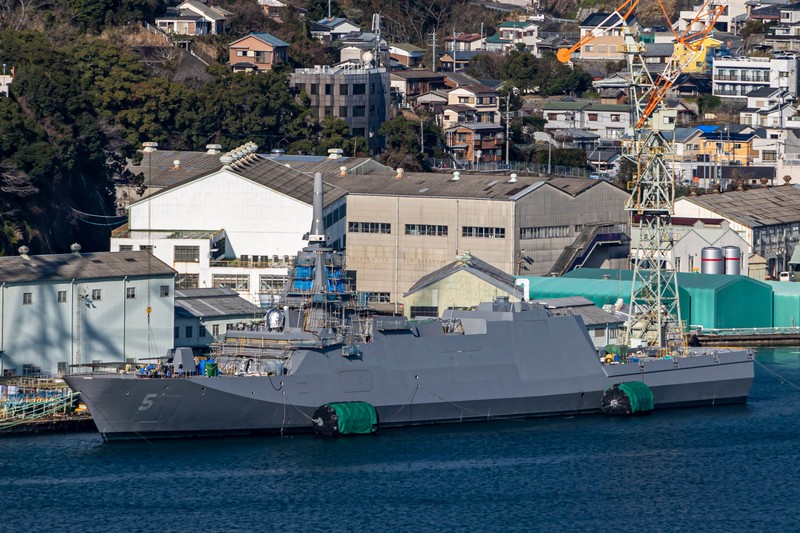
Japan’s postwar constitution still renounces the right to wage war. On Saturday, Tokyo signed a contract to build warships for another country’s navy.
The contract — signed in Canberra and announced Saturday — commissions Mitsubishi Heavy Industries to construct the first three of Australia’s new general-purpose frigates, based on Japan’s Mogami-class design. The initial deal covers the first three frigates under the broader program. The full program, reported by Nikkei Asia at 20 billion Australian dollars ($14.3 billion), promises to deepen defense industry ties between the two countries.
Nikkei Asia described the agreement as a project that promises to deepen defense industry ties, marking a historic milestone for Japanese defense manufacturing. For anyone tracking the trajectory of Japanese security policy, that is not hyperbole.
From Self-Defense to Arms Export
As recently as a decade ago, this kind of deal would have been constitutionally impossible. Japan’s postwar arms export ban — a self-imposed restriction grounded in the pacifist principles of its American-drafted constitution — barred the country from selling weapons systems abroad.
Tokyo has spent years methodically dismantling those restrictions. Revised export guidelines, expanding first to permit non-lethal equipment and components, then to allow completed weapons systems to be sold to partner nations, opened the door to exactly this kind of agreement. The Mogami deal is the policy made flesh: a Japanese shipyard building front-line warships for a foreign military.
For Japan’s defense industry, a domestic market limited to the Self-Defense Forces constrained both scale and innovation. An export revenue stream changes the economics entirely. The Mitsubishi Heavy Industries contract with Australia validates years of government investment in reviving a sector that had atrophied under self-imposed isolation.
What Canberra Gets
Australia’s decision to go with the Japanese bid reflects a calculation about more than ship specifications. The general-purpose frigate program drew interest from European and American shipbuilders, according to Nikkei Asia, but the Mogami-based proposal offered a combination of capability and delivery timeline that competitors struggled to match.
There is a strategic dimension, too. Diversifying defense procurement away from sole reliance on US and European suppliers reduces supply-chain risk at a moment when Washington’s long-term commitment to the Indo-Pacific is an open question. The AUKUS submarine program — the marquee defense cooperation agreement between Australia, the UK, and the US — has faced repeated delays and cost concerns. Canberra is clearly interested in partnership arrangements that produce hardware on schedule.
The Pacific Security Order, Rewired
The signing fits a broader pattern. US allies in the Indo-Pacific have been tightening bilateral security ties with each other, not always with Washington at the center of the arrangement. Australia and Japan have deepened military cooperation significantly in recent years, conducting more frequent joint exercises and coordinating more closely on intelligence.
This parallel network of alliances reflects a shared anxiety: that the United States, consumed by domestic political turbulence and conflicts in Europe and the Middle East, may not be the reliable security guarantor it was for the past half-century. Regional powers are hedging accordingly — not by abandoning the American alliance, but by building redundancy into it.
Japan, confronting its own pressures from China’s naval expansion and North Korea’s missile programs, has every incentive to cultivate reciprocal relationships with other maritime nations in the region. Selling warships to Australia is both a revenue stream and a commitment mechanism — Canberra becomes a stakeholder in Japan’s industrial capacity, and Tokyo becomes invested in Australia’s naval capability.
What Comes Next
The initial contract covers three frigates. If the full planned fleet is built beyond the initial three, the program would sustain a bilateral industrial partnership lasting well over a decade.
Both governments framed Saturday’s signing as a cornerstone of deeper strategic cooperation. The announced emphasis on interoperability — vessels designed to common specifications, capable of operating together in joint missions — signals that this is not merely a commercial transaction.
The larger question is whether the Mogami deal becomes a template. Japan’s defense industry now has its first major export contract. South Korea has demonstrated that there is significant global demand for Asian defense manufacturing, selling submarines, tanks, and aircraft across Europe, the Middle East, and Southeast Asia. Tokyo appears ready to compete for the same market.
The Pacific security architecture is being rebuilt, one weapons sale at a time.
Discussion (9)