 lop News
Seven people are dead in Gaza City — three of them women, one a child. The intended target, Izz al-Din al-Haddad, commander of Hamas’ Qassam Brigades, may or may not be among them.
Israeli Prime Minister Benjamin Netanyahu and Defense Minister Israel Katz announced in a joint statement Friday evening that the military had struck al-Haddad, whom they called “one of the architects” of the October 7, 2023 attack. A senior Israeli security official told reporters that preliminary information indicated the targeting was successful. The IDF has issued no official confirmation.
Hamas has neither confirmed nor denied the claim.
A residential building, then a fleeing car
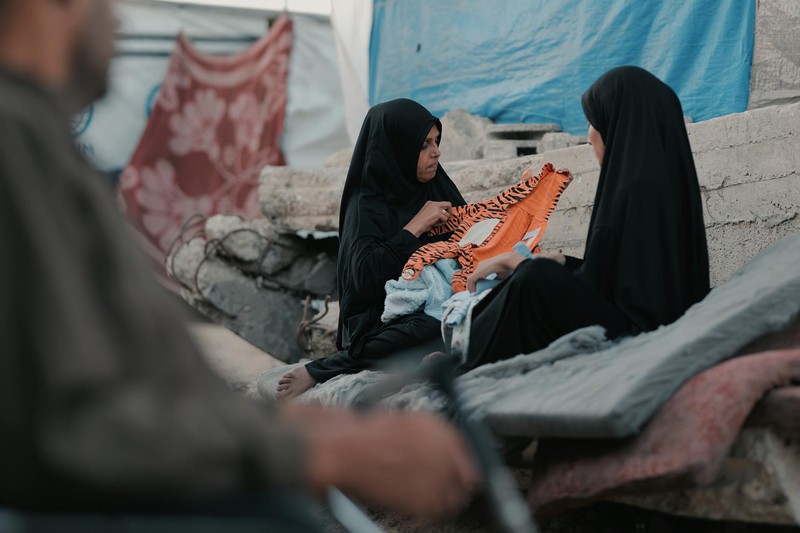
Three eyewitnesses told the BBC that a residential building known as Al-Mu’taz was struck by three missiles launched simultaneously from two directions. The building was located in Gaza City’s Rimal neighborhood, according to Al Jazeera. The area is overcrowded with displaced families who moved west seeking refuge from Israeli military operations, according to Al Jazeera’s Gaza correspondent Ibrahim Al Khalili. Hundreds of people were living inside the building, Gaza civil defense spokesman Mahmoud Basel said.
“The missile was fired without any pre-warning or notification,” Basel told Reuters. “We are talking about a number of [dead]. We are talking about a big number of wounded, among them families.”
The strike ignited a large fire and triggered panic as residents fled. Medical sources said at least 45 people were wounded, several critically, with casualties taken to the Palestine Red Crescent Society’s Saraya Field Hospital and Shifa Hospital.
What happened next speaks to both the operation’s design and its uncertainty. Witnesses and a local source said armed members of Hamas dressed in civilian clothing evacuated a severely wounded person through a side entrance of the building and placed him in a vehicle. Roughly 1.5 kilometers away, the car was struck. Three more people were killed.
That wounded person may have been al-Haddad. No body has been identified as his.
Years of intelligence, a planned kill
According to the Jerusalem Post, the strike was the product of years of surveillance by the IDF’s Southern Command and Military Intelligence Directorate. Government approval came roughly 10 days before the attack. Before the strike, the Israeli Air Force conducted what military sources described as a deception operation — approved by Brig.-Gen. Omer Tischler — designed to mask unusual activity in the Negev and Gazan airspace, keeping al-Haddad’s inner circle on low alert.
Al-Haddad has been part of Hamas’ armed wing since its founding in 1987 and is described by Israeli sources as the highest-ranking military commander remaining in Gaza. Israeli officials said he was personally involved in holding hostages — including Liri Albag and Emily Damari, both former captives of al-Haddad — and that he surrounded himself with captives to deter Israeli strikes. Both women publicly celebrated the strike on social media.
Israel has pursued a decapitation strategy throughout the war, targeting successive layers of Hamas’ military and political leadership. Al-Haddad was, by Israel’s own account, the last commander of the October 7 attacks still inside Gaza — the others having been killed in earlier operations. The pattern is consistent: a strike is announced, the target’s death is eventually confirmed, and the conflict grinds on. Hamas has replaced killed leaders, rebuilt its police force, and continues to operate across the territory — a measure of organizational resilience that years of targeted killings have not broken.
A ceasefire in name only
The strike fell on the 78th anniversary of the Nakba, the displacement of roughly 750,000 Palestinians during the 1948 war. It also fell during what is nominally a ceasefire.
The Gaza truce took effect on October 10, 2025. Since then, more than 850 Palestinians have been killed in Israeli operations, according to the Gaza Health Ministry, which is staffed by medical professionals and viewed as generally reliable by the international community. The total death toll since the war began now exceeds 72,700.
Israel maintains it has the right to target Hamas members who refuse to disarm. Hamas accuses Israel of bombing civilians and breaching the truce’s terms. Both complaints have some basis in fact. Neither resolves the deadlock.
US-led peace efforts have stalled since the start of the Iran war, according to BBC reporting. A second phase of the Trump administration’s plan, announced in January, envisioned a transitional technocratic administration governing Gaza alongside demilitarization and reconstruction. Disarmament talks remain deadlocked. Hamas has reactivated its police force and is reasserting authority on the ground.
Netanyahu and Katz said al-Haddad “refused to implement the agreement led by US President Trump to disarm Hamas and demilitarise the Gaza Strip.” Their statement ended with a warning: “Sooner or later, Israel will reach you.”
The families living in the Al-Mu’taz building were not addressed.
Discussion (10)