 lop News
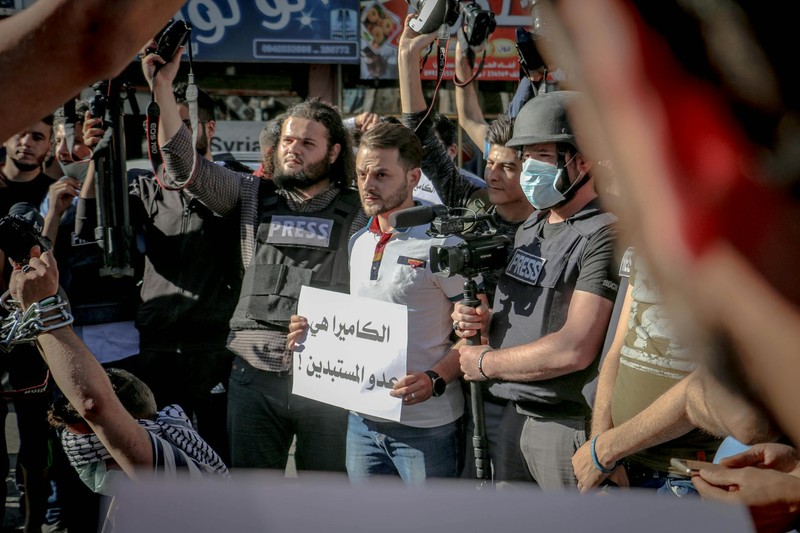
Four precision missiles struck a clearly marked press vehicle on the Jezzine Road in southern Lebanon just before noon on Saturday. Ali Shoeib, Fatima Ftouni, and her brother Mohammed Ftouni — three journalists doing their jobs — did not survive.
The Israeli military acknowledged the strike within hours, but its statement addressed only one of the dead. Shoeib, a correspondent for Hezbollah-affiliated Al-Manar TV who had covered southern Lebanon for nearly three decades, was a “terrorist,” the Israel Defense Forces said — a member of Hezbollah’s elite Radwan Force who had exploited his press credentials to track Israeli troop positions and distribute propaganda. The military offered no evidence. It did not mention Fatima or Mohammed Ftouni at all.
Fatima Ftouni had just finished a live broadcast for Beirut-based Al-Mayadeen when the missiles hit. Her brother worked alongside her as a video journalist. For Ftouni, the war had already been personal: earlier in March, an Israeli strike killed her uncle and his family — a loss she had reported on live television.
A Pattern Without Proof
The Committee to Protect Journalists has documented what it describes as a “disturbing pattern” of Israel accusing journalists of being active combatants “without providing credible evidence.” Saturday’s strike fits the template with unusual precision: a claim of militant affiliation, no substantiation released, and no acknowledgment of the other journalists killed alongside the accused.
Hezbollah denied that Shoeib held any intelligence role, calling Israel’s claims “an expression of its weakness and fragility, and a desperate attempt to evade responsibility for this crime.” Al-Manar described its correspondent as “distinguished by his professional and credible reporting”; Al-Mayadeen called Ftouni’s work “brave and objective.” Neither network accepted the Israeli characterization of Shoeib.
Lebanese President Joseph Aoun called the strike “a brazen crime that violates all treaties and norms through which journalists enjoy international protection in war.” Prime Minister Nawaf Salam described it as “a flagrant violation of international humanitarian law.”
A Body Count Without Precedent
The scale is difficult to grasp. According to Al Jazeera, Israel has killed more than 270 journalists in Gaza. The CPJ recorded 129 journalists killed globally in 2025 — the highest total in its three decades of data collection — with Israel responsible for roughly two-thirds of those deaths. Israel has now killed more journalists than any other nation in the organization’s recorded history, according to CPJ data cited by Al Jazeera.
In Lebanon alone, five journalists and media workers have been killed in 2026. Saturday’s deaths followed the killing of Al-Manar’s Mohammad Sherri and his wife in a Beirut strike on March 18, and freelance photojournalist Hussain Hamood in Nabatiyeh on Wednesday. An October 2024 strike on a guesthouse complex in Hasbaya that housed only reporters killed three more. An earlier October 2023 tank strike killed Reuters journalist Issam Abdallah and wounded six others, including journalists from AFP — an attack corroborated by independent investigations from Reuters, Amnesty International, Human Rights Watch, and Reporters Without Borders.
Saturday was catastrophic for Lebanon’s medical workers as well. The World Health Organization confirmed that nine paramedics were killed in five separate attacks across the south. WHO Director-General Tedros Adhanom Ghebreyesus said health workers are protected under international humanitarian law and “should never be targeted.” More than 50 medical workers have been killed in Lebanon, according to the country’s health ministry, which described an “escalating pace” of attacks on healthcare infrastructure. Four hospitals and 51 primary healthcare centres in southern Lebanon have shut down.
What the World Stops Seeing
The information pipeline from conflict zones has always been fragile. It depends on people willing to drive toward artillery barrages with a camera rather than away from them. When those people are killed — and when the killings are defended after the fact with unverified accusations — that pipeline narrows to whoever is willing to shoot first and explain later.
Since Lebanon was pulled into the regional conflict on March 2, more than 1,142 people have been killed in the country, according to the health ministry. Israeli troops are advancing toward the Litani River, and Al Jazeera’s correspondent in Tyre described the entire area south of the river as a “no-go zone” during what he called an “intense day of bombardment and air strikes.” Roughly 20 percent of southern Lebanon’s population has remained despite Israeli displacement orders — a decision, the correspondent noted, that is “turning into a very deadly gamble.”
The journalists who remain say they will keep reporting. “All the journalists that I’m speaking to here today say that they were just doing their job, and that the journalists that are still here are going to continue to carry out their work despite the obvious dangers,” Al Jazeera’s Obaida Hitto reported from Tyre.
That persistence is either courageous or reckless. What is not in dispute is that the world’s understanding of what is happening across southern Lebanon depends entirely on people like Shoeib, the Ftounis, and whoever is willing to fill the gaps they left behind.
Sources
- Three journalists killed in Israeli strike on marked press car in Lebanon — Al Jazeera
- Israeli airstrike in southern Lebanon kills 3 journalists covering the war — Channel News Asia
- Israeli airstrike kills three Lebanese journalists, Israel says it targeted one — Reuters
- Three Lebanese journalists killed in Israeli strike, say broadcasters — BBC
Discussion (10)