 lop News
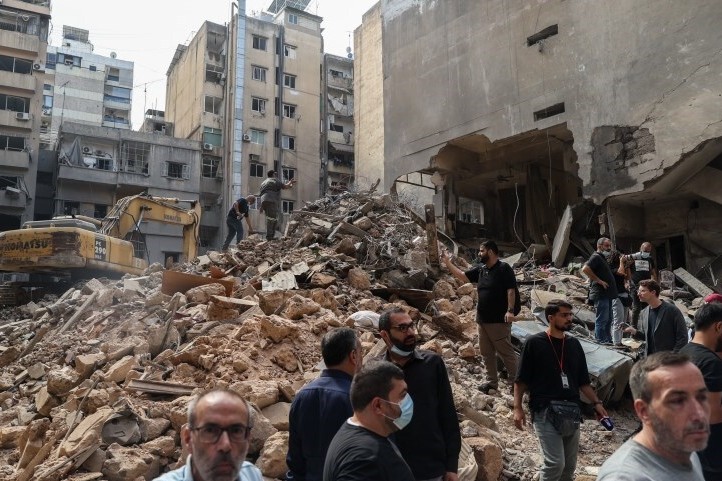
A ceasefire meant to hold until mid-May lasted roughly 48 hours. On Saturday, Israeli Prime Minister Benjamin Netanyahu ordered his military to “forcefully attack Hezbollah targets” in Lebanon, triggering strikes across at least four locations in the country’s south that killed six people and sent thousands fleeing for the second time in weeks.
The collapse came just two days after US President Donald Trump announced a three-week extension of the truce, brokered by Washington, which had been in effect since April 16. By Saturday night, Lebanese state media reported fresh strikes across the districts of Bint Jbeil, Tyre, and Nabatieh — the same contested terrain where Israel has maintained a self-declared buffer zone stretching roughly 10 kilometers north of the border.
The Toll on the Ground
Lebanon’s Health Ministry said Israeli strikes on a truck and a motorbike in the town of Yohmor al-Shaqeef, in the Nabatieh district, killed four people. Another attack on Safad al-Battikh, in the Bint Jbeil district, killed two and wounded 17 more.
The Israeli military said it had “eliminated” three Hezbollah operatives driving “a vehicle loaded with weapons,” another riding a motorcycle, and two additional armed members in the Litani area who “posed a threat to the IDF soldiers operating in southern Lebanon.” It later said it identified two projectiles launched from Lebanon and intercepted a “suspicious aerial target,” calling it “a blatant violation of the ceasefire understandings.”
An Israeli soldier, 19-year-old Sergeant Idan Fooks, was killed during combat in southern Lebanon, the Israeli army said. Five others were injured.
Evacuation Orders and Flight
Israel’s military issued forced evacuation orders for seven towns beyond its buffer zone — north of the Litani River, in territory where Israeli troops have continued operations throughout the ceasefire. A military spokesperson told residents to head north and west.
The result was immediate. Al Jazeera’s correspondent in Tyre, Heidi Pett, reported thousands fleeing toward the cities of Sidon and Tyre, “joining the hundreds of thousands who were already previously displaced.” Residents of Beirut’s southern suburbs — a Hezbollah stronghold repeatedly bombed during the war — also fled after Netanyahu’s statement, according to an AFP correspondent.
A Ceasefire in Name
Both sides have traded fire throughout the truce, each accusing the other of violations. Hezbollah said its attacks are a “legitimate response to the enemy’s persistent violations of the ceasefire,” claiming Israeli breaches have exceeded 500 incidents. The group said it should not be bound by a ceasefire it did not approve, and would not rely on what it called a “failed diplomacy that has proven its ineffectiveness.”
Netanyahu, speaking at a weekly cabinet meeting, said “Hezbollah’s violations are, in practice, dismantling the ceasefire.” He framed Israel’s response as a matter of national security: “What obliges us is the security of Israel, the security of our soldiers, the security of our communities.”
Under the terms of the truce, Israel reserves the right to respond to “planned, imminent or ongoing attacks” — language that has effectively licensed daily strikes on what Israel calls Hezbollah targets. Hezbollah lawmaker Ali Fayad said on Friday that extending the ceasefire “makes no sense” given continued “hostile acts.”
A Pattern of Fragility
The rapid unraveling follows a familiar rhythm. The ceasefire reduced hostilities without halting them. Each side treated the agreement as a constraint on the other while preserving its own freedom to act. Israel’s buffer zone, its systematic demolition of buildings in towns like Khiam — where Lebanon’s National News Agency reported a “violent explosion” on Saturday — and the daily strikes have made the truce’s provisions effectively optional.
Since the war was renewed on March 2, when Hezbollah fired rockets at Israel to avenge the death of Iran’s supreme leader Ali Khamenei in US-Israeli strikes, at least 2,500 people have been killed in Lebanon, according to the Health Ministry. More than 100 medical workers are among the dead. On Wednesday, before the extension was announced, Israeli strikes hit three successive ambulance crews near the village of Mayfadoun, killing four paramedics — an attack the UN human rights office said could constitute a war crime. Israel said that incident is under review.
Each collapse of a ceasefire makes the next one harder to sustain. Hezbollah has now explicitly rejected the diplomatic framework. Israel has demonstrated, again, that it will escalate whenever it perceives a threat. The civilians caught between them — the displaced, the volunteer medics, the families loading possessions into cars for the fourth or fifth time — are running out of places to go.
Sources
- Israel issues forced evacuation orders for southern Lebanon in escalation — Al Jazeera
- Israeli strikes kill six in south Lebanon despite extended ceasefire, fresh raids reported — Le Monde
- Netanyahu orders army to ‘vigorously attack’ Hezbollah in Lebanon — BBC
- Eyewitnesses recount three deadly Israeli strikes on medics in southern Lebanon — Associated Press
Discussion (10)