 lop News
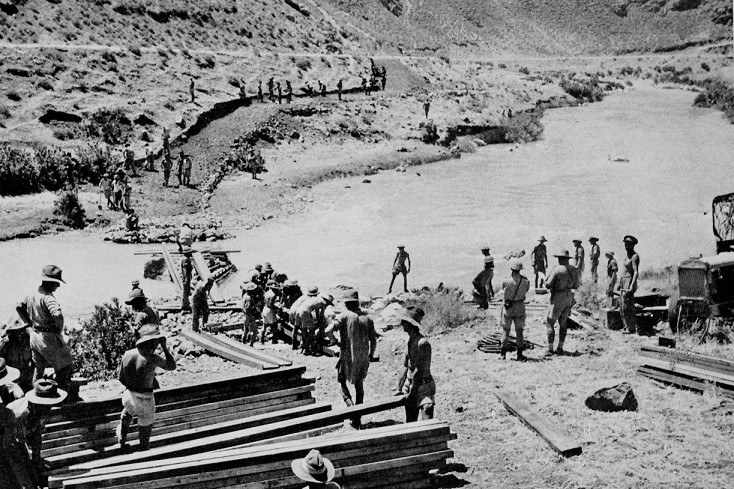
Israeli soldiers crossed the Litani River on Thursday, pushed back, then crossed again on Friday — pushing into territory that for months served as an informal northern boundary for Israel’s military campaign in Lebanon. Nearly ten thousand kilometers away, at the Pentagon, Israeli and Lebanese defense officials sat across a table from one another to discuss peace.
Both things happened on the same day.
Prime Minister Benjamin Netanyahu announced the Litani crossing personally, during a visit to Israel’s northern command. “Our forces have crossed the Litani and advanced to controlling positions,” he told military personnel, according to excerpts released by his office. “We are operating in Beirut, in the Bekaa Valley, across the entire width of the front, and are dealing Hezbollah a crushing blow.”
Lebanese security sources offered a more qualified account. They told media that Israeli troops crossed near the village of Zawtar al-Sharqiyah on Thursday, retreated to the southern bank, then crossed again on Friday at an eastern point close to the Israeli border. They described the operation as a limited incursion, not a major advance.
The gap between Netanyahu’s rhetoric and the reported scale of the operation is part of the story. But so is the timing.
The Pentagon Track
Friday’s meeting at the Pentagon marked the first direct military-to-military talks between Israel and Lebanon since the start of the negotiation process, according to Ahmed Sharawi, a research analyst at the Foundation for Defense of Democracies. The discussions are part of a US-brokered framework aimed at reinforcing an April 16 ceasefire that has never fully held.
The agenda is ambitious: ceasefire enforcement, Israeli withdrawal from southern Lebanon, border demarcation, prisoner releases, reconstruction, and — most contentious of all — the disarmament of Hezbollah.
A State Department official told Fox News Digital that “the only path to lasting peace is through direct negotiations between the two sovereign governments.” The diplomatic language is straightforward. The military reality is anything but.
The ceasefire was extended on May 15 for another 45 days, creating pressure on both sides to demonstrate progress before the current arrangement expires. A second round of political talks is scheduled for June 2 and 3 in Washington.
The Disarmament Problem
The central question hovering over the Pentagon discussions is whether Lebanon can actually disarm Hezbollah without triggering a civil war.
The November 2024 ceasefire agreement placed responsibility for disarming the group on the Lebanese state. Sharawi was blunt about the results: “We are yet to see the confiscation of one single bullet from Hezbollah.”
Lebanese officials are preparing what sources described to The New Arab as a “detailed report” for the talks, outlining steps already taken, demands, and future plans for bringing all weapons under state control. The Lebanese army is coordinating the preparations through President Joseph Aoun and the army command. But the gap between a report and a raid is vast.
Washington and Tel Aviv have reportedly proposed creating a new Lebanese army brigade, trained and funded by the US, specifically tasked with disarmament operations. The unit would be authorized to raid homes and facilities suspected of containing weapons, according to Lebanese media reports. Officers would be vetted to exclude anyone with Hezbollah ties.
Geopolitical analyst Joe Macaron told The New Arab that separating the security track from the political track was “further evidence” that negotiations were being managed in a way that tilted the balance in Israel’s favour.
Yossi Kuperwasser, a former head of Israeli military intelligence research now at the Jerusalem Institute for Strategy and Security, described the talks as a signal more than a breakthrough. “The purpose of these talks is first and foremost to send a message to Hezbollah and also to the Americans,” he told Fox News Digital. “Both sides are prepared to sit together against Hezbollah and signal that they are moving, even if slowly, toward normalization between Israel and Lebanon.”
Hezbollah has not been quiet. MP Hussein Hajj Hassan warned this week against “a security track being prepared at the Pentagon between Lebanon and the Israeli enemy under American sponsorship,” calling it a danger that extended “to all of Lebanon.” Hezbollah-linked parliamentary sources told The New Arab the group would continue responding to Israeli attacks and insisted it “will not return to before 2 March” — the date the current escalation began.
“Whoever believes they can give the Americans what they want, and behind them the Israelis, is delusional and has not read history or understood the present,” Hajj Hassan said.
Two Tracks, One Strategy?
The simultaneous military escalation and diplomatic outreach have raised a basic question about Netanyahu’s intentions: is he pursuing peace, or using the talks as cover for an expanded campaign?
Far-right members of his coalition are not being subtle about what they want. Finance Minister Bezalel Smotrich called for ten buildings in Beirut to be destroyed for every Hezbollah drone strike. National Security Minister Itamar Ben Gvir demanded Israel “take control” of the Zahrani River — roughly 10 kilometers north of the Litani.
On Thursday, Israel expanded evacuation orders to cover the area south of the Zahrani, effectively designating a new swath of Lebanese territory as a combat zone. The Litani was already the boundary of the area Israel had ordered cleared. Pushing the line north signals either a negotiating position or an expansion plan — and possibly both.
Netanyahu has been consistent in his public messaging: Israel will keep hitting Hezbollah regardless of what happens in Washington. “I have ordered an even greater acceleration of our operations,” he said in a video statement earlier this week. Israeli military chief Eyal Zamir echoed the line on Friday, telling troops that the military would continue pursuing Hezbollah “launch squads” and their operators and commanders “at every level.”
Critics inside Israel have accused the government of pursuing containment rather than decisive military victory against Hezbollah — a charge that may explain Netanyahu’s eagerness to announce the Litani crossing publicly.
The Wider War
The Lebanon front did not emerge in isolation. It is the deadliest spillover of the broader US-Iran conflict that began on February 28, when Israel and the United States launched military operations against Iran, including the assassination of Iranian Supreme Leader Ali Khamenei. Hezbollah, Iran’s most powerful regional ally, resumed rocket strikes on Israel in response.
Since March 2, Israeli strikes have killed more than 3,200 people in Lebanon, according to the Lebanese health ministry, and displaced over 1.2 million — roughly a fifth of the country’s population. Israel has lost 23 soldiers and four civilians in the same period.
Iran has called for an end to Israeli attacks in Lebanon as a condition for a wider ceasefire. That framework remains stalled. According to AFP, the US and Iran are still seeking to finalize terms of an agreement that could include the Lebanon front — but the gap between the two sides has proven durable.
So the fighting in Lebanon operates under its own logic: a ceasefire that doesn’t stop the shooting, peace talks that coincide with military advances, and a disarmament plan that no one has yet found a way to implement.
Lebanese President Joseph Aoun has called a full Israeli withdrawal from southern Lebanon “non-negotiable.” Netanyahu has shown no sign of agreeing.
The 45-day ceasefire extension runs out in late June. The Litani crossing suggests Israel is building leverage — or at least territory — before that clock stops.
Sources
- Israeli forces cross Litani River in expanded ground offensive — The New Arab (Reuters)
- Pentagon hosts first-ever Israeli-Lebanese military talks aimed at curbing Hezbollah — Fox News via MSN
- Lebanon prepares for Pentagon talks as fears grow over army-Hezbollah confrontation — The New Arab
- Israel steps up Lebanon strikes as Netanyahu escalates offensive — RFI (AFP)
- 2026 Lebanon war — Wikipedia
Discussion (12)