 lop News
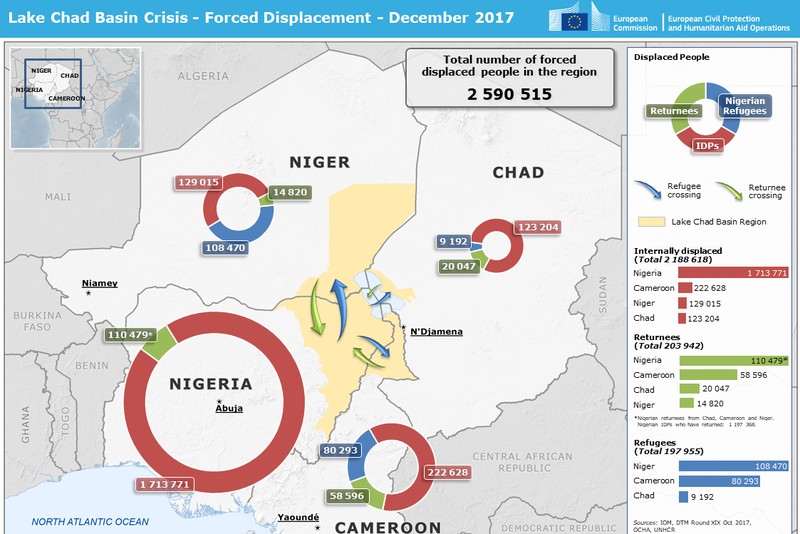
Abu-Bilal al-Minuki chose his hideout well. The Lake Chad Basin — a vast maze of waterways and swampland spanning four countries — has sheltered extremist groups for more than a decade. Terrain that punishes outsiders made it an ideal command post for a man running global operations for Islamic State.
Shortly after midnight on Saturday, a joint US-Nigerian raid ended his run.
American and Nigerian forces struck al-Minuki’s compound in Metele, Borno state, killing the man President Donald Trump described as “second in command of ISIS globally” and “the most active terrorist in the world.” Several of his lieutenants were also killed, according to Nigerian President Bola Tinubu. Nigerian forces reported zero casualties.
Trump announced the operation on Truth Social on Friday, calling it a “meticulously planned and very complex mission.” “He will no longer terrorize the people of Africa, or help plan operations to target Americans,” Trump wrote.
A Local Commander With Global Reach
Al-Minuki was a product of the territory he operated in. Born in 1982 in Borno state — the northeastern Nigerian region at the epicentre of insurgent violence since Boko Haram launched its campaign in 2009 — his nom de guerre likely derives from Mainok, a town in the state.
A senior Boko Haram commander before pledging allegiance to Islamic State in 2015, he rose through the ranks of its West Africa Province (ISWAP) after the killing of ISWAP chief Mamman Nur in 2018. The Biden administration designated him a Specially Designated Global Terrorist in 2023, describing him as a Sahel-based senior leader within IS’s General Directorate of Provinces — the administrative body providing “operational guidance and funding around the world,” according to the US State Department.
Nigerian military intelligence assessed that al-Minuki had recently been promoted to head the directorate, placing him among the most senior figures in Islamic State’s global hierarchy. That claim has not been independently verified. He was also linked to the 2018 Dapchi schoolgirls kidnapping, when more than 100 girls were seized from a boarding school in northeastern Nigeria.
The Centre of Gravity Shifts South
That a figure described as Islamic State’s global second-in-command was operating from northeastern Nigeria — rather than Iraq or Syria — is itself a marker of how far the group’s centre of gravity has drifted. Islamic State’s territorial caliphate was destroyed in 2017. Since then, sub-Saharan Africa has become the primary theatre for its operations. Roughly 90 percent of IS attacks now take place in the region, according to the BBC, with ISWAP by far its most active branch.
The Sahel has become the frontline. IS affiliates have expanded across Nigeria, Mali, Burkina Faso, and Niger, exploiting porous borders, weak governance, and local grievances that long predate any jihadist presence.
What One Death Can and Cannot Do
Trump declared that “with his removal, ISIS’s global operation is greatly diminished.” The reality is more qualified.
Malik Samuel, a senior researcher at Good Governance Africa, told the Associated Press: “If confirmed, the killing of Al-Mainuki is huge because this is the first time a security agency has killed someone this high in the ranking of ISWAP.” Samuel noted the raid struck “the heart of ISWAP’s fortified base, which is very difficult to access.”
But Islamic State’s franchise model grants regional affiliates considerable autonomy. Removing a senior coordinator disrupts command structures and funding channels; it does not automatically dismantle local networks or address the conditions that sustain them. The Lake Chad Basin will remain contested territory regardless of who holds al-Minuki’s old title.
Abuja’s track record warrants caution, too. The Nigerian military said it killed al-Minuki in 2024. It announced the death of Boko Haram leader Abubakar Shekau on roughly five separate occasions before his death was confirmed in May 2021.
A Deepening Alliance
The operation represents a notable step in US-Nigeria military cooperation. Washington deployed drones and approximately 200 troops to Nigeria earlier this year, initially described by Nigerian officials as serving in non-combat roles. The raid follows joint airstrikes against IS-linked militants in Sokoto state in December.
Tinubu confirmed the operation and called it “a significant example of effective collaboration in the fight against terrorism.” He has previously defended such partnerships: “You cannot operate the world in isolation,” he told the Africa CEO Forum in Kigali.
Trump has accused Nigeria of failing to protect Christians from Islamist militants — a charge Abuja rejects, insisting its forces target armed groups regardless of religion. The joint operation papered over that friction, at least for now.
Al-Minuki’s death removes a key node in Islamic State’s command structure. But the location of the kill tells its own story — about where the world’s most persistent extremist movement has regrouped, and where the fight against it will continue.
Discussion (8)