 lop News
Earlier on the same day Donald Trump announced that Iran had agreed to surrender its stockpile of enriched uranium, his defence secretary was on television threatening to resume bombing the country. Pete Hegseth looked into the cameras and delivered the ultimatum plainly: “If Iran chooses poorly, then they will have a blockade and bombs dropping on infrastructure, power and energy.”
By late Thursday, the American president was telling a very different story. “They’ve agreed to give us back the nuclear dust,” Trump said, using his preferred term for the enriched uranium that Washington says could be used to build nuclear weapons. He described the two sides as “close” to a peace deal and mused about travelling to Pakistan to sign an agreement.
Those two statements — bombs and handshakes, delivered the same day by the same administration — capture the essential character of this negotiation. It is being conducted at gunpoint, and the gun is still loaded.
A concession without confirmation
The uranium announcement is significant on its face. If Iran follows through, it would remove the most dangerous material at the centre of this six-week war and represent the clearest de-escalation signal of the conflict.
But a critical detail is missing: Iran has not publicly confirmed it.
Trump offered no specifics about how or when a transfer would take place. Le Monde noted that the president “has offered no details about any transfer, and Iran has given no public indication it would surrender its stockpile.” Tehran’s foreign ministry reiterated as recently as Wednesday that Iran’s right to enrich uranium was “indisputable,” though it added that the level of enrichment was “negotiable.” That language — claiming an undisputed right while offering to discuss its parameters — is the diplomatic architecture of a concession that doesn’t want to be called one.
The Iranian ambassador to the United Nations struck a measured tone, calling Tehran “cautiously optimistic” about negotiations and hoping for a “meaningful outcome.” That is the language of a government keeping its options open, not one celebrating a breakthrough.
What Pakistan built in the background
The distance between Washington’s threats and Tehran’s careful phrasing has been bridged, at least temporarily, by Pakistan.
What some observers are calling the “Islamabad Process” is the most intensive diplomatic effort Pakistan has mounted in years. Prime Minister Shehbaz Sharif is on a four-day regional tour — Jeddah, Doha, Antalya — building a coalition of support among Gulf states and Turkiye. Army chief Asim Munir, Pakistan’s most powerful figure, travelled to Tehran to meet the officials who led Iran’s delegation at the April 12 talks.
The division of labour appears deliberate. Muhammad Faisal, a security analyst at the University of Technology Sydney, described it to Al Jazeera as “dual-tracked”: Sharif reassures Gulf allies while Munir handles the hard negotiations between Washington and Tehran.
The first round of talks in Islamabad, led by US Vice President JD Vance, ended without an agreement but also without a breakdown. Pakistan’s foreign ministry spokesperson Tahir Andrabi described the outcome with careful precision: “There was neither a breakthrough nor a breakdown.” No date has been set for a second round, though both sides have signalled it would likely happen in Islamabad.
Iran’s ambassador to Pakistan was emphatic about the venue. “We will do talks in Pakistan and nowhere else, because we trust Pakistan,” he said. For a country that has spent decades treating the United States as an existential adversary, the choice of mediator is itself a signal.
The calculus in Tehran
Iran has reasons to concede that have nothing to do with trust. The US naval blockade has, by Central Command’s own account, “completely halted economic trade going into and out of Iran by sea.” CENTCOM says it has turned back 13 vessels attempting to leave Iranian ports. Fresh sanctions targeting Iran’s oil industry were imposed on Wednesday, with Treasury Secretary Scott Bessent saying they were aimed at “regime elites.”
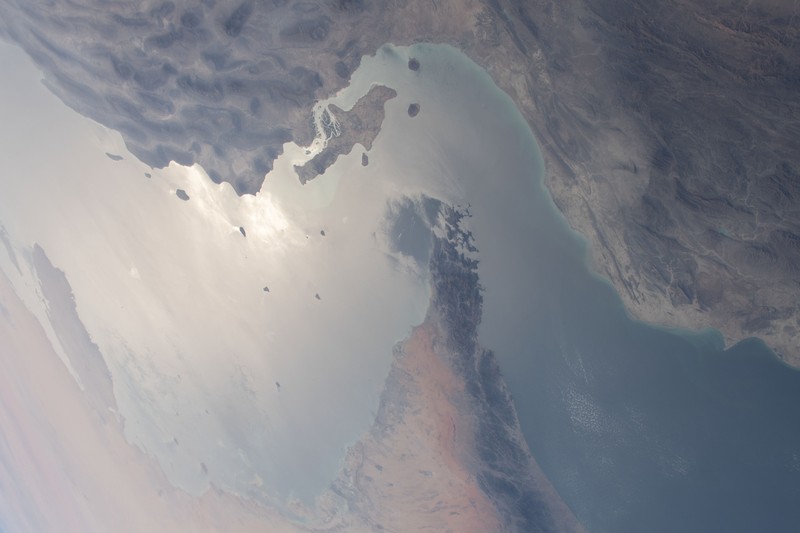
The Strait of Hormuz, through which roughly a fifth of the world’s crude oil normally flows, is effectively closed. Iran blocked it at the start of the war; the US imposed its own blockade starting Monday. The result is a choke point that neither side can fully control but that is strangling Iran’s economy far more than America’s.
Grace Wermenbol, a former US national security official now at the German Marshall Fund, assessed Tehran’s posture bluntly: it appears to be betting Washington will eventually back down. “There is no easy military option here,” she told Al Jazeera. “The only way to resolve this issue and remove the threat to maritime traffic will need to involve a diplomatic deal.”
The cost-benefit calculation for Tehran is straightforward. Holding onto enriched uranium that the US regards as a casus belli, under a blockade that is devastating the Iranian economy, produces diminishing returns. Surrendering the stockpile — or appearing ready to — buys time, relieves pressure, and keeps Pakistan’s mediation alive.
The gap that remains
The two sides remain far apart on the duration of any nuclear suspension. Washington wants 20 years; Tehran has proposed five. According to the New York Times, Iran’s five-year offer is nearly identical to the one made in Geneva in February, during the failed negotiations that Trump cited as his reason for going to war.
There is also the question of whether the current deal resembles the 2015 nuclear accord — the agreement Trump exited in 2018 and denounced as a “horrible, one-sided deal that should have never, ever been made.” A 20-year suspension is not a permanent ban, but it is being offered as a way for Iran to claim it hasn’t permanently surrendered its rights under the Nuclear Non-Proliferation Treaty. The structure is familiar, even if the politics are different.
Lebanon remains unresolved. Iran insists that any agreement must address the Israeli-Lebanon front, where Israeli strikes have killed more than 2,000 people and displaced 1.2 million. Washington wants the tracks kept separate. Pakistan’s foreign ministry sided explicitly with Tehran on Thursday: “Peace in Lebanon is essential for US-Iran peace talks.” The 10-day Israel-Lebanon ceasefire that took effect overnight may ease that pressure, though Israeli forces have said they will not withdraw from their newly established 10-kilometre “security zone” in southern Lebanon.
Buying time, or buying peace?
The two-week US-Iran ceasefire expires on April 22. Islamabad-based analyst Kamran Yousuf told Al Jazeera he would be “really surprised” if it is not extended, citing little appetite on either side for a return to war. But extension is not resolution.
Faisal, the security analyst, offered a more cautious read. If a second round of talks fails, Pakistan’s role shifts from mediator to crisis manager — where it will “focus again on brokering a ceasefire” rather than settling the conflict. The distinction matters. A mediator ends wars. A crisis manager contains them.
The uranium handover, if it happens, would be the most tangible de-escalation step of this conflict. But the distance between Trump’s triumphant announcement and Iran’s studied silence suggests the parties are still negotiating over what the concession means, what it costs, and what it buys. The gun is still on the table. For now, both sides are choosing not to reach for it.
Sources
- Iran has agreed to hand over its enriched uranium supply, says Trump — Channel News Asia
- No date set for US-Iran talks, as Pakistan pushes to keep diplomacy alive — Al Jazeera
- U.S. Is Negotiating an Iran Deal That Would Buy Time, Again — The New York Times
- Trump says Iran has agreed to hand over enriched uranium — Le Monde
Discussion (14)