 lop News
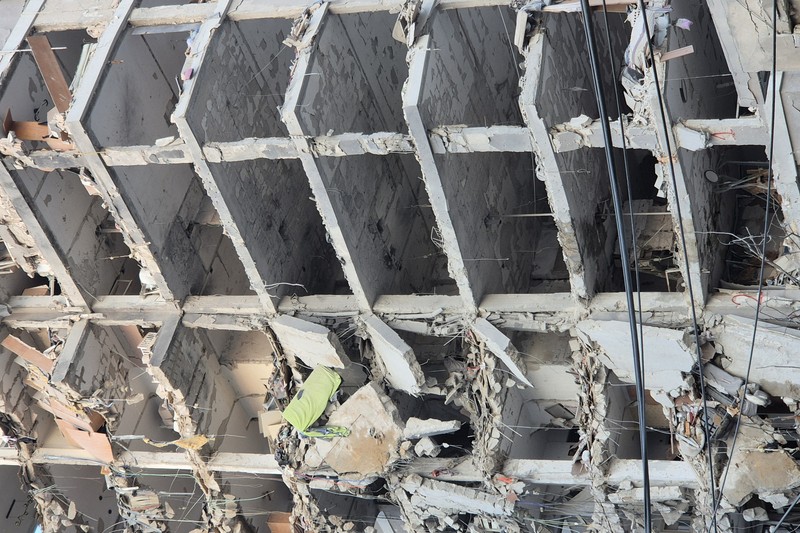
In Petah Tikva, a crater gapes next to a school where children would have been sitting in class had the calendar read a weekday. In Bnei Brak, an 11-year-old girl is fighting for her life after Iranian cluster munitions scattered bomblets across her street. In Mazkeret Batya, one person was lightly injured by shattered glass caused by a blast.
Five weeks into the Iran war, these are no longer isolated impacts on military or strategic targets. Iran is firing directly into Israeli residential areas — and Israel’s missile defenses, among the most advanced on Earth, cannot stop all of them.
Overnight Thursday and into Friday morning, Iranian missile barrages triggered air-raid sirens across Israel, from the Dead Sea to Jerusalem to municipalities north of Gaza. Two people were lightly wounded in Petah Tikva, where a large crater opened near a school. One person was injured by shattered glass in Mazkeret Batya. Falling shrapnel lightly wounded two more people as a subsequent barrage triggered countrywide alerts, according to Magen David Adom.
“From the strength of the blast, it was clear there had been an impact close to our home,” one Petah Tikva resident told the Israeli newspaper Maariv. “We were very lucky it landed in an open area, and that there are no classes right now, otherwise it could have ended in a major disaster.”
A mounting civilian toll
The overnight strikes cap a week in which the human cost of Iran’s missile campaign has become impossible to ignore. On April 1, cluster munitions struck at least four locations across central Israel, wounding 16 people including six children, according to The Media Line. The 11-year-old girl from Bnei Brak, struck by shrapnel, was hospitalized in serious condition and later deteriorated to critical.
A teenage boy from the same city was evacuated in moderate condition after trying to alert his deaf mother to the incoming strike — costing them the seconds needed to reach a shelter, MDA officials told the Israeli outlet Walla. His condition later deteriorated to serious, according to Beilinson Hospital.
Since the war began on February 28 with joint US-Israeli strikes on Iran, Iranian missile fire has killed at least 19 people in Israel and wounded more than 4,200, according to data compiled from Israeli emergency services and verified reporting. MDA says it has treated 2,223 people since the start of what Israel calls Operation “Roaring Lion” — including 1,745 physically wounded (with dozens in serious, moderate, or light condition) and 478 treated for anxiety alone.
The single deadliest incident came on March 1, when a missile slammed into a residential neighborhood in Beit Shemesh, striking a shelter inside a synagogue. Nine civilians were killed and dozens injured — the largest casualty count of the conflict.
The cluster munitions problem
By the tenth day of the war, Iran had fired roughly 300 missiles at Israel, about half of them carrying cluster warheads, according to the Israeli military. Each warhead releases about 24 submunitions containing 2–5 kilograms of explosives, which separate at an altitude of 7–10 kilometers and scatter across a radius of up to 10 kilometers.
The effect, as an Israeli military official described it to Reuters, is “similar to the explosion of a grenade — relatively limited local damage but highly dangerous to anyone nearby.” A single missile can generate dozens of separate impact sites across civilian areas.
Israel’s Arrow-3 anti-ballistic missile system intercepts most incoming threats, but cluster warheads must be destroyed above the atmosphere before they split — a narrow technical window. “Once the cluster bombs are released in the atmosphere, you cannot intercept them,” Yehoshua Kalisky, a senior researcher at the Institute for National Security Studies at Tel Aviv University, told Reuters.
Amnesty International has condemned Iran’s use of cluster munitions against residential areas as “a flagrant violation of international humanitarian law.” More than 100 nations have banned the weapons under the Convention on Cluster Munitions. Iran, Israel, and the United States have not signed the treaty.
Israeli military spokesperson Lieutenant Colonel Nadav Shoshani called the cluster munition attacks “a war crime by the Iranian regime,” accusing Tehran of “deliberately targeting civilians.”
Simultaneous fronts
The Iranian barrages are not happening in isolation. Hezbollah has maintained rocket fire from Lebanon, with a barrage on Thursday striking a kindergarten in Nahariya and damaging homes and businesses, according to Israeli media. Two men — aged 85 and 34 — were moderately wounded by shrapnel from a separate Hezbollah rocket attack in northern Israel and evacuated to Ziv Medical Center in Safed.
Israel, for its part, said its air force struck anti-aircraft and ballistic missile storage sites as well as weapons production facilities in Tehran. An Israeli tank fired on a car in southern Syria’s Quneitra province, killing a young man, Syria’s state-run SANA news agency reported.
A wider war
The conflict escalated dramatically on other fronts Friday. Iran shot down two US military aircraft — an F-15E Strike Eagle over Iranian territory and an A-10 Warthog that crashed into the Gulf — the first American aircraft lost in the war. One crew member was rescued and another remains missing, according to US media reports. Israel suspended airstrikes in areas “relevant” to the search-and-rescue operation, an Israeli official said.
Iran claimed a “new advanced defence system” downed the aircraft, directly challenging Washington’s assertions that its air defenses had been degraded. Tehran rejected a US proposal for a 48-hour ceasefire, with Iranian President Masoud Pezeshkian accusing Washington of hypocrisy and asking the world to judge “which side engages in dialogue and negotiation, and which in terrorism.”
The human cost now stretches across the region. The World Health Organization says the conflict has killed 3,300 people and displaced more than 4 million. Iranian authorities report at least 2,076 killed and 26,500 wounded in Iran. Thirteen US service members have been killed in combat and 365 wounded, according to the Associated Press.
The economic shockwaves are global. Israel’s simultaneous conflicts with Iran, Gaza, and Lebanon have cost an estimated $112 billion, according to Al Jazeera. A UN vote on a resolution addressing Iran’s blockade of the Strait of Hormuz has been postponed due to opposition from Russia and China. Australia is already facing petrol shortages, with hundreds of rural service stations out of diesel.
No exit in sight
Israel’s response calculus is narrowing. After five weeks of bombardment that has killed civilians in their homes, synagogues, and streets, domestic pressure for decisive action remains high — 78 percent of Jewish Israelis still support the war, according to polling cited by Al Jazeera. But the downing of US aircraft and the rejection of ceasefire overtures suggest Iran retains significant military capability and the political will to keep fighting.
The Israeli government has shifted further right, passing a record $271 billion wartime budget and a controversial death penalty law targeting Palestinians.
What began as a joint US-Israeli campaign against Iranian nuclear and military infrastructure has become a multi-front regional war with no diplomatic off-ramp. The missiles landing in Israeli neighborhoods this week are not anomalies — they are the new baseline. And neither side is backing down.
Sources
- Cluster munitions damage vehicles, buildings in central Israel — The Jerusalem Post
- 2026 Iranian strikes on Israel — Wikipedia
- Iranian cluster missiles pose extra challenge for Israel’s air defences — Reuters
- Live updates: A-10 aircraft hit by Iran’s air defenses, second US aircraft to go down in Middle East — Associated Press
- Iranian Cluster Munitions Strike Central Israel, Injure 16 Including Children — The Media Line
- Iran war: What is happening on day 36 of US-Israeli attacks? — Al Jazeera
Discussion (14)