 lop News
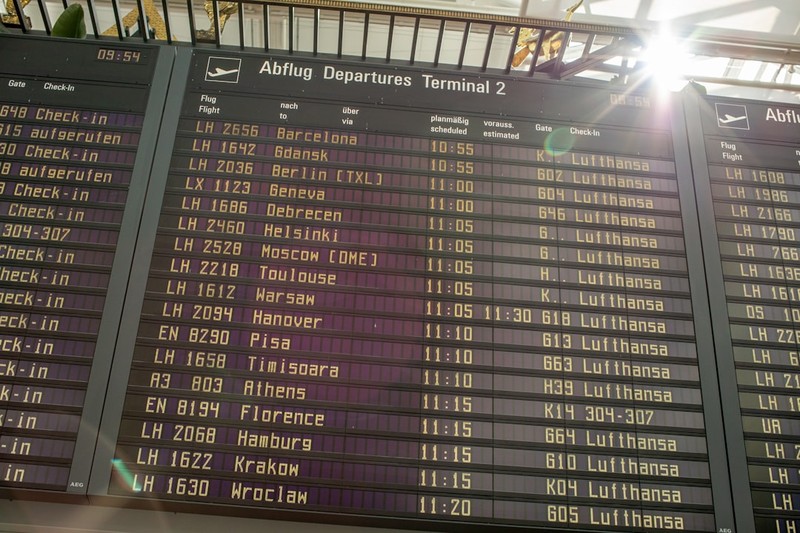
Low-cost carrier Transavia began cancelling flights this week — not because of weather, strikes, or mechanical failures, but because the fuel to power them had become too expensive to buy. The airline pointed squarely at kerosene prices. The culprit sits roughly 3,000 miles away: a blockade in the Strait of Hormuz that has choked off a fifth of the world’s oil and gas shipments since the Iran war began.
Transavia is not alone. Ryanair, Volotea, Lufthansa, and Scandinavian Airlines have all announced cancellations or route cuts. Air France-KLM has slapped a €100 surcharge on long-haul flights. The chain reaction runs from a contested waterway in the Persian Gulf through commodity markets to the departure board at your local airport.
From Hormuz to the Holding Pattern
The Strait of Hormuz is 21 nautical miles wide at its narrowest point. Through it passed roughly a fifth of global oil and gas tanker traffic before February’s US and Israeli strikes on Iran. Since then, both Iran and the US have at different points blocked the waterway. Europe has lost access to roughly 500,000 barrels of jet fuel per day that previously arrived from Gulf refineries.
The continent consumes about 1.6 million barrels of jet fuel daily, according to data cited by Deutsche Welle. About 1.1 million barrels come from domestic refining. The missing half-million used to arrive from the Middle East. It no longer does.
Prices Doubled, Margins Erased
Jet fuel prices in Europe rose from approximately €68 per barrel in February to €154 by late April, according to the International Air Transport Association. For an industry where fuel accounts for 25% to 50% of operating expenses, the math is brutal.
“If fuel prices […] remain high and airlines have not hedged, they could go bankrupt,” Marina Efthymiou, an aviation management professor at Dublin City University, told Deutsche Welle.
Airfare across Europe has climbed 24% year-on-year, according to advisory firm Teneo. The biggest impact falls on low-cost carriers — Transavia, Ryanair, Volotea — whose business models run on thin margins and cheap fuel. When kerosene doubles in price, marginally profitable routes become money-losers overnight.
“It’s not so much a fuel shortage issue as an issue of profitability,” said Thierry Bros, an energy specialist and professor at Sciences Po in Paris. “With the rising price of kerosene, a company like Transavia has no other choice but to increase ticket prices. If the cost becomes prohibitive for travellers, and they are unwilling to pay, grounding airplanes might end up being the most financially sound choice.”
Lufthansa is cutting 20,000 short-haul flights over the next six months. SAS will cancel around 1,000. “We are obliged to do so, because otherwise we just are bankrupt in a few months,” Air France-KLM senior vice president Sebastien Justum told the European Parliament.
Regional airports face a parallel threat. Olivier Jankovec, director general of Airports Council International Europe, warned that many now confront “both a supply and demand shock.” For them, he said, “this is nothing short of an existential threat.”
The Clock and the Stockpiles
The head of the International Energy Agency warned in mid-April that Europe had roughly six weeks of jet fuel remaining. France’s government says it holds about two months of strategic reserves — roughly two million barrels, according to Economy Minister Roland Lescure — plus about 10 days of commercial stock at airports. The refineries supplying Paris’s major airports source the majority of their crude from North America rather than the Gulf, according to an Aéroports de Paris executive, giving France a stronger position than neighbours like the UK, which imports 60% of its kerosene from Saudi Arabia, the UAE, and Kuwait.
“The combination of these factors should save the summer,” said Wouter Dewulf, a transport economics professor at the University of Antwerp, though he warned that a prolonged conflict could raise the same supply questions by autumn.
Exporters of refined jet fuel are also tightening their grip. South Korea, the world’s largest jet fuel exporter, is starting to limit shipments because its own crude comes from the Middle East. The supply squeeze is cascading.
Brussels Scrambles
The European Commission launched its AccelerateEU plan in late April, including an EU-wide fuel observatory to map supplies and coordinate distribution. Commission President Ursula von der Leyen told the European Parliament that fossil fuel import costs had risen by over €27 billion in 60 days of conflict.
Airlines for Europe, an industry group representing 80% of the continent’s air traffic, has asked Brussels to relax anti-tankering rules that require airlines to load 90% of fuel within the bloc, and to temporarily suspend carbon pricing under the Emissions Trading System. The industry frames these as emergency measures, not permanent policy rollbacks.
The coordination helps, but it has hard limits. As Efthymiou put it: “It can stop a national-level shortage from becoming a continent-wide panic, but it cannot create fuel that isn’t there.”
For now, Europe’s airlines are choosing between flying at a loss or not flying at all. That choice is showing up on departure boards — and on the bottom line.