 lop News
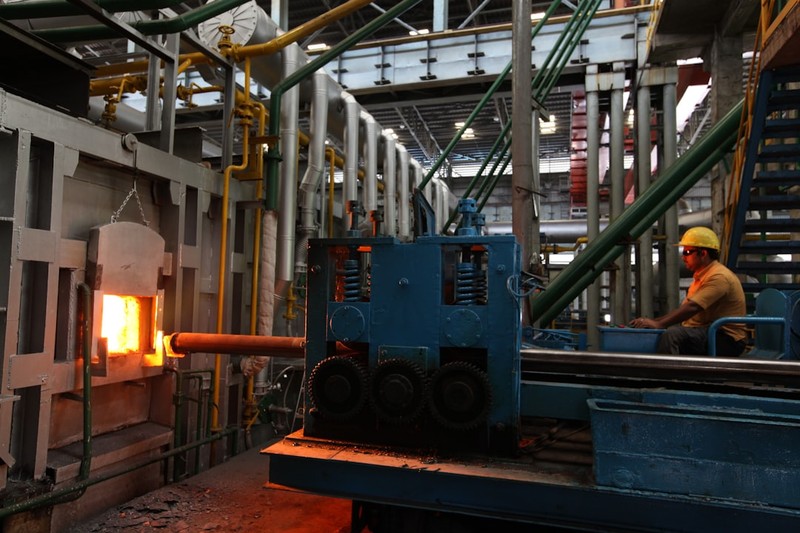
The missiles that struck Emirates Global Aluminium’s Al Taweelah smelter on Saturday did not hit a military installation, an air defence battery, or a naval convoy. They hit the UAE’s largest aluminium production site — the industrial backbone of an economy that ranks fifth globally in the metal’s production.
Across the Gulf, Aluminium Bahrain’s plant was struck the same day. Two employees at Alba suffered minor injuries, according to the company. At EGA’s Al Taweelah site in Abu Dhabi’s Khalifa Economic Zone, six people were injured — none with life-threatening wounds — and the facility sustained what the company described as “significant damage.”
Iran’s Islamic Revolutionary Guard Corps claimed responsibility for both strikes in a statement carried by state broadcaster IRIB overnight on Saturday. The IRGC described the facilities as industries “associated with and connected to the military and aerospace industries of the US,” and said the attacks were retaliation for US-Israeli strikes on two Iranian steel plants. Reuters could not independently verify the claims about the companies’ ties to the American military.
A deliberate escalation
This was not a proxy skirmish or a shipping lane disruption. The IRGC chose to hit aluminium smelters — strategic, fixed, economic assets that cannot be hidden or relocated. The message was unmistakable: Gulf states that host US military bases are no longer just tolerating risk to their security apparatus. Their economies are now on the line.
The IRGC was explicit about this shift. In a statement carried by Tasnim News Agency, the corps said its response would “not follow the principle of ‘an eye for an eye’” but would instead deliver “a more lethal blow to the military and economic structure of the enemies.”
The distinction matters. Previous Iranian retaliation during the five-week-old US-Israeli campaign has focused on military targets and commercial shipping. Aluminium plants are neither. They are export-driven industrial assets that employ thousands and generate billions in revenue for sovereign wealth funds. EGA is jointly owned by Mubadala Investment Company and the Investment Corporation of Dubai. Alba is one of Bahrain’s largest employers and a cornerstone of the island nation’s non-oil economy.
Nine percent of global supply at risk
The Gulf region accounts for about 8 percent of global primary aluminium production, according to the International Aluminium Institute, with some industry estimates putting the figure closer to 9 percent. EGA alone sold 2.84 million tonnes of cast metal last year, serving more than 400 customers in over 50 countries. Its aluminium feeds the construction, automotive, aerospace, packaging, and electronics industries.
The Al Taweelah smelter produced 1.6 million metric tonnes of cast metal in 2025, alongside an adjacent alumina refinery that turned out 2.4 million tonnes of raw material.
Those supply chains were already under severe strain. The effective closure of the Strait of Hormuz since the conflict began in late February has prevented most Gulf aluminium producers from shipping metal to world markets through normal channels. Alba declared force majeure on March 4 and began shutting down three smelting lines — 19 percent of its total capacity of more than 1.62 million metric tonnes per annum — to preserve business continuity. Qatar’s Qatalum announced a controlled production shutdown on March 3, citing natural gas shortages. On Saturday, Bahrain’s Foulath Holding, parent company of Bahrain Steel, also declared force majeure.
EGA said it had “substantial metal stock on the water when the conflict began, and stock on the ground in some overseas locations.” Reuters reported earlier this month that the company was rerouting exports and raw material imports via the Omani port of Sohar. Analysts at Julius Baer estimated in a recent note that 70 to 80 percent of regional production could theoretically be rerouted by truck to ports in Oman, Saudi Arabia, and Fujairah — but at significantly higher cost than seaborne shipping.
Saturday’s strikes add physical destruction to the logistical disruption.
The impossible balance
For Gulf Arab states, the war has crystallised an uncomfortable reality. The US military presence that has underwritten their security for decades now functions as a magnet for Iranian retaliation. Bahrain hosts the US Navy’s Fifth Fleet. The UAE permits American forces to operate from its territory. Both countries have long sought to maintain pragmatic relations with Iran while aligning with Washington on security.
That balancing act is collapsing under the weight of sustained military operations. Since the conflict erupted at the end of February — following the assassination of Iranian leader Ayatollah Ali Khamenei along with several senior military commanders and civilians on February 28, according to Tasnim — Bahrain and other Gulf states have been repeatedly targeted by Iranian missile and drone strikes.
Saturday’s attacks extended the pattern across the region. A worker at Oman’s Salalah port was injured in a drone attack. Maersk temporarily halted operations there. Saudi Arabia’s air defence systems intercepted 10 drones, according to the Saudi Ministry of Defence. Kuwait’s National Guard shot down four more after air raid sirens sounded for the second time in hours.
Oman’s Foreign Ministry condemned the attacks on its territory, noting that no party had claimed responsibility and that authorities are investigating the “sources and motives.”
What comes next
Al Jazeera correspondent Zein Basravi, reporting from Dubai, characterised the trajectory plainly: “If Iran continues at this pace by matching attack for attack, that is very concerning, especially since the number of attacks on Iran continues to go up and this conflict continues to escalate.” He added that further escalation in Iran makes further escalation in the Gulf Cooperation Council states “inevitable.”
EGA chief executive Abdulnasser Bin Kalban said the company is “deeply saddened and are assessing the damage to our facilities.” Alba said it is similarly assessing damage while remaining “focused on maintaining its operational resilience.” Both companies face a reality that no insurance policy or supply chain workaround can fully address: the factories themselves are now targets.
The aluminium industry is the canary in this particular coal mine, but it will not be the last sector drawn in. Gulf states have spent decades diversifying their economies away from hydrocarbons — building petrochemical plants, steel mills, aluminium smelters, and logistics hubs. That diversification was meant to be their insurance against a post-oil future. It has instead created a sprawling landscape of fixed, high-value targets that no air defence system can fully shield.
Sources
- Iran’s IRGC claims attacks on UAE, Bahrain aluminium facilities — Al Jazeera
- Emirates Global Aluminium reports ‘significant damage’ from Iranian strikes — Reuters
- Bahrain’s Alba confirms Iranian attack on its facilities — Reuters
- UAE and Bahrain’s main aluminium producers say plants damaged by Iranian attacks — The National (UAE)
- IRGC Attacks Factories Linked to US Military Industries in Bahrain, UAE — Tasnim News Agency
Discussion (12)