 lop News
Iran has formally responded to Washington’s proposal to end the three-month war. What Tehran actually said is being kept from the public — even as Iranian drones streak across Gulf skies and military commanders have reportedly vowed “surprising” new methods of warfare if attacked again.
The contradiction is the story.
Iranian state media confirmed Sunday that Tehran’s reply to the 14-point US proposal had been delivered through Pakistani mediators. Iran’s IRNA news agency said the response drew on ensuring “maritime security” in the Gulf and the Strait of Hormuz. Beyond that, silence — from both sides.
A Pakistani diplomatic source told Al Jazeera Arabic that the response had been passed to the Americans. US Ambassador to the UN Michael Waltz said the Trump administration had not yet received it. The gap between those two statements captures the fog surrounding talks conducted not through direct channels but through a chain of intermediaries stretching from Islamabad to Doha to wherever Iran’s injured Supreme Leader Mojtaba Khamenei is sheltering.
Waltz told ABC’s “This Week” that Khamenei has been “severely injured” and “is in hiding,” making negotiations “go longer and slower, I think, than anyone would like.”
A Proposal Built on Red Lines
The US proposal, as described by multiple outlets citing unnamed officials, demands Iran freeze all uranium enrichment for at least 12 years and surrender its stockpile of roughly 440kg of uranium enriched to 60 percent — a short step from weapons grade. In return, Washington would gradually lift sanctions, release billions in frozen Iranian assets, and end its naval blockade of Iranian ports.
Iran’s conditions, according to Al Jazeera’s reporting from Tehran, include a three-phase approach: first, a 30-day period focused on ending hostilities on all fronts, including Lebanon, where fighting between Hezbollah and Israel persists despite a separate ceasefire since April 17. Iran also wants UN Security Council guarantees that attacks will not resume — a tall order given Washington’s veto power.
A senior Iranian parliament member previously dismissed the US offer as a “wish list.”
Drones Over the Gulf
Whatever words landed on the negotiating table, the military situation deteriorated further on Sunday.
The UAE said its air defences intercepted two drones launched from Iran. Kuwait reported hostile drones in its airspace at dawn. A cargo ship sailing from Abu Dhabi was struck by a drone in Qatari waters, sparking a fire that was brought under control without casualties, according to Qatar’s Ministry of Defence.
The Iranian parliament’s foreign policy spokesperson, Ebrahim Rezaei, declared that Tehran’s “restraint is over” and warned that “any aggression against our vessels will be met with a heavy and decisive Iranian response against American vessels and bases.”
Iran’s IRGC Navy echoed the threat, warning of a “heavy assault” on US regional bases if Iranian ships are attacked.
The Hormuz Squeeze
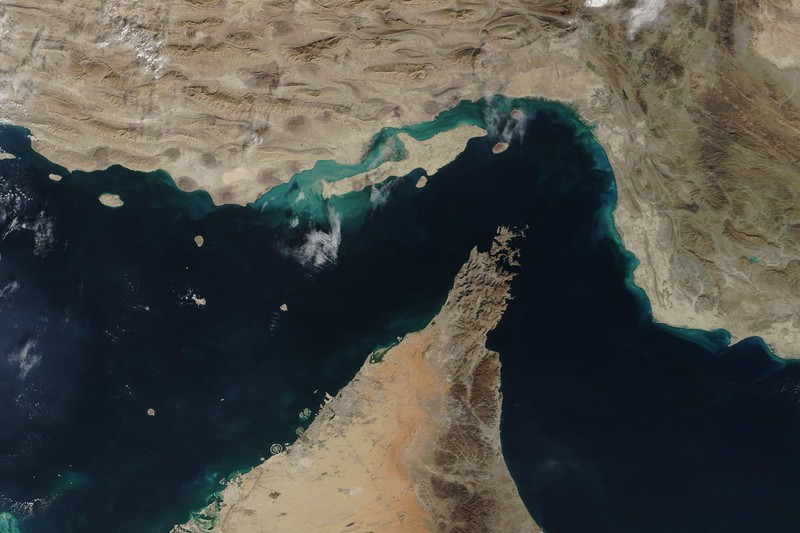
The economic stakes are enormous and growing. Iran has effectively blocked non-Iranian shipping through the Strait of Hormuz since the war began on February 28, choking a waterway that normally carries roughly one-fifth of the world’s oil and gas.
A small breakthrough came Sunday when a Qatari LNG tanker, the Al Kharaitiyat, transited the strait — the first such crossing since the war began. Sources told CNBC that Iran approved the passage to build confidence with Qatar and Pakistan, both mediators. A Panama-flagged bulk carrier bound for Brazil also crossed using an Iranian-designated route.
These were exceptions, not a reopening. Iranian lawmakers are drafting legislation to formalize Tehran’s control over the strait, including bans on vessels from “hostile states.”
The US countered with its own blockade of Iranian ports last month. A CIA assessment, first reported by the Washington Post, suggested Iran would not face severe economic pressure from that measure for about four months. A senior intelligence official publicly called that report false.
The Clock
President Donald Trump, facing a war that surveys show is unpopular with American voters paying higher gasoline prices, is scheduled to visit China this week. He has publicly pressed for a quick resolution, warning on Truth Social that if Iran does not agree to a deal, “the bombing starts” — at what he said would be a much higher intensity than before.
Iranian President Masoud Pezeshkian, speaking at a reconstruction meeting Sunday, insisted that negotiations do not mean surrender. “We will never bow our heads before the enemy,” he posted on X.
Defense ministers from more than 40 nations will meet Monday to discuss a UK-French proposal for policing maritime traffic through Hormuz. Britain is deploying a warship to the region. NATO allies, however, have refused to join US-led efforts to force the strait open without a comprehensive peace deal.
For now, the world is left to parse a classified Iranian response to an urgent war — reading drone trails and diplomatic silence for clues about what comes next.
Discussion (9)