 lop News
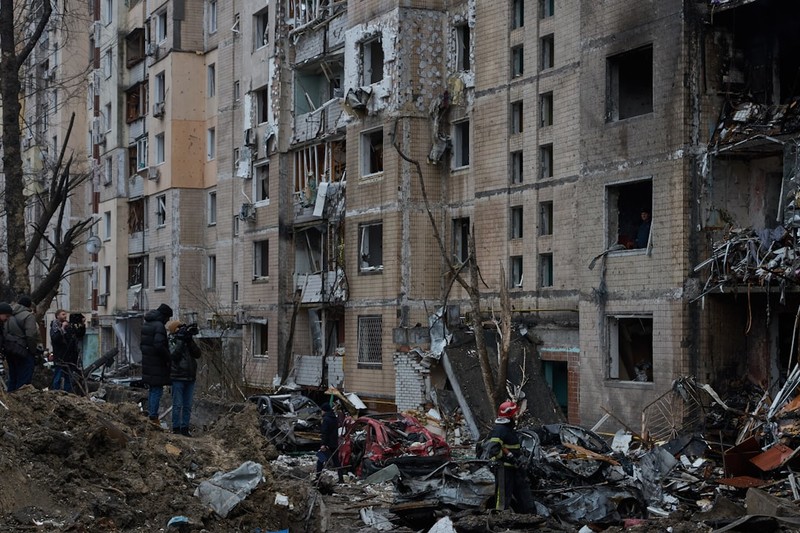
Kyiv reportedly woke to explosions before dawn on Sunday, according to local media and social media accounts. Waves of missiles and drones were said to have crashed into the capital in what officials described as one of the heaviest assaults the city has endured in months. Air raid sirens had reportedly been sounding since the small hours. By sunrise, the damage was still being counted.
The barrage came with a warning attached — one issued hours earlier by Ukrainian President Volodymyr Zelenskiy. Russia, he said, was preparing to strike Ukraine with the Oreshnik, a hypersonic ballistic missile that first appeared in the war in November 2024. Ukrainian officials warned that the weapon could be launched at any moment, according to reports.
A Barrage Meant to Overwhelm
The assault on Kyiv reportedly combined cruise missiles and drones in layered waves — a tactic Russia has refined over three years of war. The method is typically straightforward: exhaust air defenses, saturate interception systems, and let whatever survives find its target. The specific types of weapons used had not been independently confirmed as of Sunday.
Details on casualties and specific damage remained unclear in the immediate aftermath. Ukrainian officials urged residents to remain in shelters as emergency services responded across the city. The strike was described by officials as one of the largest in recent months, though exact figures on the number of weapons launched had not been independently confirmed as of Sunday.
The scale of the attack matters less than its timing. The overnight barrage was not an isolated event. It was the kinetic component of a broader signal — one that began with Zelenskiy’s public warning about the Oreshnik and ended with ordnance falling on residential neighborhoods.
The Oreshnik Signal
The missile barrage is, in one sense, routine. Terrible and deadly, but a pattern Ukraine has learned to survive. The Oreshnik threat is something else entirely.
Zelenskiy’s announcement that Russia was preparing to use the hypersonic weapon, reported by Reuters, represents an escalation in kind, not just in volume. The Oreshnik, which Russia first deployed against the Ukrainian city of Dnipro in late 2024, travels at speeds that make interception by current Ukrainian air defense systems effectively impossible.
Its military utility is debatable. Its psychological and political purpose is not. The Oreshnik exists to demonstrate that Russia can reach any target in Ukraine with a weapon no defense can stop. It is a message aimed as much at Kyiv’s Western backers as at Ukrainian civilians — a reminder that the Kremlin retains the capacity to escalate, and the willingness to use it.
A War on Two Clocks
The assault comes at a moment when global attention is focused elsewhere. The escalating confrontation between the United States and Iran has consumed diplomatic bandwidth and media coverage. Congressional debates over continued military aid to Ukraine have grown louder and more contentious in Washington. Russia has shown a consistent pattern of intensifying operations during periods of Western distraction, and the timing of this barrage fits that pattern with some precision.
But this is not a one-way intensification. Ukraine has demonstrated its own reach. In recent days, Ukrainian forces have reportedly carried out deep strikes into Russian territory, according to Ukrainian military channels. If confirmed, such attacks would represent some of the deepest Ukrainian strikes into Russia to date — evidence that Kyiv is prepared to escalate its own long-range campaign even as Moscow pushes harder in the other direction.
Those strikes have not been independently verified. Russian officials did not immediately comment.
Calculated to Test Resolve
What is unfolding is not simply a military escalation. It is a political test — calibrated to measure whether Western support for Ukraine has begun to fracture under the weight of competing crises.
Russia’s calculus is straightforward. The longer the war continues, the greater the strain on Western alliances. Every new weapons system deployed — whether hypersonic missiles or waves of Shahed drones — is designed to accelerate that fatigue, to make the cost of supporting Ukraine feel higher than the cost of walking away.
Ukraine’s calculus is equally clear. Deep strikes into Russian territory, continued development of domestic drone capabilities, and appeals for accelerated Western aid all serve a single purpose: to demonstrate that Kyiv can still impose costs, that the war is not lost, and that abandonment would carry consequences of its own.
The Oreshnik threat sits at the center of this dynamic — a weapon designed not to win a battle but to shift a political calculation, to make Western policymakers wonder whether the next escalation might be the one that finally overwhelms Ukraine’s defenses.
As of Sunday morning, there was no confirmation that the Oreshnik had been launched. The barrage had ended. The sirens had stopped. In Kyiv, residents emerged from shelters to assess the damage.
The war continued — in the space between what is threatened and what is done.
Discussion (9)