 lop News
3:30 AM. Five litres of fuel. Six hundred and fifty grams of explosive powder. A man crouching outside Bank of America’s Paris headquarters, lighter in hand, two streets from the Champs-Élysées.
Then the police tackled him.
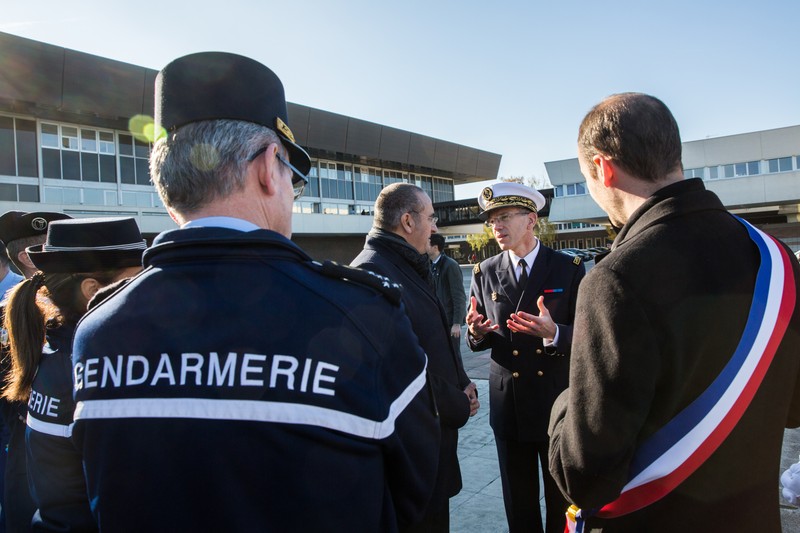
The scene, described by police sources and reported by Le Parisien, unfolded in the early hours of Saturday, March 28. A suspect placed a homemade device — a five-litre container filled with what authorities believe was fuel, connected to an ignition system packed with roughly 650 grams of powder — in front of the bank’s offices in the 8th arrondissement. Officers on patrol moved in as he attempted to light it.
A second individual who was present fled and remains at large, according to multiple sources. The device was secured and transferred to the Paris police forensics laboratory for full analysis.
The investigation
France’s National Anti-Terrorism Prosecutor’s Office immediately took over the case. In a statement, prosecutors said the investigation covers attempted destruction by fire or other dangerous means in connection with a terrorist plot, manufacture and transport of an incendiary device, and participation in a terrorist criminal association — a charge that signals authorities are examining whether the suspect had accomplices or ties to a broader network.
The Paris judicial police and France’s domestic intelligence agency, the DGSI, are both involved in the probe.
The suspect told police he was recruited via Snapchat and paid €600 ($690) to carry out the attack, and that he had been driven to the scene by another person, according to Le Parisien.
What the minister said
Interior Minister Laurent Nuñez praised the officers, posting on social media that their actions had “thwarted a violent terrorist attack in Paris last night.” On BFMTV, he drew an explicit link between the incident and the war in the Middle East, noting that similar actions had occurred in neighbouring countries, claimed by “small groups that referred to the conflict.”
Nuñez had already stepped up security this week around Iranian opposition figures and sites associated with US and Jewish interests, citing what he called the “current international context” — a reference to the US-Israeli military campaign against Iran launched on February 28.
A pattern across Europe
The Paris incident did not emerge in isolation. Since early March, a series of attacks has unsettled the continent. On March 9, an improvised explosive device detonated outside a synagogue in Liège, Belgium. A synagogue in Rotterdam, a Jewish school, and a commercial centre in Amsterdam were targeted in the days that followed. On March 23, four vehicles belonging to a volunteer Jewish ambulance service were set alight in London.
A previously unknown group calling itself Harakat Ashab al-Yamin al-Islamia (HAYI) — roughly “The Islamic Movement of the Companions of the Righteous” — has claimed responsibility for several of these attacks via Telegram and X, circulating videos through channels affiliated with pro-Iranian Iraqi Shia militias.
An analysis by the International Centre for Counter-Terrorism (ICCT) found that HAYI had no digital footprint before March 9 and that its claim materials contain notable linguistic errors in Arabic, including the misspelling of the word “Islamic.” The group’s sudden appearance, its dissemination through established pro-Iranian networks, and the relatively unsophisticated nature of both its propaganda and its operatives suggest something less organic than a spontaneous militant movement.
Disposable agents
The profile of the Paris suspect fits an emerging template. In the Rotterdam synagogue attack, suspects were identified as five youths from Tilburg, aged between 17 and 19. The ICCT notes that this recruitment model mirrors tactics pioneered by Russian sabotage networks in Europe, where locally recruited individuals — so-called “disposable agents,” often young people attracted by quick cash — carry out low-sophistication attacks with minimal operational ties to their handlers.
Iran has a documented history of external operations in Europe. One recent study identified 102 such plots on the continent since 1979, more than half of them since 2021. MI5 reported disrupting more than 20 Iranian-linked plots in the UK in 2025 alone.
What changes now
The Bank of America targeting marks a shift. Previous attacks since the start of the Iran war focused on Jewish community sites. A US corporate headquarters represents an escalation — a piece of American financial infrastructure, in one of the world’s most surveilled cities, selected by a suspect who, if his account is accurate, needed nothing more than a Snapchat message and a car ride.
Bank of America, headquartered in Charlotte, North Carolina, said it was “aware of the situation and are communicating with the authorities.”
The suspect is in custody. The second individual is being sought. And across Europe, the question is no longer whether the Iran conflict will reach the continent. It already has — in the form of a five-litre container and a lighter on a quiet street in the 8th arrondissement.
Sources
- France opens terror probe after Paris Bank of America attack attempt — Reuters
- French police foil bomb attack in Paris outside Bank of America building — Le Monde
- France opens probe into suspected attack on Bank of America in Paris — Al Jazeera
- Hybrid Threat Signals: Assessing Possible Iranian Involvement in Recent Attacks in Europe — International Centre for Counter-Terrorism
Discussion (10)