 lop News
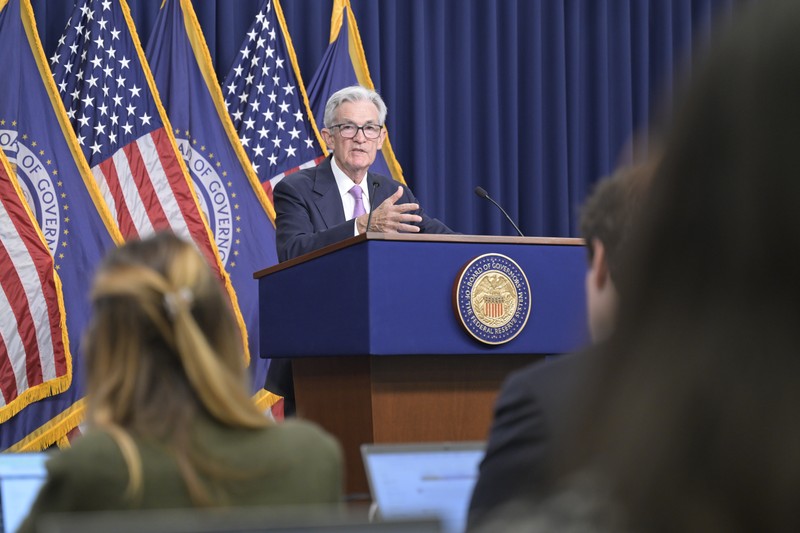
Jerome Powell held the line on interest rates. Then he held the line on his job.
On Wednesday, the Federal Reserve kept its benchmark rate unchanged at 3.5% to 3.75% — the third consecutive hold — despite months of pressure from President Donald Trump to cut. Hours later, Powell announced he would remain on the Fed’s Board of Governors after his term as chair ends in May, denying Trump an additional appointment and preserving his own institutional influence.
The rate decision split the Federal Open Market Committee 8-4. The last time four members dissented from a single decision, the Soviet Union had just dissolved and George HW Bush was fighting for re-election. That was October 1992.
A Split From Both Directions
The four dissenters came from opposite corners. Governor Stephen Miran, a Trump appointee who has pushed for rate cuts at every meeting since joining the central bank in September 2025, again dissented in favor of a quarter-point reduction. The other three — Cleveland Fed president Beth Hammack, Minneapolis president Neel Kashkari, and Dallas president Lorie Logan — wanted to hold rates but objected to the statement’s language implying future cuts were likely.
At issue was a single sentence in the FOMC statement: “In considering the extent and timing of additional adjustments to the target range for the federal funds rate, the Committee will carefully assess incoming data, the evolving outlook, and the balance of risks.” The word “additional” signals the next move would be a cut. Hammack, Kashkari, and Logan wanted that signal gone.
Rachel Ziemba, adjunct senior fellow at the Center for a New American Security, told Al Jazeera that “three members resisted including an easing bias, suggesting more divides in the central bank ahead.”
The inflation numbers explain the friction. Prices rose 3.3% in March, according to the latest reading — 1.3 percentage points above the Fed’s 2% target. Brent crude briefly touched $119 a barrel on Wednesday, a 7% daily jump, as the conflict with Iran continued to disrupt global oil markets. The average US gasoline price has climbed to $4.22 a gallon, according to AAA data cited by Al Jazeera — up from $2.98 in late February.
The Chairman Who Wouldn’t Leave
The rate hold was universally expected. Markets had priced a 100% chance of no change, according to CME FedWatch. Powell’s announcement about his own future was not.
“The things that have happened really in the last three months I think have left me no choice but to stay until I see them through at least that long,” Powell said, referring to a Justice Department investigation into cost overruns on renovations at the Fed’s headquarters — an investigation Powell publicly called a “pretext” in January.
US Attorney Jeanine Pirro recently transferred the probe to the Fed’s inspector general, but warned she would “not hesitate to restart a criminal investigation should the facts warrant doing so.”
Powell’s chair term expires May 15. His governor term runs through January 2028. By staying, he denies Trump a board vacancy and keeps his own vote on the rate-setting committee. The last time a sitting chair remained on the board after losing the gavel was Marriner Eccles in 1948, when President Harry Truman pressured the Fed to keep rates low to reduce government borrowing costs.
That clash eventually produced the 1951 Treasury-Fed Accord, which formalized the central bank’s independence. Powell invoked that legacy on Wednesday with his most pointed remarks yet.
“The institution is being battered over these things,” he said. “We’re having to resort to the courts to enforce our ability to make monetary policy without political considerations.”
Warsh Waits in the Wings
Earlier Wednesday, the Senate Banking Committee advanced Trump’s nomination of Kevin Warsh as the next Fed chair in a party-line vote. The full Senate is expected to confirm him.
Warsh has spoken of reopening the 1951 Accord and modernizing it for an era where the central bank holds $6.7 trillion in fixed-income assets, advocating greater coordination with the Treasury on debt issuance. During his confirmation hearing, Democratic Senator Elizabeth Warren accused him of being a “sock puppet” for Trump. Warsh disputed the characterization.
But Warsh inherits a divided committee. As Josh Jamner, senior investment strategy analyst at ClearBridge Investments, noted, Warsh will take departing governor Miran’s seat rather than Powell’s — so the balance of doves and hawks won’t shift on arrival.
Brent Schutte, chief investment officer at Northwestern Mutual, wrote that the dissent “highlights the potential for more of the same in the coming months as a new Chair focused on changing the Fed takes over, but also the reality that the nearer-term economic outlook remains highly uncertain given conflicting labor market and economic growth signals against a backdrop of inflation that has been stuck at 3% plus since the end of 2023.”
Markets are pricing no further rate changes this year or into 2027. Powell, for his part, said he plans to “keep a low profile as a governor.” Given a president who has threatened to fire him, a Justice Department that may restart its investigation, and a successor eager to reshape the institution he has led for eight years, that may be the least credible sentence he delivered all day.
Discussion (10)