 lop News
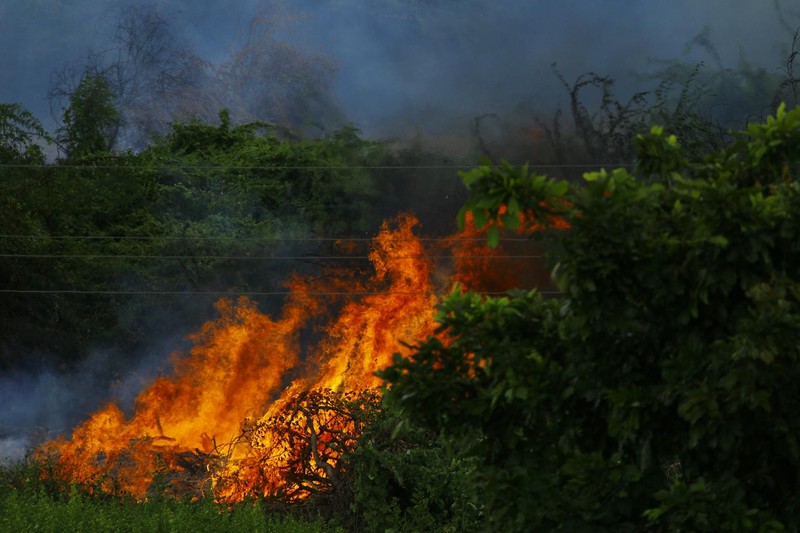
The 2019-2020 Australian bushfires tore through landscapes already cracked by drought. The combination was devastating: in areas where fire followed dry conditions, plant and animal species suffered 27 to 40 percent greater declines than in areas that burned alone.
A study published today in Nature Ecology & Evolution finds that this kind of compound assault — heat, fire, flood, and drought arriving in quick succession — will become routine for much of the world’s wildlife within decades. By 2085, under a medium-high emissions trajectory, 36 percent of the area within terrestrial vertebrates’ current geographic ranges is projected to face two or more types of extreme events in the same period.
The research was led by Stefanie Heinicke, a postdoctoral researcher at the Potsdam Institute for Climate Impact Research (PIK), with an international team of 18 scientists spanning multiple countries and disciplines. It covers 33,936 species — amphibians, birds, mammals, and reptiles — across 794 ecoregions worldwide. Rather than relying solely on temperature projections, the team used climate impact models: process-based simulations that translate climate data into tangible outcomes like burned area, flooded land, and soil moisture levels.
“I think climate change, and in particular extreme events, are still really being underestimated when it comes to conservation planning,” Heinicke said. “It’s not just going to be a gradual shift of temperature over many years.”
Single events alone are staggering
By 2050, under the medium-high emissions scenario (SSP3-7.0, which tracks current trends of continued high emissions), 74 percent of current land animal habitats are projected to experience heatwaves. Wildfires could affect 16 percent of ranges, droughts 8 percent, and river floods 3 percent. By 2085, heatwave exposure reaches 93 percent of species’ ranges. Wildfire exposure climbs to 25 percent.
Co-author Katja Frieler, who heads the Inter-Sectoral Impact Model Intercomparison Project at PIK, flagged the wildfire findings as particularly significant. “I don’t know of another study that has projected wildfire exposure for animals yet, so seeing that there is a bigger threat from fires than drought for example; this was a significant blind spot,” she said.
Amphibian ranges face disproportionately strong drought exposure by 2085, while flood risks concentrate in localized areas of Central Africa, taiga, and tundra.
The compound threat multiplies the damage
The study’s central finding is about what happens when these events stack. By 2050, 22 ecoregions — mainly mid-latitude zones — will have at least half their area exposed to two or more event types. By 2085, that number reaches 236 ecoregions.
Species-rich regions face the brunt: the Amazon basin, tropical Africa, and Southeast Asia emerge as hotspots across virtually every projection. Southeast Asia is especially exposed for threatened species.
The damage compounds because it arrives from multiple directions at once. The 2019-2020 Australian heatwave killed more than 72,000 flying foxes. The Pantanal fires that same year killed an estimated 17 million vertebrates. Carnaby’s Black Cockatoo lost 60 percent of its population after a single 2011 heatwave in Western Australia. A review of 519 studies cited in the paper found 57 percent documented negative species responses, including 31 cases of local extirpation and 100 cases of population decline exceeding 25 percent.
Emissions still write the ending
Under a low-emissions pathway (SSP1-2.6), roughly aligned with the Paris Agreement goal of limiting warming to below 2°C, only 9 percent of land animal habitats would face multiple extreme events by 2085 — a quarter of the medium-high scenario’s toll.
“There’s still a lot of difference we can make by cutting emissions as fast as we can from today,” Heinicke said.
The study acknowledges limitations: a relatively coarse spatial resolution, the exclusion of small islands where endemic species face particular risk, and the assumption that species ranges remain static rather than shifting in response to changing conditions. But the direction is unambiguous. The question for global wildlife is no longer whether extreme events are coming — it is how many kinds will arrive at once, and whether emissions fall fast enough to reduce the count.
Sources
- Land vertebrates increasingly exposed to multiple extreme events by 2085 — Nature Ecology & Evolution
- A third of animal habitats on land could experience multiple extreme events by 2085, new study suggests — Potsdam Institute for Climate Impact Research