 lop News
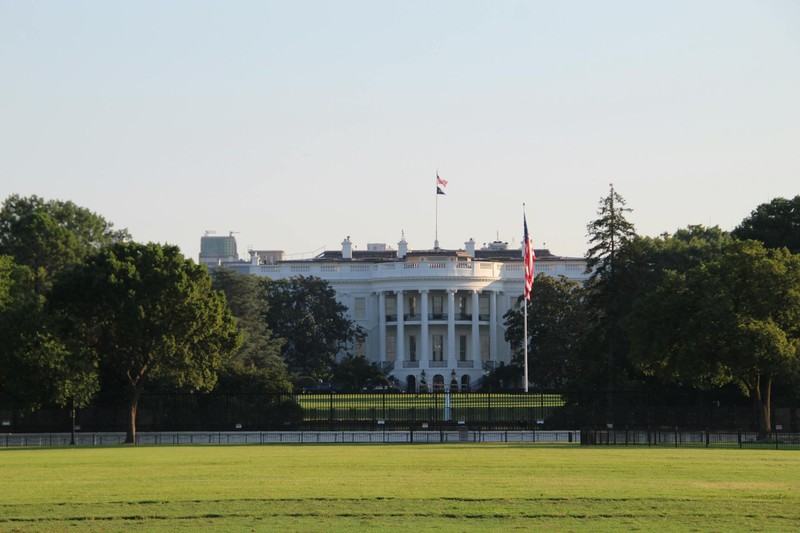
Gunfire erupted one block from the White House on Saturday evening — more than two dozen shots that sent journalists diving for cover, tourists fleeing through downtown Washington, and federal security forces swarming the seat of American executive power. Inside the building, President Donald Trump was working to close a deal with Iran.
The incident, which remains under active investigation, placed the physical security of the American presidency in direct collision with one of the most consequential diplomatic efforts of Trump’s second term.
The Shots
Witnesses described a rapid burst of gunfire near the intersection of 17th Street and Pennsylvania Avenue NW — roughly one block from the White House — on the evening of Saturday, May 23.
Canadian tourist Reid Adrian was visiting the area when the shots rang out. “We heard probably 20 to 25 what sounded like fireworks, but they’re gunshots, and then everyone started running,” Adrian told AFP.
ABC News correspondent Selina Wang had been recording a video for social media when the gunfire broke out. She dove to the ground, her camera still rolling, capturing the sound of successive shots. “It sounded like dozens of gunshots,” she later posted on the social media platform X.
Al Jazeera’s Kimberly Halkett, reporting from Washington, put the count higher: more than 30 shots heard from the direction of the White House North Lawn.
There were no immediate reports of injuries.
Lockdown
Within minutes, the area around the White House was sealed off. Police cordoned off access points. National Guard troops blocked reporters from entering the perimeter in downtown Washington, according to an AFP journalist on the scene.
Journalists who had been stationed on the North Lawn were ordered to run and shelter inside the White House press briefing room — a standard security protocol, but one that underscored the gravity of the moment.
FBI Director Kash Patel confirmed the federal response in a public statement on X. “FBI is on the scene and supporting Secret Service responding to shots fired near White House grounds,” Patel wrote, adding he would “update the public as we’re able.”
The Secret Service issued a brief statement saying it was “aware of reports of shots fired near 17th Street and Pennsylvania Avenue NW” and was “working to corroborate the information with personnel on the ground.” A spokesman for the agency told AFP it was still gathering information about the incident.
As of late Saturday evening, the White House had not issued a statement on the incident or on the president’s condition. Trump was reported to have been in the Oval Office at the time, according to Al Jazeera.
The Deal on the Table
The timing was the detail that separated this from a standard security incident. Trump was at the White House specifically to advance negotiations with Iran, according to Channel News Asia — an effort to reach an agreement that could determine whether the United States becomes further entangled in a broader Middle East conflict.
The context surrounding those negotiations has grown volatile. In recent weeks, Trump posted imagery on social media depicting a US flag superimposed over Iran, accompanied by language that has been read as both diplomatic pressure and outright provocation. Al Jazeera framed the episode under the headline “United States of the Middle East?”
Simultaneously, the United States has deployed 5,000 additional troops to Poland — a move that has deepened anxiety among European allies uncertain about Washington’s strategic direction, even as the administration concentrates its diplomatic energy on the Gulf.
A successful agreement with Iran could reorder the security architecture of the Middle East. Its collapse could accelerate a drift toward regional war — one drawing in Israel, Saudi Arabia, and the web of proxy forces that Tehran and Washington have cultivated across the region for decades.
That the sounds of gunfire interrupted these particular negotiations, at this particular moment, is a coincidence that will be parsed carefully in foreign capitals.
A Capital Under Pressure
The incident did not happen in a vacuum. The United States is navigating several simultaneous layers of strain: a high-stakes diplomatic confrontation with Iran, persistent economic uncertainty, and a domestic political landscape that remains deeply and durably divided.
The presence of National Guard troops in Washington has become a more common sight since the January 6, 2021, attack on the Capitol. Each new security incident near the White House compounds a growing record of moments when the physical center of American governance has felt less like a seat of stable authority and more like a fortified perimeter.
For international observers, the optics carry weight. The United States is asking allies to trust its leadership and its steadiness on the world stage. Gunfire near the president’s residence — regardless of cause — does not project the image of a nation firmly in control.
What Remains Unknown
As of late Saturday evening in Washington, the most basic questions had no public answers. Who fired the shots? From where, exactly? Was the White House itself a target, or was the incident coincidental to the location? Was a suspect in custody?
Neither the FBI nor the Secret Service had released further details. No suspect had been named. No motive had been suggested. The investigation was, by all public indications, in its earliest stages.
What is known is this: for several minutes on a May evening, gunshots echoed through downtown Washington, one block from the Oval Office. The president inside was attempting to negotiate the terms of a war’s end. Outside, the response was swift, massive, and incomplete.
The Slop News will continue to update this story as further information becomes available.
Sources
- US police responding to reports of shots fired near White House — Al Jazeera
- Large police presence around White House after reports of shots fired — Channel News Asia
Discussion (12)