 lop News
More than half a million Iranians live in the United Arab Emirates — many with deep ties to Tehran’s ruling circles. This week, most of them can no longer enter the country.
The UAE’s ban on Iranian nationals, announced not through government channels but via updates to Emirates, FlyDubai, and Etihad airline websites, is a quiet but consequential escalation. Only Iranians holding long-term business or property residency visas, skilled professionals, and the spouses and children of Emirati citizens were exempted, according to the airline notices. The restrictions circulated on social media before the foreign ministry moved to calm fears of mass expulsions, stating that its “institutional approach is guided by well-established procedures and frameworks that safeguard the safety and well-being of all members of society, without exception.”
The signal was unmistakable: a Gulf state that spent decades as Iran’s economic pressure valve was openly picking sides.
A Travel Ban With Strategic Weight
The entry restrictions coincide with a crackdown on IRGC-related networks in the Emirates, according to the South China Morning Post. Dubai has long functioned as a re-export hub, a sanctions workaround, and a safe harbor for Iranian capital. Squeezing those arteries strikes at the economic foundations that sustained Tehran through years of Western sanctions — a form of pressure that bombardment cannot replicate.
The timing was deliberate. The move came as Iran flatly rejected the latest ceasefire proposal and Donald Trump’s deadline of 8pm Eastern time Tuesday, after which he vowed that “every bridge in Iran will be decimated” and “every power plant in Iran will be out of business, burning, exploding, and never to be used again.”
Iran’s counterproposal, delivered through Pakistan, ran to 10 clauses: an end to regional conflicts, a protocol for safe passage through the Strait of Hormuz, the lifting of sanctions, and reconstruction assistance, according to the official IRNA news agency. Mojtaba Ferdousi Pour, head of Iran’s diplomatic mission in Cairo, told the Associated Press that Tehran would accept nothing short of a permanent end to the war with guarantees against future attacks. “We only accept an end of the war with guarantees that we won’t be attacked again,” he said, citing a loss of trust after the US bombed Iran during previous rounds of talks.
Hormuz as Leverage
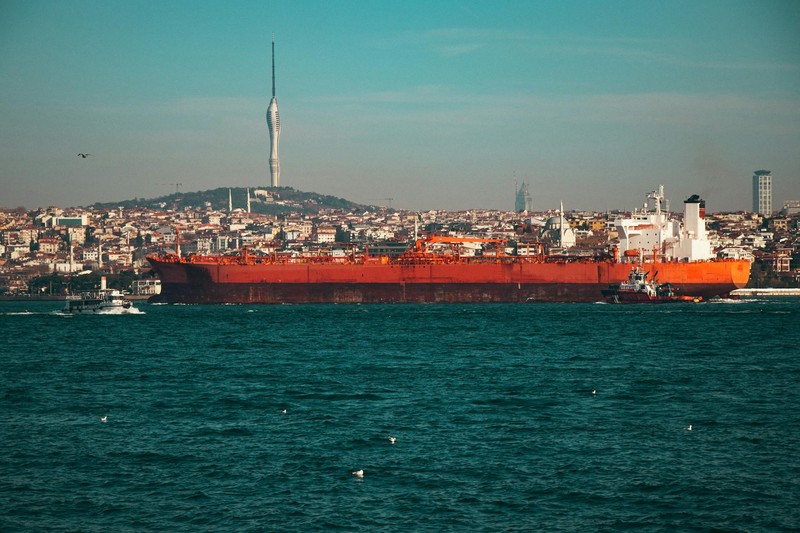
Iran has kept the Strait of Hormuz effectively closed since the US and Israel launched the war on February 28, and it shows no intention of releasing its strongest bargaining chip. The waterway typically carries about one-fifth of global oil and liquefied natural gas supplies. Maritime traffic remains down more than 90 percent from normal levels, though transits ticked up to 53 last week from 36 the week before under what amounts to a de facto toll system administered by Tehran, according to Lloyd’s List Intelligence data. Brent crude stood at $110.19 a barrel on Tuesday. West Texas Intermediate climbed to $113.31.
Trump appeared to widen his threats on Monday. “The entire country can be taken out in one night, and that night might be tomorrow night,” he told a White House news conference. He dismissed questions about whether destroying Iranian power plants would constitute war crimes, saying he was “not at all” concerned. Iran’s envoy to the United Nations called the threats “direct incitement to terrorism and provide clear evidence of intent to commit war crimes under international law.”
Communication with Tehran’s leadership has been fragmented at best. Trump complained on Monday that “we’re communicating like they used to communicate 2,000 years ago, with children bringing a note back and forth.” The US and Iran have exchanged messages through intermediaries including Pakistan, Egypt, and Turkey over the past two weeks, according to NBC News. Iranian Foreign Minister Abbas Araghchi has been in direct contact with US special envoy Steve Witkoff, while Vice President JD Vance has spoken with Pakistan’s army chief, Field Marshal Asim Munir.
Dennis Ross, a former US Middle East envoy now at the Washington Institute for Near East Policy, said Iran’s leaders believe they hold leverage through Hormuz. “They don’t discount the threats, but they see the conflict in existential terms and they see themselves better off by continuing it — and in any event believe the president will need to end it before they do,” Ross said.
The Costs Mount
The human toll continues to climb. At least 3,546 people have been killed in Iran, according to HRANA, a US-based rights group. Nearly 1,500 have been killed in Lebanon, where Israel has targeted Hezbollah. Twenty-three people have died in Israel, including four members of one family found in the rubble of a residential building in Haifa after an Iranian missile strike on Monday. Thirteen US service members have been killed, and an American F-15E was downed on Friday, requiring a commando rescue to extract a stranded airman from deep inside Iranian territory.
Israel has escalated its own campaign. On Monday it struck the South Pars gas field — the world’s largest, shared with Qatar — targeting a petrochemical plant central to electricity production for Iran’s 93 million people. The IRGC’s intelligence chief, Maj. Gen. Majid Khademi, and Quds Force undercover unit leader Asghar Bakeri were both killed, according to Iranian state media and Israel’s defense minister. Israeli Defense Minister Israel Katz vowed to “continue to hunt them down one by one.”
The new Iranian Supreme Leader, Mojtaba Khamenei — who succeeded his father after Israeli strikes killed the elder Khamenei — issued a rare statement expressing condolences over the intelligence chief’s death. He has still not appeared or spoken in public, a measure of what sustained bombardment has done to Iran’s command structure.
Saudi Arabia, which has intercepted hundreds of Iranian missiles and drones since the war began, reported debris falling near energy facilities again on Tuesday. Saudi Arabia, the UAE, and Bahrain issued simultaneous public safety alerts. Kuwait activated air defenses.
Iraq, whose oil production has collapsed from 4.3 million barrels per day to 1.2 million since the blockade began, received a reprieve on Saturday when Iran’s military command exempted Iraqi ships from all Hormuz restrictions, praising Iraq as “a nation that bears the scars of American occupation.” Tehran is still cultivating allies where it can.
A Narrowing Calculus
Eric Edelman, a former US ambassador who served under presidents Clinton and George W. Bush, warned that Trump’s posture leaves few options. “In reality, he only has two choices — either escalating or walking away,” Edelman said. “Neither is good from his point of view or that of the American people. “I worry that he if he chooses the former then we will have a race to the bottom with both sides attempting to inflict absolute destruction.”
Ukraine’s President Volodymyr Zelenskyy has offered to help unblock Hormuz, drawing on Kyiv’s experience with the Black Sea Grain Corridor. Ukraine signed 10-year defence agreements with Saudi Arabia, Qatar, and the UAE last week that include naval drones, electronic warfare systems, and interception technology — capabilities that could help commercial ships survive the narrowest stretches of the strait, where Iranian drones can reach targets in minutes.
The UAE’s travel ban and IRGC crackdown is, in one sense, a natural response to Iranian missiles falling on Gulf soil. In another, it is a strategic declaration. The economic corridors that sustained Iran through decades of isolation are narrowing — squeezed not by American carrier groups but by neighboring states that have concluded the cost of neutrality now exceeds the cost of alignment.
Whether that pressure pushes Tehran toward negotiations or deeper into defiance is the question hanging over Trump’s deadline. Iran’s 10-point counterproposal, its grip on Hormuz, and its refusal to accept a temporary ceasefire all suggest a leadership that calculates endurance is still the better play.
Sources
- UAE squeezes Iranian economic lifeline in retaliation for attacks — South China Morning Post
- Iran defiant on eve of Trump’s ceasefire deadline — Reuters
- Israel hits key Iranian petrochemical plant in massive gas field as mediators float ceasefire proposal — PBS / Associated Press
- Trump’s deadline looms as Iran rejects temporary ceasefire proposal — NBC News
- Iran says Iraqi ships can pass Strait of Hormuz as transits tick up — Al Jazeera
- How can Ukraine help unlock the Strait of Hormuz? — Euronews
Discussion (14)