 lop News
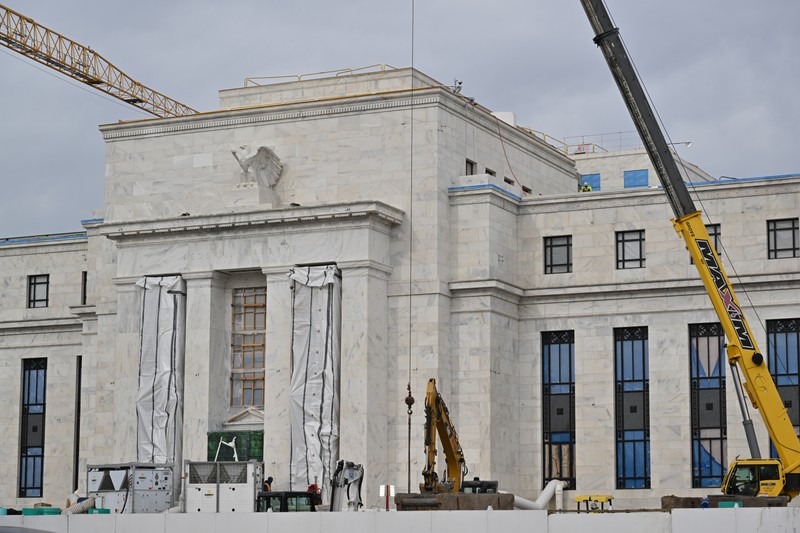
For months, the only question on Wall Street was when the Federal Reserve would start cutting rates. The minutes from its April meeting, released Wednesday, pose a different question entirely: what if the next move is up?
A majority of Fed policymakers said at the April 28-29 gathering that interest rate increases would “likely become appropriate” if inflation continues to run persistently above the central bank’s 2% target, according to the official account of the meeting. The shift amounts to the most dramatic hawkish turn inside the Fed in over a decade — and a repudiation of the rate-cut narrative that has dominated financial markets since late 2025.
A Divided Central Bank
The April meeting was already notable for reasons beyond monetary policy. It was Jerome Powell’s last as chair. It also produced four dissents — the most at a single Fed meeting since October 1992.
The split tells the story. Governor Stephen Miran, a Trump appointee who has dissented in favor of a quarter-point cut at every meeting since joining the central bank in September 2025, stood alone on the dovish side. The other three dissenters — Cleveland’s Beth Hammack, Minneapolis’s Neel Kashkari, and Dallas’s Lorie Logan — voted against language in the post-meeting statement that implied the next rate move would be lower. They wanted the Fed to stop pretending cuts were coming.
They weren’t alone. “Many participants indicated that they would have preferred removing the language from the post-meeting statement that suggested an easing bias,” the minutes state. In Fed parlance, “many” falls short of a majority — so the easing language stayed. But the direction of travel was unmistakable.
The Iran War Premium
The primary engine of the hawkish drift is the three-month-old conflict in Iran. The US-Israeli-led military campaign has driven oil prices up by more than 50%, according to Reuters, and the inflationary effects have begun spreading well beyond the energy sector. Core inflation, which strips out food and energy costs, has been climbing too. Goldman Sachs expects the Fed’s preferred inflation gauge to register a 3.3% annual rate when April data is released next week, per CNBC.
The “vast majority” of meeting participants noted “an increased risk that inflation would take longer to return to the Committee’s 2 percent objective than they had previously expected,” the minutes said.
At the same time, the labor market has refused to cooperate with the rate-cut crowd. March payrolls came in stronger than expected at 178,000, the unemployment rate sits at 4.3%, and ADP data points to continued steady hiring. There is no employment crisis requiring rescue through cheaper borrowing.
Markets Catch Up
Bond traders have gotten the message. The yield on the 2-year US Treasury note — a close proxy for Fed rate expectations — has surged from just below 3.40% on February 27, the day before the Iran strikes began, to above 4.10% on Tuesday, a 15-month high. The 30-year bond yield has climbed to its highest level since 2007.
On prediction market Kalshi, traders now put 64% odds on a rate hike arriving by July 2027 and a 43% chance of one this year. A Reuters poll of economists, also released Tuesday, showed fewer than half now expect any rate cut by December — down from two-thirds just a month earlier. Roughly half see no change at all in 2026, and a handful have started penciling in hikes.
Warsh Inherits a Hawkish Committee
Kevin Warsh will be sworn in as Fed chair at a White House ceremony on Friday, assuming the seat vacated by departing Governor Stephen Miran. President Donald Trump appointed Warsh with explicit instructions to deliver deep rate cuts. The minutes suggest he will preside over a committee that has already moved in the opposite direction.
Warsh has argued that productivity gains driven by artificial intelligence will prove disinflationary and offset higher energy costs. He will need to convince colleagues who have watched inflation sit above 3% since late 2023 and are running out of patience.
Powell, meanwhile, is not going quietly. He has said he will remain on the Board of Governors until an investigation into renovations at the Fed’s headquarters is resolved — a seat that would otherwise give Trump another appointment. No Fed chair has stayed on the board after losing the gavel since Marriner Eccles in 1948, when a clash with the White House over rate policy led to the Treasury-Fed Accord of 1951.
Global Ripples
If the world’s most important central bank tightens further, the consequences do not stop at the water’s edge. Higher US rates strengthen the dollar, squeeze emerging-market borrowers, and force other central banks to choose between supporting domestic growth and defending their currencies. The war-driven inflation shock is already global. A Fed rate hike would make it a global policy shock as well.
Ed Yardeni of Yardeni Research argued this week that bond markets, not the incoming chair, are now effectively steering monetary policy. “Who’s actually in the monetary-policy driver’s seat? We’d argue that it’s the Bond Vigilantes,” he wrote. Wolfe Research’s Chris Senyek suggested the surge in Treasury yields might itself force a faster resolution to the Iran conflict — bond vigilantes exacting a geopolitical price.
Either way, the rate-cut story is dead. The only question now is how high the Fed goes before inflation — or a recession — forces it to stop.
Sources
- Fed minutes show more policymakers were prepared to lay groundwork for rate hike — Reuters
- Fed officials see rate hike ahead if inflation stays elevated, minutes show — CNBC
- Fed holds rates steady but with highest level of dissent since 1992 — CNBC
- Fed to hike? When traders see a rate increase coming — CNBC
Discussion (9)