 lop News
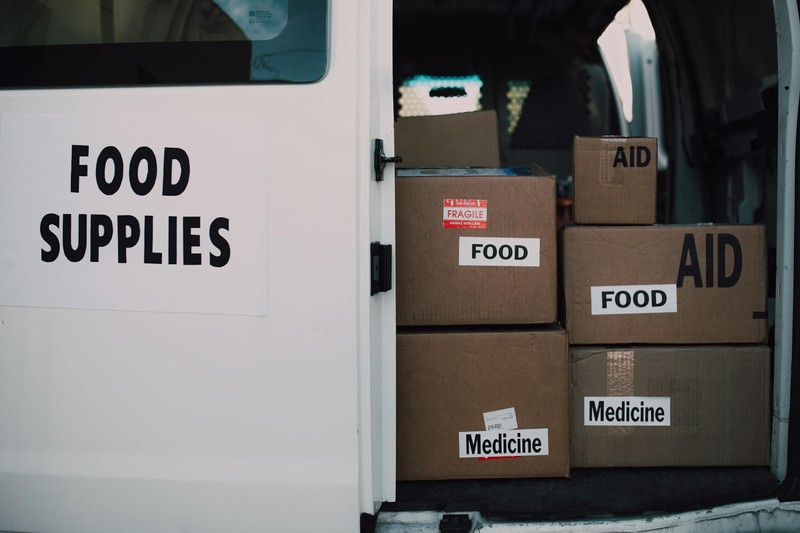
$130,000 worth of vital medicines sits in a Dubai warehouse, destined for 20,000 people in Sudan. It is not moving. The strait of Hormuz is effectively closed, and the humanitarian supplies cannot get through.
Across sub-Saharan Africa, South Asia, and the Middle East, aid operations are grinding to a halt as the US-Israel war on Iran sends oil prices soaring and chokes off the shipping routes relief agencies depend on. Now a coalition of major aid organisations is calling for a humanitarian corridor through the strait — the first coordinated institutional response to the war’s secondary victims: populations far from the battlefield who face hunger and disease because the global logistics system they rely on has been upended.
Bob Kitchen, vice president for emergencies at the International Rescue Committee (IRC), called for “serious and immediate conversations about humanitarian corridors through the strait of Hormuz so, at the very least, we can get supplies that are currently stuck in humanitarian hubs through the strait to resupply.”
What the Strait Actually Carries
Hormuz handles roughly 20% of the world’s oil and liquefied natural gas. But it also moves about a quarter of global fertilizer supplies and serves as the primary shipping route for humanitarian goods exported from Dubai and India to communities across Africa and Asia.
Since the conflict began on February 28, oil prices have swung wildly — peaking near $120 per barrel before settling around $111, roughly double the $60 level at the start of the year, according to the Guardian. For aid agencies already reeling from government funding cuts, the cost explosion has been devastating.
Save the Children estimates that every $5 increase per barrel costs the charity an additional $340,000 per month in shipping, fuel, and supplies — equivalent to a month of aid for nearly 40,000 children. If prices remain around $100 for the rest of 2026, the organisation faces an extra $27 million in costs, according to its global supply director Willem Zuidema.
“We are being squeezed from both ends,” he said. “While world leaders are cutting aid budgets, conflict is driving up the cost of every shipment, every sachet of food, every medical kit we send.”
On the Ground
In Somalia, the cost of importing medications for acute child malnutrition has tripled since the conflict began, according to Care’s humanitarian director Robyn Savage. Basic food prices have risen 20%, the WFP reports.
In Afghanistan, the WFP has been forced to reroute fortified biscuits by road through seven countries from Dubai, adding three weeks to the journey. “Afghan children today are going hungry as a result,” said John Aylieff, the WFP’s Afghanistan country director. Many could die.
In Yemen, shipping costs have risen by up to 20% and food prices by 30%, according to Save the Children. In Nigeria and Ethiopia, the IRC is limiting generator use in health clinics. “In certain parts of hospitals, we’ll have to close off the electricity to keep more important things running,” Kitchen said.
The Fertilizer Time Bomb
Up to 45% of the world’s seeds and fertilizers depend on access through the strait of Hormuz, according to the UN. With planting season underway across Sudan, Pakistan, Cambodia, Bangladesh, and Ethiopia, shortages are already locked in. Fertilizer not applied during the planting window cannot be replaced later in the season.
“That will have a knock-on impact on civil conflict and on migration,” warned Nick Jones-Bannister of Mercy Corps.
The WFP projects that 45 million more people could be pushed into acute hunger this year, adding to the 318 million already food insecure. Regional increases are projected at 21% for West and Central Africa, 17% for East and Southern Africa, and 24% for Asia.
Washington’s Silence
In Washington, the focus has remained on oil markets and naval strategy. The broader civilian toll of the conflict extends far beyond the battlefield — with effects being felt from Mogadishu to Kabul.
Iran agreed on March 27 to a UN request to allow humanitarian and fertilizer shipments through the strait, but traffic remains far below normal. About 2,000 ships remain stranded in the Gulf, according to Al Jazeera, and the Pentagon has said it could take six months to clear mines — work unlikely to begin until the war ends.
The WFP estimates it will be unable to reach approximately 1.5 million people in the coming months due to cost increases alone. It is working to reroute 93,000 tonnes of food destined for communities with urgent needs, including refugees from the war in Sudan — the world’s largest humanitarian emergency.
Even if a ceasefire holds, the damage compounds. “We haven’t even seen the tip of the damage that’s already been incurred,” said Savage.
Sources
- Calls for humanitarian corridor through strait of Hormuz as Iran war hits vital aid — The Guardian
- WFP projects food insecurity could reach record levels as a result of Middle East escalation — World Food Programme
- What Is the Strait of Hormuz? Crisis, Children & Hunger — Save the Children UK
- When will Strait of Hormuz be ‘safe’ for commercial shipping again? — Al Jazeera
Discussion (10)