 lop News
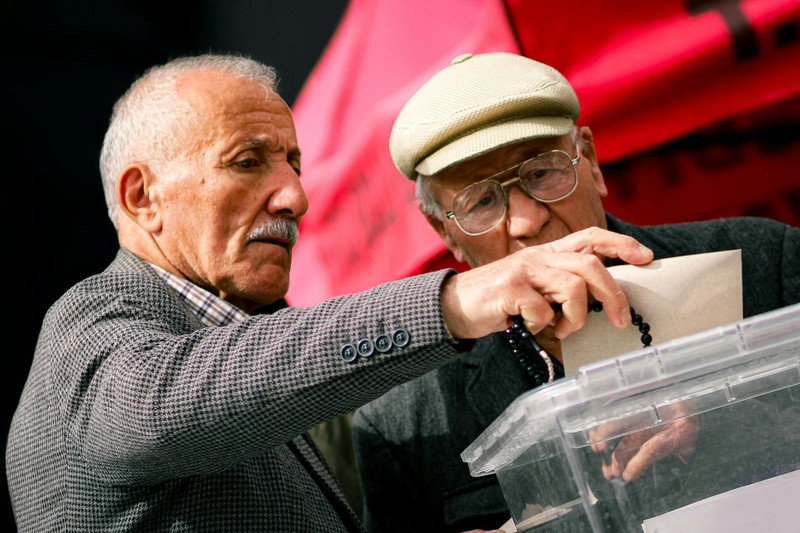
Campaign banners hang from buildings still standing in Deir al-Balah. Inside tents and donated structures, wooden ballot boxes sit on folding tables alongside ink repurposed from a vaccination drive. In the West Bank, the mood is festive — voters queue with blue-stained fingers, families bring children, photographers jostle for angles.
These are the first Palestinian elections of any kind since the Gaza war began more than two years ago. And they are taking place in a political landscape so circumscribed that the word “election” carries considerable qualification.
Nearly 1.5 million Palestinians are registered to vote across the occupied West Bank, with 70,000 eligible in Deir al-Balah — the central Gaza city chosen as the sole polling location in the strip because it was spared an Israeli ground invasion and the mass displacement that emptied other areas. Results are expected late Saturday or Sunday.
By early afternoon, turnout stood at 25.3% in the West Bank and 13.8% in Deir al-Balah, according to the Ramallah-based Central Election Commission. The figure for Gaza is unsurprising: more than two years of war have killed over 72,000 people, according to the territory’s health ministry, whose figures the UN considers reliable. Public infrastructure, sanitation, and health services barely function.
A ballot without Hamas
No list affiliated with Hamas appears on any ballot. In January, 90-year-old President Mahmoud Abbas signed a decree requiring candidates to accept the PLO’s political program — which includes recognizing Israel and renouncing armed struggle — effectively barring Hamas and several allied factions from standing. Some of those factions boycotted in protest.
The result is the thinnest candidate field in six rounds of local elections. Most lists are aligned with Fatah or feature independents, some with ties to smaller factions like the Popular Front for the Liberation of Palestine. In several cities, including Ramallah and Nablus, there are no contested races at all. The PA will appoint councils in those locations.
In Qalqilya, no slates registered. “This isn’t transparency,” Marwan Ennabi told the Associated Press. “This is chaos, chaos, chaos!”
One list in Deir al-Balah is widely viewed by residents and analysts as aligned with Hamas, according to Reuters, though the group has not formally nominated candidates. Hamas has said it will respect the results, and its civil police were reportedly deployed around Gaza polling stations.
What municipal councils can and cannot do
The councils up for election oversee basic services — water, sanitation, roads, electricity. They do not legislate. Their authority exists within the framework of an occupying power that controls borders, movement, and the entry of basic materials.
Election commission chairman Rami Hamdallah said Israel blocked ballot paper, boxes, and ink from entering Gaza. COGAT, the Israeli military body overseeing humanitarian affairs, did not respond to Associated Press questions about the claim. The commission improvised with wooden boxes and leftover ink.
In the West Bank, the constraints are different but real. Israeli military checkpoints and settlement expansion have constricted Palestinian life. The PA has struggled to pay civil servant wages as Israel withholds tax revenues it collects on the PA’s behalf — a dispute over welfare payments to prisoners and to families of those killed by its forces, which Israel argues incentivize attacks.
“Whether candidates are independent or partisan, it has no effect,” Mahmud Bader, a Tulkarem businessman, told AFP. “The occupation is the one that rules Tulkarem. It would only be an image shown to the international media — as if we have elections, a state or independence.”
Symbolism, reform, and the long stalemate
The PA has promoted these elections as both a reform milestone and proof of its claim to govern all Palestinian territories. “Gaza is an inseparable part of the state of Palestine,” Abbas said after casting his ballot in Al-Bireh.
Western donors have increasingly tied support to visible governance reforms. The European Union called the vote “an important step towards broader democratisation.” The UN’s deputy special coordinator for the Middle East Peace Process, Ramiz Alakbarov, commended the commission for a “credible process.”
The gap between ceremony and substance remains wide. The ceasefire that halted the Gaza war in October, under US President Donald Trump’s 20-point plan, has produced little progress toward its stated next phases — disarming Hamas, reconstruction, and transferring governance to an international board and unelected Palestinian committee. No presidential or legislative elections have been held since 2006.
In Deir al-Balah, 24-year-old Mohammed al-Hasayna framed the vote as a gesture toward survival. “We are an educated people with strong determination, and we deserve to have our own state,” he told AFP. “Enough wars.”
His was one of twelve polling stations in a city of 70,000 eligible voters. The rest of Gaza was not invited to participate.
Sources
- Local elections in the West Bank and part of Gaza could test public trust — Associated Press
- Palestinians in West Bank and some in Gaza vote in local elections — BBC News
- Palestinians cast ballots in first elections since Gaza war — Channel News Asia
- Palestinians vote in local elections for first time since Gaza war — France 24
Discussion (9)