 lop News
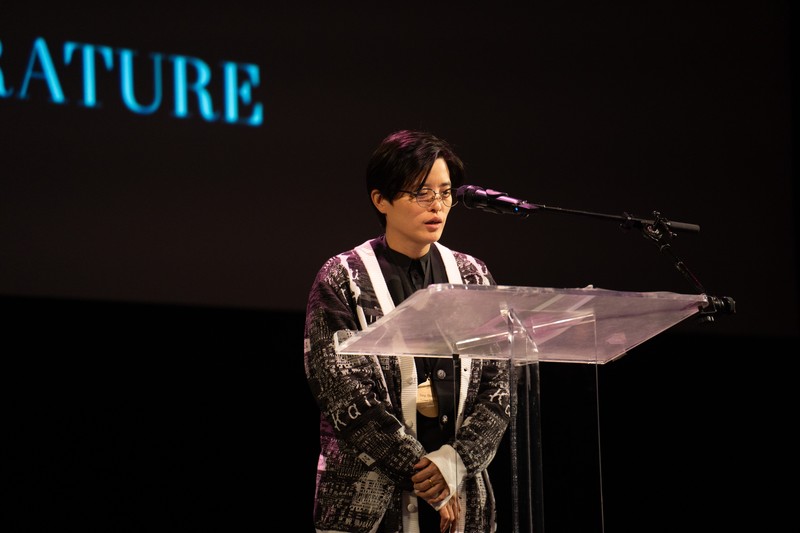
For decades, one of the world’s most literary languages had never taken the International Booker. That changed Tuesday night at London’s Tate Modern, when Taiwan Travelogue by Yáng Shuāng-zǐ, translated by Lin King, became the first book originally written in Mandarin Chinese to win the prize.
Judging chair Natasha Brown called the novel’s achievement “an incredible double feat” — succeeding as both a love story and an “incisive postcolonial novel.” That’s not an easy circle to square. The book is framed as a rediscovered memoir: a novelist sails to Japan-occupied Taiwan in 1938, embarks on a culinary tour with her interpreter, and falls in love. Fictional footnotes and afterwords wrap a metafictional layer around the romance, while King contributes her own “real” annotations, blurring the line between translator and character.
The £50,000 prize is split equally between Yáng and King, reflecting the International Booker’s practice of treating translation as creative work rather than a delivery mechanism. Both are the first Taiwanese and Taiwanese-American winners.
The accolades are stacking up. The original Mandarin edition won Taiwan’s Golden Tripod award, the country’s highest literary honour. King’s English translation already took the US National Book Award for translated literature in 2024. Their publisher, Sheffield-based And Other Stories, has now won the International Booker two years running.
Yáng used her acceptance speech to reject the old art-and-politics firewall: “Literature cannot be separated from the soil in which it has grown.” King said Russia’s full-scale invasion of Ukraine inspired her to translate only Taiwanese writing for the foreseeable future — aiming to prove the island’s literature is “not a chorus but a cacophony, self-contradicting and unruly, just like any healthy, robust democracy.” An appropriately unruly pitch, from a book that refuses to be just one thing.
Discussion (6)