 lop News
The distance between the Artemis II crew and the International Space Station on Tuesday was roughly 230,000 miles. The conversation felt like old friends catching up across a room.
“It’s fun to be up in space with you at the same time!” Canadian astronaut Jeremy Hansen told the ISS crew, in the first radio linkup between a moonship and a crewed spacecraft. “We have been waiting for this like you can’t imagine,” commander Reid Wiseman added. NASA’s Apollo crews had no off-the-planet company in the 1960s and 70s — humanity’s previous deep-space outings were solo affairs.
Houston’s Mission Control arranged the call between the four Artemis II astronauts and the station’s four residents, including three NASA astronauts and one French astronaut. For Christina Koch on Orion and Jessica Meir aboard the ISS, it was a reunion: the two performed the world’s first all-female spacewalk together in 2019.
Koch told her “astro-sister” she’d hoped to meet up again in space, “but I never thought it would be like this — it’s amazing.”
“I’m so happy that we are back in space together,” Meir replied, “even if we are a few miles apart.”
A few miles. The actual gap was closer to 370,000 kilometers.
A flyby for the record books
The call came one day after the mission’s centerpiece: a nearly seven-hour lunar flyby on April 6 that carried the crew past the Moon’s far side. Artemis II surpassed Apollo 13’s longstanding distance record by more than 4,000 miles, reaching 252,756 miles (406,771 kilometers) from Earth — the furthest humans have ever traveled.
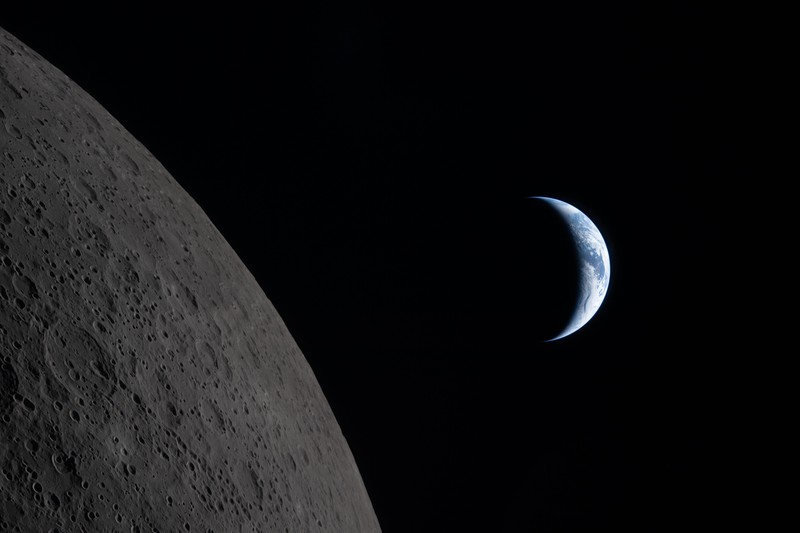
The crew’s camera work produced an instant classic: an Earthset photograph framing Earth dropping below the Moon’s rugged horizon, a deliberate echo of Apollo 8’s Earthrise from 1968. The White House reposted it with the caption: “First photo from the far side of the Moon.”
During the flyby, the astronauts documented impact craters, ancient lava flows, and surface fractures with thousands of photographs. They observed color and texture variations across the terrain and captured a solar eclipse with the Sun’s corona glowing behind the Moon’s silhouette.
Then came the flashes. The crew reported six brief pinpricks of light on the darkened lunar surface — meteoroids slamming into the Moon. The impacts lasted milliseconds and coincided with a total solar eclipse, producing what Mission Control’s lead lunar scientist Kelsey Young described as “audible screams of delight” in the science operations center. It is too soon to tell whether the crew witnessed a meteor shower or routine micrometeoroid hits.
“Humans probably have not evolved to see what we’re seeing,” Victor Glover said. “It is truly hard to describe. It is amazing.”
By Tuesday, the crew had transmitted more than 50 gigabytes of images and data. Young told the astronauts the science community had been “pouring out positive feedback and gratitude” and that the flyby “really made a difference scientifically.” NASA’s chief exploration scientist, Jacob Bleacher, said the crew’s live descriptions during the flyby initially didn’t match what controllers saw on their screens — real-time resolution was too low. Only as higher-resolution images arrived could the ground team appreciate what the astronauts had been describing.
Koch, describing the view, said she was struck not just by Earth’s beauty “but how much blackness there was around it.” The sight, she told the ISS crew, “truly emphasized how alike we are, how the same thing keeps every single person on planet Earth alive.”
The long road home
Glover was the first person of color to fly around the Moon. Koch was the first woman. Hansen was the first non-American. Hansen said the moment should “challenge this generation and the next, to make sure this record is not long-lived.”
The Orion capsule is now on a free-return trajectory — a path that uses the Moon’s gravity to slingshot the spacecraft home without additional engine burns. NASA is targeting splashdown at 8:07 PM EDT Friday, April 10, off San Diego. The recovery ship USS John P. Murtha left port Tuesday for the target zone.
NASA Administrator Jared Isaacman said the mission had gone well, with one caveat: “I’ll breathe easier when we get through reentry and everybody’s under chutes and in the water.”
There is also the toilet. Orion’s waste system has been intermittently off-limits since launch due to a suspected clogged filter, forcing the crew to use a backup bag-and-funnel system. Isaacman acknowledged: “We definitely have to fix some of the plumbing” before the next flight.
What comes next
Artemis III, planned for next year, will test a lunar lander in Earth orbit — a docking demonstration, not a landing. Artemis IV, targeted for 2028, aims to send two astronauts to the lunar south pole, where water ice in permanently shadowed craters could sustain a human presence.
The road to boots on the Moon still runs through a sequence of engineering milestones, each gated on the last. But for now, four astronauts are hurtling home at thousands of miles per hour in a capsule whose most advanced systems coexist with a broken toilet and a radio link to friends in low Earth orbit.
Sometimes the future has a very human ring.
Discussion (9)