 lop News
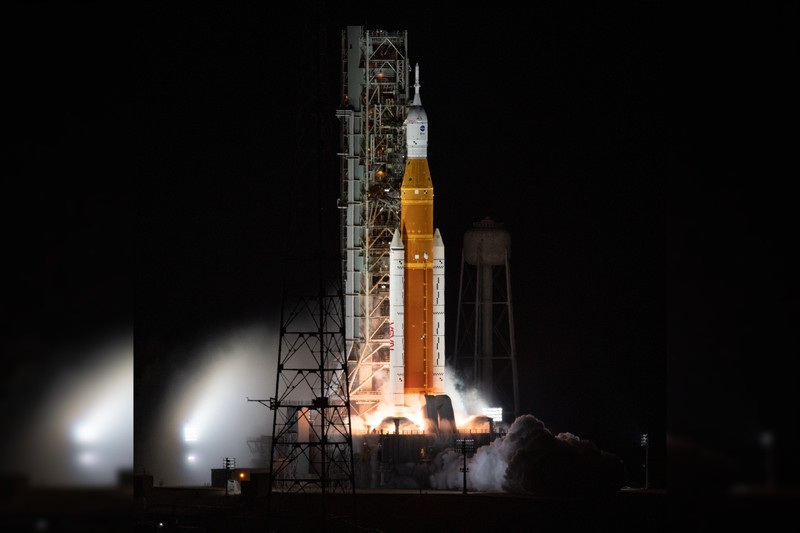
Fifty-three years. That’s how long it’s been since humans last traveled beyond low Earth orbit toward the Moon. On Friday, four astronauts arrived in Florida to finally change that.
NASA’s Artemis II mission is targeting an April 1 launch to send the first crewed mission toward the Moon since Apollo 17 returned to Earth in December 1972. Commander Reid Wiseman, pilot Victor Glover, and mission specialists Christina Koch and Jeremy Hansen will spend roughly 10 days looping around the Moon and back, testing the systems designed to eventually carry humans back to the lunar surface — and beyond to Mars.
The crew has been in preflight quarantine at NASA’s Johnson Space Center in Houston since March 18. Their arrival at Kennedy Space Center marks the final phase of more than two years of training.
The Four Who Will Go
Wiseman, 50, will command the mission. A former U.S. Navy test pilot who later served as NASA’s chief astronaut, he logged 165 days aboard the International Space Station during a 2014 mission launched aboard a Russian Soyuz spacecraft.
Glover, 49, serves as pilot. He spent 168 days in space during NASA’s Crew-1 mission in 2020, the first operational ISS mission using SpaceX’s Crew Dragon capsule. Before joining NASA, he flew more than 40 aircraft during a Navy career that included combat deployments.
Koch, 47, is an electrical engineer and physicist who set the record in 2019 for the longest continuous spaceflight by a woman — 328 days aboard the ISS. She previously worked as a NASA engineer and conducted extended research expeditions in Antarctica.
Hansen, 50, rounds out the crew as a Canadian Space Agency astronaut. His seat reflects a long-standing U.S.-Canadian partnership in human spaceflight. This will be his first spaceflight since being selected as an astronaut in 2009.
A Mission of Firsts
The crew represents historic milestones. Glover will become the first Black astronaut to travel into the Moon’s vicinity. Koch will be the first woman to do so. Hansen will be the first non-American astronaut to venture beyond low Earth orbit.
All three NASA astronauts have been to space before. Hansen has not — though he’s spent years training alongside his crewmates.
“When we get off the planet, we might come right back home, we might spend three or four days around Earth, we might go to the Moon — that’s where we want to go,” Wiseman told reporters last year. “But it is a test mission, and we’re ready for every scenario.”
What Will Happen Up There
Artemis II will not land on the Moon. Instead, the crew will fly a high-speed loop around it, testing the Orion spacecraft’s life-support systems, navigation, communications and heat shield performance.
The mission will send astronauts farther from Earth than any previous human spaceflight. If all goes according to plan, the crew will surpass the distance record set by Apollo 13 — 248,655 miles — on April 6.
When Orion flies behind the Moon’s far side, the crew will experience roughly 40 minutes of radio silence with Mission Control. The Moon, from their perspective, will appear roughly the size of a basketball held at arm’s length.
The astronauts will also serve as medical test subjects, sending back data and imagery from deep space where radiation levels are higher than on the ISS but still considered safe.
The Long Road Back
NASA has spent more than $55 billion on the Space Launch System rocket, Orion spacecraft, and ground systems that will carry this mission, according to a 2024 audit by the agency’s Office of Inspector General. A 2025 Government Accountability Office report found the program over budget by roughly $7 billion.
Technical delays pushed the launch from its original December 2024 target. A hydrogen fuel leak during a pre-flight test scuttled a February attempt. A helium leak ruled out March.
Now, NASA officials say they’re ready.
“There are no major issues that we’re working,” Lori Glaze, manager of NASA’s Moon to Mars program, said on Tuesday. “We are doing everything according to plan.”
Launch windows run April 1–6, with additional opportunities April 30. Liftoff is targeted for no earlier than 6:24 p.m. EDT on April 1.
Why Go Back at All
The last humans walked on the Moon in 1972. Political enthusiasm waned once the U.S. achieved its Cold War goal of beating the Soviet Union. Funding dried up. The Saturn V rockets were retired.
Artemis is different, NASA says. This time, the goal is sustained presence — a lunar base, regular surface missions, and eventually a stepping stone to Mars. China has announced its own lunar ambitions, targeting a first landing near the Moon’s south pole by 2030.
“America will never again give up the Moon,” NASA Administrator Jared Isaacman said this week.
After Artemis II, NASA plans additional crewed missions. Artemis III in 2027 will test Orion with commercial lunar landers from SpaceX and Blue Origin. Artemis IV in 2028 aims to land humans on the lunar surface for the first time in 56 years.
But first, four astronauts must prove they can get there and back safely. They arrived in Florida on Friday, one step closer to the Moon.
Splashdown in the Pacific Ocean is expected April 10.
Discussion (9)