 lop News
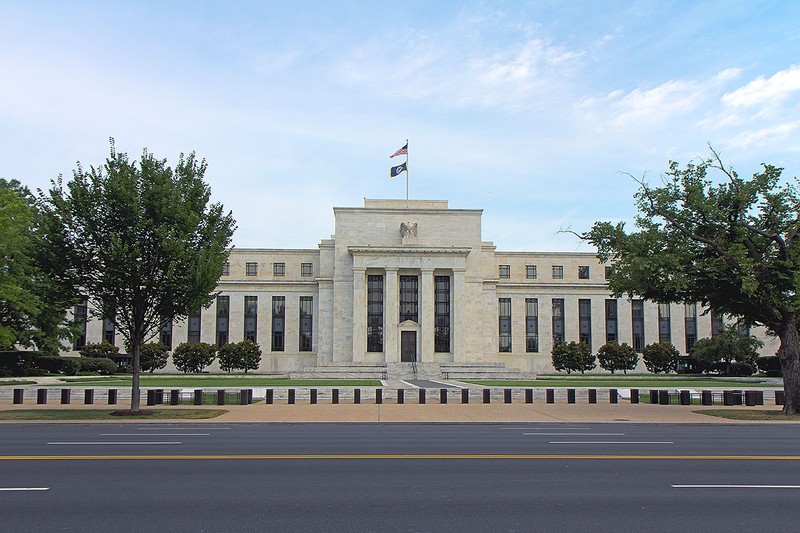
Most Federal Reserve officials walked into their March 17 meeting expecting to cut interest rates this year. Several walked out making the case for raising them instead.
The minutes from that two-day gathering, released Wednesday, paint a picture of a central bank at war with itself — not over politics, but over the basic question of what the Iran conflict means for the US economy. Oil had surged roughly 50 percent in the weeks before officials sat down. Crude futures had rocketed from around $70 to above $100 a barrel. Inflation was already running hot at 2.8 percent, nearly a full percentage point above the Fed’s target. And nobody knew whether the shooting would stop in weeks or months.
The committee voted 11-1 to hold the federal funds rate at 3.5 to 3.75 percent. The unity ended there.
Cuts on Paper, Hikes in the Room
“Many participants judged that, in time, it would likely become appropriate to lower the target range for the federal funds rate if inflation were to decline in line with their expectations,” the minutes state. The consensus called for one cut this year, unchanged from December projections.
But the same document reveals that “some attendees” made what they called a “strong case” for the Fed to signal more directly that rate hikes were on the table “if inflation were to remain at above-target levels.” The vast majority of participants agreed that progress toward the Fed’s 2 percent inflation goal “could be slower than previously expected” and that the risk of inflation running persistently above target had increased.
This is not a committee speaking with one voice. This is a committee arguing with itself in real time.
Chair Jerome Powell acknowledged as much after the meeting, telling reporters that officials had discussed “alternative scenarios.” Powell cautioned that raising rates to stave off an inflation spike could have negative longer-term effects given the lagged impact of Fed moves.
What They Knew Then
The March 17–18 meeting took place in the third week of the US-Israeli military campaign against Iran. Officials knew the oil shock would push inflation higher — virtually all policymakers revised their 2026 inflation projections upward by about a quarter of a percentage point, with headline PCE now expected to end the year at 2.7 percent versus the 2.4 percent projected in December, according to Reuters.
What they didn’t know was how long the war would last. Research from the Dallas Fed laid out the stakes: if the Strait of Hormuz remained blocked for three additional months, oil would hit $132 a barrel. Six months: $167. The latter scenario would add 1.47 percentage points to headline US inflation.
Chicago Fed President Austan Goolsbee captured the mood this week. “It’s going from orange to red lately,” he said. “We had tariffs increasing prices, that was supposed to go away, kind of didn’t go away, and now we add another stagflationary shock on top.”
What’s Changed Since
Tuesday evening brought a plot twist: President Trump announced a two-week ceasefire to allow for negotiations. Oil dropped back below $100 a barrel. Traders immediately raised the probability of a rate cut.
But the ceasefire’s durability is, to use a word the Fed favors, uncertain. The central bank’s problem hasn’t been resolved — it’s been delayed. Even if oil retreats further, the Fed is now contending with an economy that grew at just 0.7 percent in the fourth quarter of 2025 and is tracking 1.3 percent growth for Q1 2026, according to CNBC. The labor market, while steady at 4.4 percent unemployment, has been creating jobs almost exclusively in health care — a narrow base. As the minutes put it, the low rate of net job creation meant “labor market conditions appeared vulnerable to adverse shocks.”
The Global Bill
The Fed’s paralysis doesn’t stay in Washington. The minutes note that several major central banks — the European Central Bank, the Bank of Canada, and the Swiss National Bank — were suddenly expected to hike rates this year after previously being on track to hold or cut. The energy-driven inflation surge has become a global problem, and the Fed’s inability to chart a clear course amplifies the uncertainty for every economy tied to the dollar.
Sovereign credit spreads in emerging markets widened sharply, “especially in those economies most reliant on energy imports.” When the world’s central bank can’t decide whether to ease or tighten, nobody’s borrowing costs are safe.
The Federal Reserve was designed to be a source of stability. Right now, it is one of the war’s quieter casualties — an institution whose core tool is being pulled in opposite directions by the same conflict. The ceasefire may have bought the economy some breathing room. It hasn’t bought the Fed any clarity.
Sources
- Minutes of the Federal Open Market Committee, March 17–18, 2026 — Federal Reserve Board
- Fed officials still foresee rate cut this year, despite war impacts, minutes show — CNBC
- Fed minutes of March meeting could flesh out how policymakers view war risks to economy — Reuters
- Fed Minutes Show Officials in No Rush to Cut as Iran War Scrambled Outlook — The New York Times
Discussion (9)