 lop News
Somewhere between 42 and 58 percent. By the end of this century, that is how much of the Atlantic Meridional Overturning Circulation — the vast conveyor belt that carries tropical warmth to Europe and shapes weather across three continents — could vanish. Not the worst-case projection. The most accurate one.
A study published in April in Science Advances found that previous estimates of the AMOC’s decline were systematically too optimistic. By combining real-world ocean observations with climate models using a statistical method called ridge regression, researchers arrived at a central estimate: a roughly 51 percent slowdown by 2100. That is 60 percent worse than the model average.
The IPCC already considers a 50 percent AMOC weakening to be “substantial.” The system is currently at its weakest point in at least 1,600 years.
What happens when the conveyor belt slows
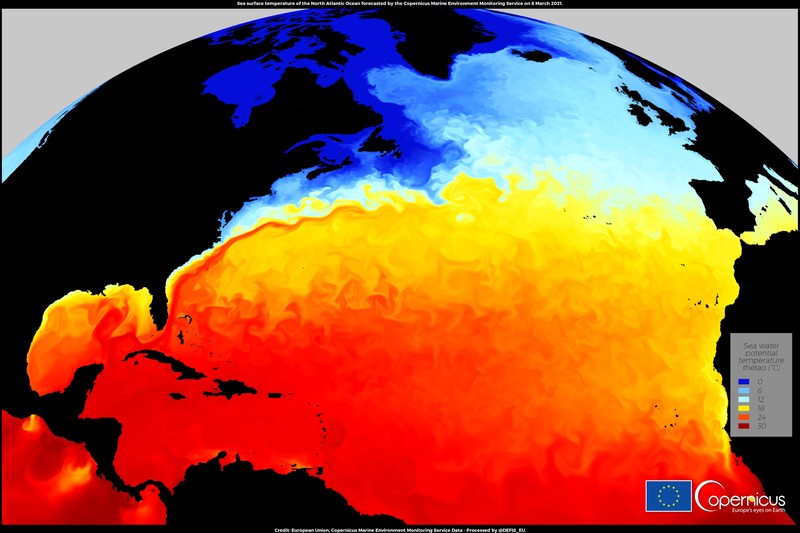
The AMOC carries warm, salty surface water northward from the tropics. In the North Atlantic, the water cools, becomes denser, and sinks, forming a deep return current that flows south again. This cycle redistributes heat on a planetary scale.
Arctic warming is disrupting it. Warmer air means the ocean cools more slowly. Slower cooling means less dense water, which sinks more sluggishly. Additional rainfall over the North Atlantic further dilutes surface salinity, compounding the problem in a feedback loop.
A full AMOC collapse would shift the tropical rainfall belt on which millions of people rely to grow their food, plunge western Europe into extreme cold winters and summer droughts, and add 50 to 100 centimeters to already rising sea levels around the Atlantic. Such a collapse — which scientists say could happen if the system passes a tipping point, possibly as early as mid-century — would last for hundreds to thousands of years. The amount of land suitable for growing wheat and maize, which supply roughly two-fifths of global calories, would be cut by more than half.
The models were arguing. Now they’re not
Climate scientists have long acknowledged a frustrating spread in AMOC projections. Some models showed minimal further weakening by 2100; others predicted declines as steep as 65 percent. The new study, led by Dr Valentin Portmann at the Inria Centre in France, used four methods to compare model outputs against observed ocean temperature and salinity data. The models that matched reality best were the ones showing the strongest weakening.
“We found that the AMOC is going to decline more than expected compared to the average of all climate models,” Portmann said. “This means we have an AMOC that is closer to a tipping point.”
A companion study from the University of Miami, also published in Science Advances, provided the observational backbone. Researchers analysed 20 years of data from four deep-ocean monitoring arrays along the western boundary of the North Atlantic and found a consistent decline at every latitude measured — from the subtropics to mid-latitudes.
Shane Elipot, a physical oceanographer at the University of Miami and senior author of that study, described the western boundary measurements as “the canary in a coal mine” for detecting large-scale shifts in Atlantic circulation.
A pattern of tipping points arriving early
Professor Stefan Rahmstorf of the Potsdam Institute for Climate Impact Research, who has studied the AMOC for 35 years, called the findings “very concerning.” He noted that the models do not include meltwater from the Greenland ice sheet — meaning the real-world decline could be even steeper.
“I now am increasingly worried that we may well pass that AMOC shutdown tipping point, where it becomes inevitable, in the middle of this century, which is quite close,” Rahmstorf said. He put the current risk of collapse at above 50 percent — a figure that would have been considered alarmist just a decade ago.
Not every scientist agrees on the timeline. María Paz Chidichimo, an ocean circulation expert at Argentina’s National Scientific and Technical Research Council, cautioned that model projections still vary significantly. Laura Jackson of the UK Met Office said “it is still an open question as to which model AMOC projections are most likely.”
But the direction of travel is clear. The AMOC is weakening. The best available evidence says it is weakening faster than consensus models predicted. And the consequences — for European agriculture, West African rainfall, North American coastal cities, and global food supplies — are not abstract future scenarios.
“Nations need to prepare now,” Chidichimo said. That may be the least controversial sentence in climate science. It is also the one most consistently ignored.
Sources
- Critical Atlantic current significantly more likely to collapse than thought — The Guardian
- A vital system of Atlantic Ocean currents is weakening and closer to collapse than thought, new studies find — CNN
- ‘Nations need to prepare now’: Key Atlantic ocean current is much closer to collapse than scientists thought — Live Science
- Scientists say a critical Atlantic ocean current is weakening and the world could feel the impact — Science Daily / University of Miami Rosenstiel School
Discussion (9)