 lop News
30 degrees Celsius inside the Arctic Circle. 50 degrees on Turkey’s Mediterranean coast. The hottest year Europe has ever recorded — by a margin that should trouble anyone who assumed climate reports had lost their power to shock.
2025 entered the books as Europe’s warmest year on record, according to the European State of the Climate report published Wednesday by the EU’s Copernicus Climate Change Service and the World Meteorological Organization. At least 95 percent of the continent saw above-average annual temperatures. Britain, Norway, and Iceland each logged their hottest year ever.
But the record itself isn’t the most striking finding. The rate is. Since 1980, Europe has been warming twice as fast as the global average, making it the fastest-warming continent on Earth. Temperatures are now roughly 2.5°C above pre-industrial levels.
“Heatwaves are becoming more frequent and severe,” said WMO Secretary-General Celeste Saulo. “And in 2025, we saw long duration heatwaves from the Mediterranean to the Arctic Circle.”
A Continent Without a Cold Season
Sub-Arctic Finland, Norway, and Sweden — known as Fennoscandia — endured a record 21-day heatwave in July. Temperatures hit 30°C within the Arctic Circle and peaked at 34.9°C. In an average year, the region sees perhaps two days of strong heat stress, when temperatures feel above 32°C. In 2025, parts of Fennoscandia suffered nearly two weeks of it.
Turkey hit 50°C for the first time. Eighty-five percent of Greece’s population endured temperatures at or above 40°C, peaking at 44°C. Spain weathered its most intense heatwave since at least 1975. Two significant heatwaves struck western and southern Europe in June alone, then a third in August.
Europe’s winters are physically shrinking. The area experiencing freezing temperatures fell below average again in 2025.
Ice, Snow, and Rising Seas
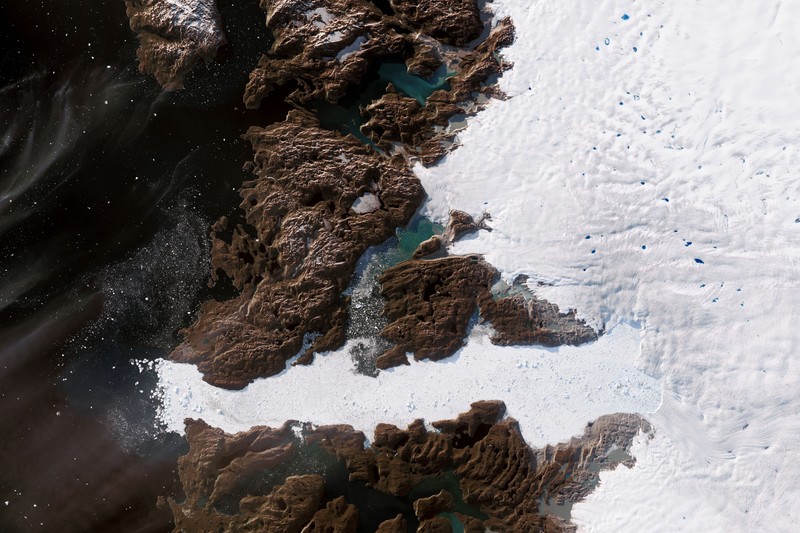
Glaciers recorded net mass loss across the continent. Iceland suffered its second-largest annual melt since records began. The Greenland Ice Sheet shed roughly 139 billion tonnes of ice — which Samantha Burgess, strategic lead for climate at ECMWF, described as “equivalent to losing 100 Olympic-sized swimming pools every single hour.” That melt alone raised global sea level by 0.4 millimeters.
By end of March, Europe had lost snow cover equivalent to the combined size of France, Italy, Germany, Austria, and Switzerland — 1.32 million square kilometers below average.
Oceans on Fire
Sea surface temperatures across European waters reached their highest annual average on record for the fourth consecutive year. Eighty-six percent of Europe’s ocean territory experienced at least one day of strong marine heatwave conditions, with the Mediterranean and Norwegian seas hit hardest.
The consequences reach underwater. Mediterranean seagrass meadows — “biodiversity hotspots housing thousands of fish per acre” and critical nursery habitats, according to report author Claire Scannell of Ireland’s weather service — are highly sensitive to warming waters.
Land Ablaze
Wildfires consumed a record 1,034,550 hectares. Greece saw 50 fires ignite within 24 hours. More than half the continent experienced drought in May. Over 70 percent of European rivers ran below average annual flows.
Heat-related deaths in Europe reached nearly 63,000 in 2024, according to the Lancet Countdown, with heat-connected mortality rising in almost every monitored region since 2014.
Why Europe, and Why Now
The continent that birthed the Industrial Revolution is now its most disproportionate victim. Parts of Europe extend into the Arctic, where temperatures are rising at three to four times the global rate. As snow and ice retreat, darker surfaces absorb more heat, amplifying further melt — a feedback loop known as Arctic amplification.
There is a cruel irony in the data: Europe’s success in reducing air pollution has also removed aerosol particles that once seeded low-level clouds, stripping away a natural cooling barrier. Cleaning the air unmasked warming that had been partially hidden.
The Energy Transition, Hastened by War
Europe’s energy politics have been reshaped by more than climate policy. Russia’s invasion of Ukraine shattered decades of fossil fuel dependency, accelerating a shift toward domestic renewables. In 2025, renewables generated 46.4 percent of Europe’s electricity — surpassing fossil fuels for the third year running. Solar power reached a record 12.5 percent share, growing by more than 20 percent for the fourth consecutive year. Every EU country expanded its solar grid.
“We need to speed up,” said Dusan Chrenek, principal advisor at the European Commission’s climate office. “We need to work on transitioning away from fossil fuels.”
The El Niño phenomenon, which drove global temperature records in 2024, is expected to return mid-year. If it does, the next European summer could make 2025 look moderate.
Discussion (9)