 lop News
121 confirmed cases on Wednesday. 225 by Friday. In 48 hours, the Democratic Republic of Congo’s Ebola outbreak nearly doubled — and the world’s top health official flew to the epicenter to see it for himself.
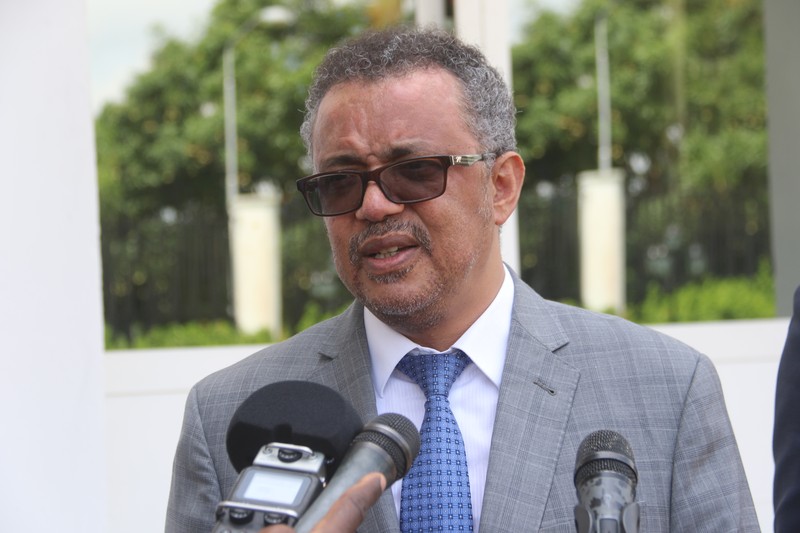
WHO Director-General Tedros Adhanom Ghebreyesus landed in Bunia, capital of Ituri province, on Saturday to confront a crisis accelerating faster than the response can match. The outbreak, declared on May 15, has produced at least 1,077 suspected cases and 246 deaths across three eastern Congolese provinces, according to the Africa Centres for Disease Control and Prevention (Africa CDC). Neighbouring Uganda has confirmed nine infections and one death.
Tedros does not often visit outbreak zones in person. His presence in Ituri signals what Médecins Sans Frontières (MSF) described as a “deeply alarming” situation. “Never before has an Ebola outbreak recorded so many cases so soon after its declaration,” MSF deputy director Dr Alan Gonzalez said on Saturday, adding that his teams were “witnessing a response that has not yet caught up to the rapid spread of the epidemic.”
A rare strain with no vaccine
The culprit is the Bundibugyo ebolavirus — one of three Ebola types behind most major epidemics, and the least documented. Unlike the Zaire strain, which devastated West Africa between 2014 and 2016 and now has an approved vaccine, Bundibugyo has no proven vaccine or specific treatment. WHO says several experimental candidates look “promising enough” to evaluate in clinical trials, and the head of Africa CDC has said a vaccine could be ready by year’s end.
The death rate in previous Bundibugyo outbreaks ranged from 30 to 50 percent, the WHO has cautioned. The confirmed-case fatality rate so far appears lower, but the true picture is clouded by untested samples. MSF says hundreds remain unprocessed, and the WHO believes the virus circulated undetected before the outbreak was declared.
Conflict, distrust, and displacement
Even basic containment tools are hard to deploy. Eastern DRC has endured near-continuous conflict for three decades. Ituri province is terrorised by Islamic State-linked ADF militants and ethnic militias. North and South Kivu, which have also recorded cases, are partly controlled by the Rwanda-backed M23 rebel group. At least three health centres have been attacked by communities angered over burial protocols that conflict with local funeral customs.
Nearly one million displaced people are crowded into camps in Ituri alone. Dorcas Mapenzi, a resident of the Kingonze camp on Bunia’s outskirts, told reporters: “If Ebola comes, we’ll be wiped out as we’re packed like sardines.”
Tedros acknowledged the cultural tensions directly. “Certain practices including touching of bodies of those who have died from Ebola, can spread the virus further,” he said. “While we grieve for those we’ve lost, we must do everything we can so that we don’t lose another, and get into a cycle of grief.”
Funding shrinks as borders close
International assistance is arriving, but it is shrinking. The US has pledged more than $112 million and the EU has dispatched medical supplies. Yet Africa CDC says global funding for the response has more than halved, from $498 million to $219 million.
Regional governments are sealing themselves off. Uganda and Rwanda have shut crossings with DRC; Uganda has ordered a 21-day quarantine for arrivals from Congo. Washington has barred most non-US passport holders who recently visited DRC, Uganda, or South Sudan. Tedros has dismissed border closures as ineffective, arguing they discourage transparent reporting.
Health ministers from the Intergovernmental Authority on Development, an eight-nation East African bloc, agreed this week to redirect roughly $7 million toward regional prevention. A US plan to open an Ebola quarantine facility in Kenya for exposed Americans was suspended by a Kenyan court after a legal challenge; Kenya’s health minister later said the project would proceed, though its status remains unclear.
Brazilian health officials said Saturday they are investigating a suspected Ebola case in São Paulo state — a 37-year-old man who recently returned from DRC, now in isolation. If confirmed, it would be the virus’s first known jump beyond Africa in this outbreak.
There are small signs of progress. A lab in Bunia can now return results within 24 hours; until recently, samples had to be shipped 1,500 kilometres to Kinshasa. On Wednesday, WHO announced the outbreak’s first confirmed recovery — a patient discharged after two negative tests.
“We can stop it,” Tedros told residents. “If we do our best, it can be stopped.” Two weeks in, the gap between that confidence and the numbers on the ground keeps widening.
Sources
- WHO chief visits Congo Ebola epicentre Saturday to urge community action — Euronews
- WHO chief visits epicentre of Ebola outbreak in DR Congo — Channel News Asia
Discussion (9)